

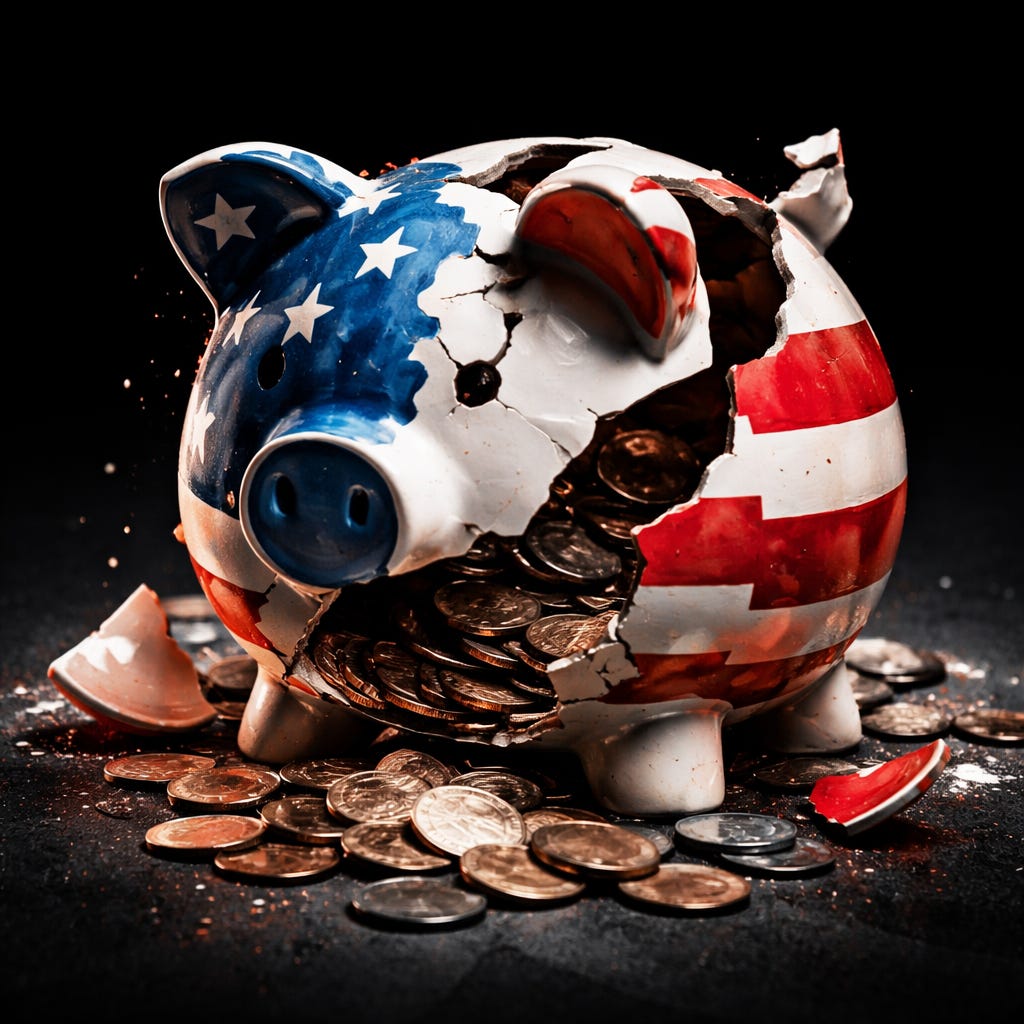
Note: I wrote this article before SCOTUS ruled Trump’s tariffs were not legal.
There’s a simple rule in economics.
When politicians say someone else is paying… you should immediately check your wallet.
Because most of the time, it’s you.
Over the past year, the U.S. government collected roughly $287 billion in tariff revenue. That sounds impressive if you’re selling a political story about “making other countries pay.”
But here’s the reality the data shows…
Americans paid it.
Not foreigners. Not exporters. Not rival governments.
Americans.
The Federal Reserve Bank of New York analyzed trade data through late 2025 and found U.S. consumers and businesses absorbed between 86% and 94% of tariff costs depending on the month. Independent research from multiple institutions reached the same conclusion.
Different datasets. Different methods. Same answer.
That’s not opinion. That’s convergence.
The mechanism isn’t complicated.
When a government imposes a tariff, the importer… an American company… pays the tax at the border.
That company then has two options…
Accept lower profits
Raise prices
Most do a combination of both.
Which means consumers pay more and businesses earn less.
Either way, domestic wealth gets squeezed.
That’s exactly what happened.
Major companies reported tariff-related hits to profits. Household goods companies announced price increases.
Government inflation data showed price rises across categories like clothing, furnishings, and household supplies during the same period tariffs increased.
You don’t need ideology to connect those dots.
Just arithmetic.
Researchers estimate tariffs added measurable pressure to inflation and cost the average U.S. household roughly $1,000 in 2025, with higher costs projected moving forward.
Put another way…
This was one of the largest tax increases Americans have experienced in decades… delivered through trade policy instead of legislation.
And there’s another consequence most political speeches ignore.
Competitiveness.
When American manufacturers import components, tariffs raise their costs. Foreign competitors sourcing the same parts without tariffs suddenly have an advantage.
Higher costs → weaker competitiveness → lost market share → fewer jobs.
Some economic models estimate tariffs could reduce U.S. GDP growth modestly while increasing unemployment relative to baseline projections.
Nothing catastrophic.
But definitely not “free money from foreigners.”
From a Canadian perspective, this part matters.
Companies operating inside trade agreements without those tariffs face a different cost environment. That changes competitive dynamics across North America and globally.
Policies don’t exist in isolation. They shift relative advantage.
There’s also legal uncertainty hovering over the whole situation.
U.S. courts are evaluating whether certain tariff authorities were applied correctly under emergency powers legislation.
If rulings go against the government, analysts estimate potential refunds to businesses could reach into the hundreds of billions.
That’s not pocket change.
But the deeper issue isn’t legal. It’s credibility.
Political messaging promised foreign countries would pay.
Data shows Americans paid.
When multiple independent institutions… central banks, academic researchers, policy organizations… all reach the same conclusion, the credibility gap becomes impossible to ignore.
Tariffs can be useful tools in certain strategic situations.
But they are never magic.
They are taxes.
And taxes always come from somewhere.
Usually closer to home than people want to admit.
The Recap…
Politicians said foreigners would pay.
The data says Americans paid.
$287 billion worth.
Tariffs aren’t economic patriotism — they’re taxes with better branding.
The Gut Punch…
“If your grocery bill went up, congratulations — you helped fund trade policy.”
Source Credit:
Source: Federal Reserve Bank of New York data, Tax Foundation analysis, academic tariff research and publicly reported economic statistics.
🔎 The GeezerWise Standard
This space is built on disciplined thinking.
Facts over spin.
Verification before amplification.
Good-faith discussion over tribal noise.
I use AI tools to help shape my spoken drafts into clear writing.
The judgment, conclusions, and final message are mine.
If you’re new here, this explains how I decide what’s worth sharing:
How I Decide What’s Worth Sharing → [link]
💌 Subscribe at GeezerWise.com to receive future letters:
www.geezerwise.com/subscribe
— Fred Ferguson
GeezerWise
#CanadaStrong
I think Canada was rather clever, even if unwittingly. When the U.S. declared tariffs on most goods, Canada declared counter-tariffs. Canadians would pay the counter-tariffs so we initiated a Buy Canadian program and blamed the U.S. tariffs for price increases. Then when it became apparent that CUSMA would cover 90% of our purchases and sales from tariffs, we dropped the counter-tariffs. However the Buy Canadian was seriously embedded in our National psyche. Additionally we patted ourselves on the back for being the good guy! That's a win-win to me.