

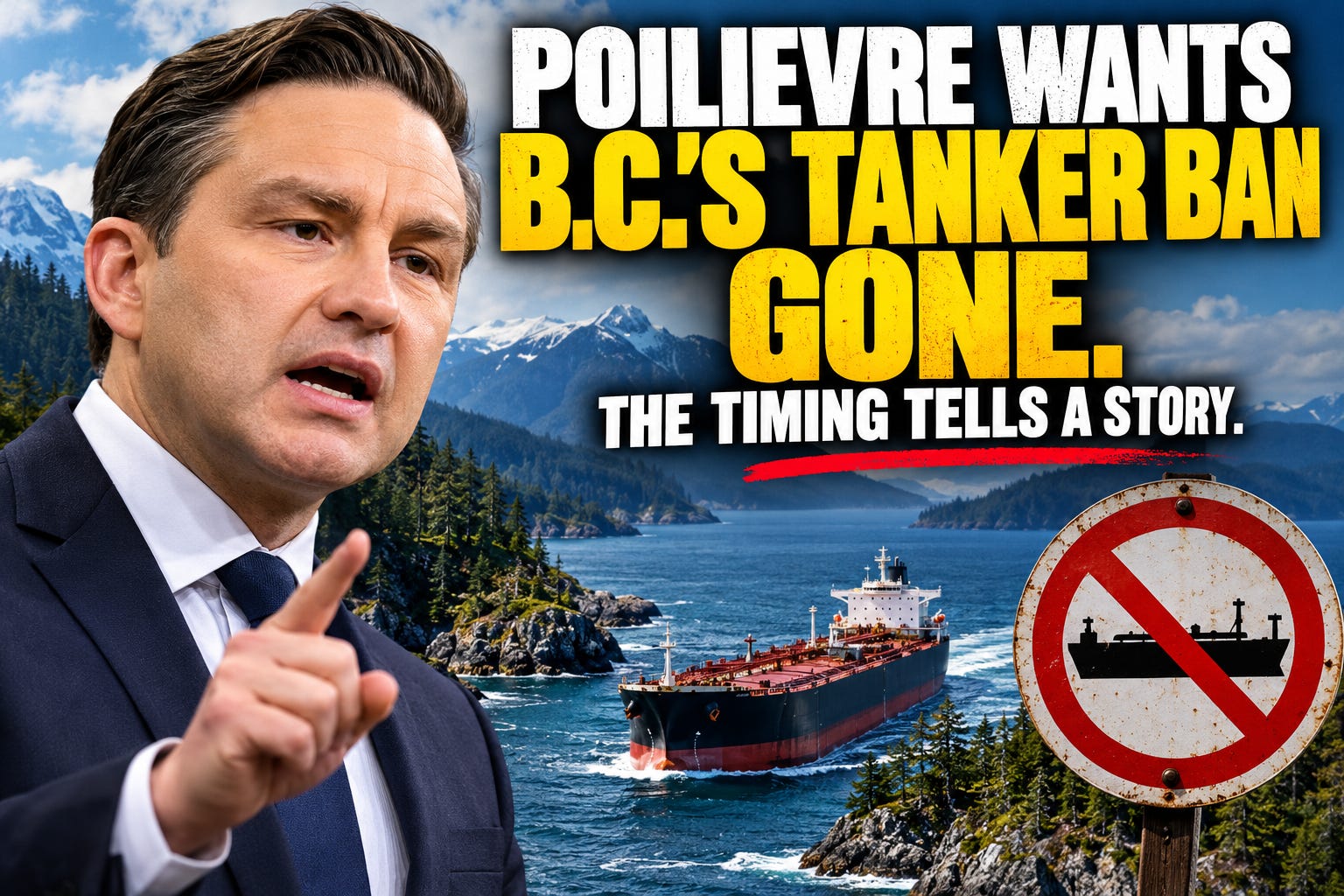
Pierre Poilievre didn’t waste much time.
On Saturday, British Columbians voted in a new Conservative majority government.
By Monday, Poilievre was calling on Mark Carney to repeal the federal oil tanker restrictions protecting B.C.’s northern coast.
Interesting timing, wouldn’t you say?
And there’s something else that makes this worth a closer look.
Canada already has a new west coast oil pipeline project moving forward.
It’s called Pacific Link.
On October 1, Carney designated it a project of national interest. Canada and Alberta will share ownership, with Indigenous communities offered an ownership stake and private industry participating.
The proposed pipeline follows a southern route toward the Vancouver area, avoiding the environmentally sensitive northern coast.
It’s not built yet. There’s still engineering, consultation, environmental review and a pile of work ahead.
But it’s a real project with federal backing and a defined path forward.
So why are the Conservatives suddenly trying to reopen the northern coast?
There’s another proposal
This isn’t simply about building another pipeline.
Poilievre’s October 26 letter points to a proposal from Calgary-based Strathcona Resources.
The company wants to move as much as 250,000 barrels of Canadian oil a day by rail to Prince Rupert, where it could be shipped to overseas customers.
The Conservatives argue this would reduce Canada’s dependence on American refineries and help Canadian producers get better prices.
That’s a legitimate economic objective.
I’ve spent enough time writing about Canada’s dependence on the United States to understand the argument.
But here’s where things get interesting.
The proposal needs access to northern B.C. ports for large oil tankers.
And federal law currently restricts that.
The Oil Tanker Moratorium Act, passed in 2019, prevents tankers carrying more than 12,500 metric tonnes of crude or persistent oil from loading or unloading at ports along the designated northern coast.
It doesn’t prohibit every tanker from sailing through nearby waters. That’s an important distinction.
It does, however, prevent the kind of large-scale oil export operation being proposed for Prince Rupert.
Poilievre wants that changed.
British Columbia already made a deal
Back in July, Carney and then-premier David Eby signed an agreement committing Ottawa to preserve the northern tanker moratorium.
That agreement was part of a broader effort to advance economic development while protecting sensitive coastal waters.
Then came Saturday’s provincial election.
Eby’s NDP lost. Lorne Doerkson’s Conservatives won a projected majority.
And two days later, Poilievre was asking Ottawa to repeal the tanker restrictions.
Now, I can’t tell you whether those events were coordinated.
And I won’t pretend to know what the incoming B.C. government will ultimately decide.
But I can read a calendar.
A federal Conservative leader has renewed his push to change a major coastal protection law immediately after his provincial counterparts won power.
That deserves attention.
There’s a reason those protections exist
The northern B.C. coast isn’t just another stretch of shoreline.
It includes waters around Haida Gwaii, Hecate Strait and the Great Bear Sea.
These are environmentally sensitive waters supporting fisheries, marine wildlife and coastal communities, including First Nations whose lives and livelihoods are closely connected to the ocean.
And we have a pretty ugly example of what happens when a major oil tanker accident occurs in northern Pacific waters.
In 1989, the Exxon Valdez spilled approximately 11 million gallons of crude oil into Alaska’s Prince William Sound.
The environmental damage was enormous. Oil contamination persisted in some coastal areas for decades.
That doesn’t mean every tanker will spill its cargo.
It means the consequences of getting this wrong deserve more than a political slogan.
And moving oil by rail doesn’t eliminate environmental risks either.
Before anyone starts celebrating a new export opportunity, Canadians deserve to know what additional risks they’re being asked to accept, who would bear them and who would receive the economic benefits.
Then there’s the First Nations question
On the very same Monday that Poilievre released his letter, Carney was meeting with provincial premiers and First Nations leaders in Ottawa.
It was the first gathering of its kind in two decades.
The federal government outlined major commitments involving education, housing, clean drinking water and Indigenous participation in economic development.
Among them were $3.5 billion annually for First Nations education and more than $4.5 billion for water infrastructure.
The meeting also explored ways for First Nations to share directly in the ownership and benefits of major projects.
That’s important.
Because Canada cannot keep talking about reconciliation while treating Indigenous participation as something to sort out after the big decisions have already been made.
And let’s not pretend every First Nation has the same position on resource development.
They don’t.
Some support major energy projects. Others oppose particular routes or developments. Many want greater ownership and control over what happens in their territories.
Their positions deserve to be heard individually.
Which brings me back to Poilievre.
What exactly is the rush?
Canada has already committed to a southern pipeline project designed to get more Alberta oil to overseas markets.
It has federal support, Alberta’s participation and a process underway to determine the final conditions.
The Conservatives are now asking Parliament to change a separate law to accommodate another export proposal.
Maybe that proposal has economic merit.
If it does, demonstrate it.
Show Canadians the numbers. Show coastal communities the environmental safeguards. Show First Nations how their rights and interests will be respected.
And explain why the existing northern coastal protections should be weakened when another major west coast export project is already being advanced.
Simply declaring that Ottawa is the only obstacle doesn’t answer those questions.
I’m all for Canada developing its resources and finding customers beyond the United States.
I’ve argued for that repeatedly.
But becoming less dependent on America doesn’t mean we have to abandon every environmental protection standing between an oil company and a new export terminal.
Canada needs more economic independence. It doesn’t need to confuse independence with giving every industry everything it asks for.
And if the Conservatives believe northern B.C.’s tanker restrictions should disappear, they can start by explaining why British Columbians should accept the additional risk.
Winning an election isn’t the same thing as winning that argument.
The Recap…
Poilievre wants Canada’s northern B.C. oil tanker restrictions repealed.
His demand came two days after the Conservatives won a projected provincial majority, even though Canada already has a southern pipeline project moving forward.
The question isn’t whether Canada should export more oil.
It’s whether opening another part of our coastline is worth the risks.
The Gut-Punch…
A new government may change the politics. It doesn’t change the coastline.
Source credit
Conservative Party — October 26 letter calling for tanker ban repeal
Prime Minister of Canada — Pacific Link project announcement, October 1
Prime Minister of Canada — First Nations and First Ministers meeting, October 26
Canadian Press via Global News — Poilievre’s demand and B.C. election context
If you enjoy thoughtful conversations, Canadian stories, and the occasional smart-ass observation about the world we’re living in, you’re in the right place.
Subscribe free and get new stories, insights, and observations delivered directly to your inbox.
No paywall.
No spam.
No nonsense.
Leave anytime with a single click.
I promise not to take it personally.
PP is out of talking points so he now has something new to once again capture the headlines and get people talking about him. It’s so pathetic. Why can’t he just let the adults in the room make the decisions?