

The timing deserves a closer look.
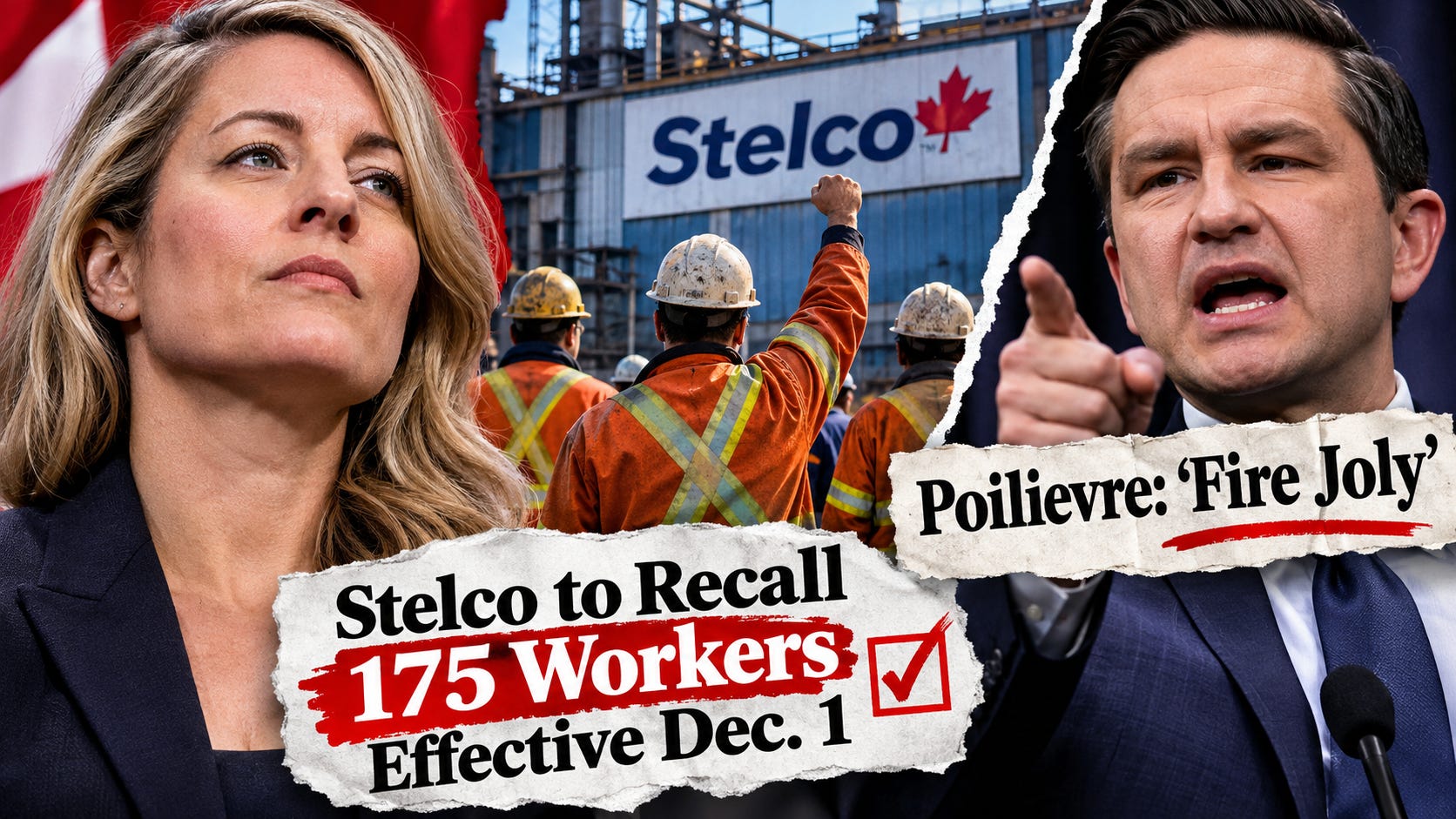
Pierre Poilievre wanted Mélanie Joly fired.
Not criticized. Not questioned.
Fired.
On November 10, the Conservative leader stood in Brampton, Ontario, and demanded that Prime Minister Mark Carney get rid of his industry minister.
He called her a failure. Accused her of costing Canadians jobs and money. Said her threats of legal action against multinational corporations amounted to political theatre.
Three days later, something interesting happened.
Cleveland-Cliffs, the American company that owns Stelco, announced it would recall all 175 workers laid off at its Hamilton finishing operations.
Effective December 1.
And those workers would receive back pay covering their layoff period.
Funny how quickly the story can change when somebody starts producing results.
But there’s more to this than an embarrassing bit of political timing.
There’s a lesson here about American corporate ownership, Canadian jobs, and what happens when a government decides that signed agreements actually mean something.
First, Let’s Talk About Those 175 Workers
In September, Cleveland-Cliffs announced it was cutting back Stelco’s operations.
The company blamed American tariffs, weak demand for Canadian steel, and competition from cheaper imported products.
Those are real pressures.
Donald Trump’s tariffs have done serious damage to Canadian steel producers.
But there was a problem.
When Cleveland-Cliffs purchased Stelco in 2024, Ottawa approved the acquisition subject to legally binding commitments.
Those commitments included employment obligations.
The American company didn’t simply buy a Canadian steelmaker and receive permission to do whatever it pleased afterward.
It made promises.
And Canada’s industry minister wanted those promises honoured.
Joly maintained that the layoffs violated the company’s commitments under the Investment Canada Act.
Cleveland-Cliffs disagreed.
It insisted it was complying with all 34 undertakings attached to its acquisition.
So this wasn’t a settled legal finding. It was a serious dispute over what the company had promised and whether it was delivering.
And Joly wasn’t prepared to leave it at an exchange of angry letters.
She Had Something More Powerful Than a Press Conference
Joly warned Cleveland-Cliffs that Ottawa could take legal action.
She demanded a credible plan to bring the workers back.
She also asked Canada’s Competition Bureau to examine the company’s conduct.
That last move followed some remarkable remarks by Cleveland-Cliffs CEO Lourenco Goncalves.
Goncalves had publicly explained that buying Stelco helped protect his American business from Canadian steel competition.
Think about that.
An American steel company purchases a Canadian competitor.
Its CEO then describes protecting his American operations from that competitor as part of the reason for the purchase.
That doesn’t automatically prove a competition-law violation.
But it certainly gives Canadian authorities something worth examining.
And Joly wasn’t finished.
She warned that Ottawa could ask a court to force Cleveland-Cliffs to sell its Canadian steel business if the company failed to meet its legal obligations.
That’s a serious threat.
And unlike some political threats, this one had legislation behind it.
Yes, Canada Can Force a Foreign Owner to Sell
Here’s where the law matters.
Section 40 of the Investment Canada Act allows the government to apply to a superior court when a company fails to comply with a lawful demand under the Act.
Depending on the circumstances and the court’s findings, remedies can include ordering compliance with commitments, imposing financial penalties, or requiring a foreign investor to divest control of a Canadian business.
In plain English?
If a foreign company buys a Canadian business, makes binding commitments to secure approval, and then fails to honour them, Canada has legal tools to enforce those promises.
Including, potentially, forcing a sale.
But let’s get one thing straight.
A court-ordered sale is not nationalization.
It doesn’t automatically make the Canadian government the new owner.
And Joly couldn’t simply walk into Stelco, point at the machinery, and declare it government property.
She would have to follow the legal process, and a court would have to determine whether the conditions for an order were met.
That’s how the rule of law works.
It’s also why the threat mattered.
The minister wasn’t merely asking Cleveland-Cliffs to be nice.
She was reminding the company that Canadian law applies to American corporations operating in Canada.
Then Came November 13
Cleveland-Cliffs announced it had secured enough customer commitments to restart its Hamilton finishing operations.
All 175 laid-off workers would be recalled effective December 1.
The company also promised to compensate them retroactively for their standard wages during the layoff period.
That’s not a vague promise to consider hiring people someday.
It’s a specific commitment, with a date and back pay attached.
Now, did Joly single-handedly make this happen?
We can’t establish that.
Cleveland-Cliffs credits improved customer commitments.
And those customer arrangements may well have been important.
But Ron Wells, president of United Steelworkers Local 1005, saw another factor.
He credited the pressure applied by Ottawa.
And the workers themselves deserve recognition.
They stood up. Their union stood up. The federal government applied pressure.
Then the company changed course.
The result doesn’t prove that every allegation against Cleveland-Cliffs was correct.
It doesn’t settle every question about Stelco’s future.
And until December 1 arrives, the recall remains a commitment that must be fulfilled.
But for 175 workers and their families, it’s a meaningful development.
Especially heading into Christmas.
Meanwhile, Poilievre Wanted the Minister Gone
Let’s return to November 10.
Poilievre was speaking about Stellantis and the Brampton assembly plant when he demanded Joly’s dismissal.
He accused her of threatening lawsuits without delivering results.
He called on Carney to fire what he described as his failed, costly, job-killing industry minister.
That’s a serious political accusation.
And to be fair, the Brampton situation is serious.
Thousands of Canadian auto workers have been left without the production jobs they were promised.
Taxpayer money was committed to help secure Canada’s automotive future.
Canadians deserve answers about what happened to that investment.
Poilievre is entitled to demand accountability.
In fact, that’s part of his job.
But there’s a difference between demanding accountability and declaring somebody a failure before the outcome of their work is known.
Three days after his demand, Stelco announced its recall.
Not because Poilievre asked Joly to be fired.
And not because somebody delivered a particularly clever insult at a microphone.
The announcement followed weeks of legal and political pressure from Ottawa, along with efforts by workers, their union and the company’s customers.
That distinction matters.
Political theatre is easy. Enforcing corporate commitments is considerably harder.
And Joly Has Another Fight on Her Hands
The Stelco announcement doesn’t mean Joly’s work is finished.
Not even close.
She’s also confronting Stellantis over its Brampton assembly plant.
In 2022, Ottawa committed up to $529 million in federal assistance to help Stellantis retool its Brampton and Windsor operations.
Ontario committed additional support.
The idea was to protect Canadian automotive manufacturing and prepare those facilities for the next generation of vehicles.
But Stellantis abandoned its plan to build the Jeep Compass at Brampton.
Production shifted to Illinois.
And the Brampton plant remained idle, leaving more than 2,000 workers without jobs.
Now Stellantis has agreed to sell the plant to Roshel, a Canadian manufacturer of armoured vehicles.
That could create industrial activity at the site.
But it doesn’t automatically replace the automotive jobs Stellantis was expected to provide.
And it doesn’t automatically erase the company’s obligations under its government funding agreement.
On November 12, Joly issued a formal notice alleging that Stellantis had breached that agreement.
The company was given 30 days to correct the problems or face potential consequences, including repayment demands and legal action.
Stellantis has offered to return $24 million in federal support associated with Brampton.
Ottawa says the amount potentially owed is much larger.
That dispute remains unresolved.
And unlike Stelco, there has been no comparable announcement restoring the thousands of lost Brampton jobs.
So let’s not pretend Joly has won that battle.
She hasn’t.
But she’s using the government’s contractual powers to demand answers and pursue remedies.
That’s considerably more than simply complaining that an American company has treated Canadian workers badly.
Here’s What I Want to Know
Why is it that when an American-owned company breaks faith with Canadian workers, the first instinct of some politicians is to attack the Canadian minister trying to hold it accountable?
There are legitimate questions about how these deals were approved.
There are legitimate questions about whether governments handed out too much assistance without enough protection for taxpayers.
And there are legitimate questions about whether Canada should allow foreign corporations to acquire strategically important industries without stronger safeguards.
Ask those questions.
Demand answers.
Hold the government accountable.
But don’t ignore the results when they arrive.
On November 10, Poilievre demanded Joly’s dismissal.
On November 13, Cleveland-Cliffs announced that 175 Stelco workers would be recalled with back pay.
Those two events don’t prove Joly deserves all the credit.
They do, however, make Poilievre’s sweeping declaration of failure look rather premature.
And the next test is already underway in Brampton.
Will Stellantis honour its obligations?
Will taxpayers recover money if those obligations aren’t met?
Will Canadian auto workers get a real future instead of another corporate announcement?
Those are the questions worth asking.
Because this isn’t about whether Mélanie Joly wins a political argument.
It’s about whether Canadian governments can make powerful foreign corporations honour their commitments.
And whether Canadian workers can count on somebody to enforce the rules.
The Recap…
Pierre Poilievre demanded Mélanie Joly’s firing on November 10, accusing her of failing Canadian workers.
Three days later, Cleveland-Cliffs announced that all 175 workers laid off at Stelco’s Hamilton finishing operations would be recalled December 1, with back pay.
The company credits renewed customer commitments. The union also credits pressure from Ottawa.
Joly had warned that the federal government could seek court-ordered divestiture under the Investment Canada Act if Cleveland-Cliffs failed to meet its obligations.
Meanwhile, her separate fight with Stellantis over the Brampton assembly plant and taxpayer funding remains unresolved.
One dispute has produced a concrete commitment. The other still needs answers.
The Gut-Punch…
Poilievre wanted the minister fired. The steelworkers wanted their jobs back.
Three days later, one of those demands was getting results.
And it wasn’t Poilievre’s.
GeezerWise… Facts, Not Fables.
Source Credit:
Cleveland-Cliffs’ November 13, 2026, recall announcement; The Canadian Press reporting on Stelco, Stellantis and Poilievre’s remarks; Global News’ November 10 coverage of Poilievre’s Brampton news conference; United Steelworkers Local 1005 statements; and Section 40 of Canada’s Investment Canada Act. Reporting and legislative provisions independently reviewed as of November 15, 2026.
If you enjoy thoughtful conversations, Canadian stories, and the occasional smart-ass observation about the world we’re living in, you’re in the right place.
Subscribe free and get new stories, insights, and observations delivered directly to your inbox.
No paywall.
No spam.
No nonsense.
Leave anytime with a single click.
I promise not to take it personally.
And what is extremely disturbing is that the CEO admitted to buying Stelco to undermine and kill the business as it is in direct competition with his US company. Pierre knows this and still blamed Joly. Clearly Poilievre is behind the Trump regime and not team Canada. He needs to STFU and go south and take his Maga living cabinet with him.
I think an apology is due to Minister Joly from P.P.