

Here’s something that bothers me.
A Canadian employer hires a foreign worker. That worker comes here legally, gets up in the morning, goes to work, earns a paycheque and pays taxes.
The government takes its share, just as it does from the rest of us.
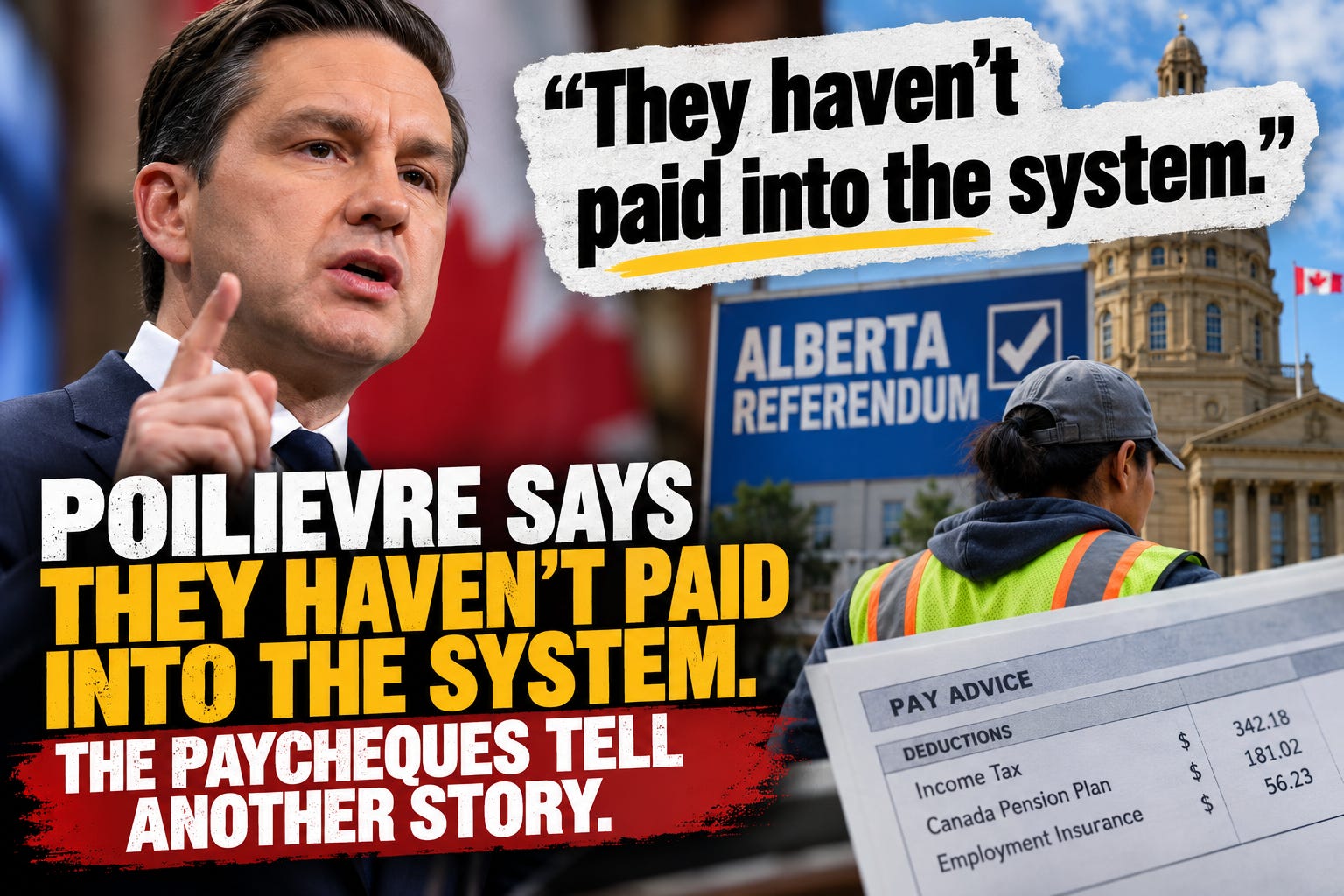
Then a politician stands in front of a microphone and talks about people who have never paid into the system.
Excuse me?
That’s the part of Pierre Poilievre’s response to Alberta’s referendum that caught my attention.
Not his argument that Canada needs to control immigration. We do.
Not his position that provinces should have a greater say in immigration decisions. There’s a reasonable discussion to be had there.
It’s the way he talked about the people already here.
Following Alberta’s October 19 referendum, Poilievre said the province had rejected Prime Minister Mark Carney’s direction on immigration.
Then he talked about cutting off what he called “deluxe benefits” going to people who had never paid into the system and weren’t Canadian permanent residents.
That’s quite a statement.
And it deserves a closer look.
The people Alberta actually voted about
Albertans were asked ten referendum questions.
Five concerned immigration, eligibility for provincial services or related requirements.
One proposed making people with legal but non-permanent immigration status wait at least 12 months before qualifying for provincially funded social support programs.
Another proposed charging certain temporary residents fees or premiums for health care and education.
Notice something?
Legal immigration status.
We’re not talking exclusively about people sneaking across a border or ignoring deportation orders.
We’re talking about people Canada has given permission to live, work or study here.
And according to the unofficial results, Albertans supported those proposals.
The referendum was non-binding. The government would still have to introduce legislation before changing the rules.
But Poilievre was quick to embrace the political message.
Here’s where I have a problem.
Have these people really paid nothing?
According to the Canada Revenue Agency, your income tax obligations depend on your tax residency and circumstances, not whether you’re a Canadian citizen.
A temporary foreign worker earning taxable employment income in Canada doesn’t get to tell the taxman, “Sorry, I’m only visiting.”
And Employment and Social Development Canada makes another point quite clear.
Foreign workers in insurable employment pay Employment Insurance premiums, whether or not they expect to collect benefits.
They can qualify for EI if they meet the applicable conditions.
In other words, they’re paying into at least some of the same systems Canadian workers do.
They’re also buying groceries, paying rent, filling their vehicles and contributing to the economy around them.
That doesn’t mean every temporary resident pays the same taxes or qualifies for every public program.
They don’t.
It means the blanket suggestion that temporary workers haven’t contributed doesn’t survive a look at an ordinary paycheque.
And I would expect someone hoping to become Canada’s prime minister to understand that distinction.
Alberta already has rules
Here’s something else that seems to have been lost in the political shouting.
Alberta doesn’t automatically hand provincial health coverage to everyone who arrives with a suitcase.
Its existing health insurance rules require eligible temporary residents to establish residency, intend to remain in Alberta for at least 12 consecutive months and hold acceptable immigration documentation.
For many temporary foreign workers, that includes a valid work permit meeting specific conditions.
There are also rules governing international students.
So the real question isn’t whether Alberta should have eligibility requirements.
It already does.
The question is whether the province should make those requirements more restrictive, charge additional fees or exclude certain legally admitted residents from services.
That’s a legitimate policy debate.
But let’s have that debate using the facts.
Not the convenient suggestion that temporary residents are all enjoying some taxpayer-funded holiday.
Then came the criminals
Poilievre also called for removing foreign criminals and passing his proposed One Law for All Act.
Now, I don’t have a problem with enforcing Canadian law or deporting foreign nationals when the law permits it.
Neither should anyone else.
But what does that have to do with a temporary worker paying taxes in Alberta?
Those are two different questions.
One concerns eligibility for provincial services.
The other concerns criminal justice and immigration enforcement.
Putting them together in the same political response may be effective messaging.
It doesn’t make them the same issue.
And Canadians should be able to discuss immigration without having every conversation drift toward criminals, deportations and border security.
There’s another side to this that politicians keep forgetting
Canadian businesses employ temporary foreign workers because they need labour.
Farmers, food processors, hotels, restaurants and other employers have relied on these programs.
Canada approved those arrangements.
The workers didn’t invent the system.
Our governments did.
And employers participated in it.
If we’ve admitted too many people too quickly, that’s a government policy problem.
If housing construction hasn’t kept up, that’s a planning problem.
If hospitals and schools are struggling with population growth, governments have some explaining to do.
Temporary residents aren’t responsible for writing Canada’s immigration policies.
Yet they’re awfully convenient people to blame when the system comes under pressure.
I think Canada needs sustainable immigration.
I think we should know how many people we’re admitting, whether we have enough housing and whether provincial services can handle the growth.
I also think someone working legally in this country deserves to be described accurately.
Those positions aren’t contradictory.
They’re common sense.
And there’s something particularly irritating about watching politicians complain that Canada has too many people…
while rarely acknowledging the employers who asked for workers, the governments that approved their entry and the planning failures that followed.
The worker at the end of that chain didn’t make those decisions.
Here’s what I’d like Poilievre to explain
Which deluxe benefits?
Who exactly is receiving them?
Are we talking about temporary workers, international students, asylum claimants or people without legal immigration status?
Because those aren’t interchangeable categories.
And how much have the people he’s talking about actually contributed through income taxes, payroll deductions and other taxes?
Give Canadians the numbers.
Show us the programs.
Explain the eligibility rules.
Then tell us what you want to change.
That’s what opposition leaders are supposed to do.
Poilievre is entitled to argue for lower immigration levels and stricter benefit rules.
But Canadians are entitled to expect something more precise than political language that lumps very different people together.
We can fix a system without turning everyone caught inside it into the villain.
And we can demand better immigration policies without pretending the people who came here legally have contributed nothing.
That’s not being soft on immigration.
That’s being honest about it.
The Recap…
Alberta voted to consider tighter restrictions on provincial benefits for temporary residents.
Poilievre says people who haven’t paid into the system shouldn’t receive deluxe benefits.
But legal temporary workers can pay income taxes and EI premiums, and Alberta already has health coverage eligibility rules.
Before we blame the people working here, perhaps we should look at the policies that brought them here.
The Gut-Punch…
If Canada invited you here to work, deducted taxes from your paycheque and then called you someone who never contributed, you’d have a few questions too.
Sources:
Conservative Party of Canada… Poilievre’s statement following Alberta’s referendum
Government of Canada… Temporary foreign workers and EI contributions
Canada Revenue Agency… Working in Canada temporarily: tax obligations
Government of Alberta… Health care coverage for temporary residents
If you enjoy thoughtful conversations, Canadian stories, and the occasional smart-ass observation about the world we’re living in, you’re in the right place.
Subscribe free and get new stories, insights, and observations delivered directly to your inbox.
No paywall.
No spam.
No nonsense.
Leave anytime with a single click.
I promise not to take it personally.
Poilievre has built his entire career on politica roles. Roles paid for by taxes. So, tell me, who didn't pay into the system?