

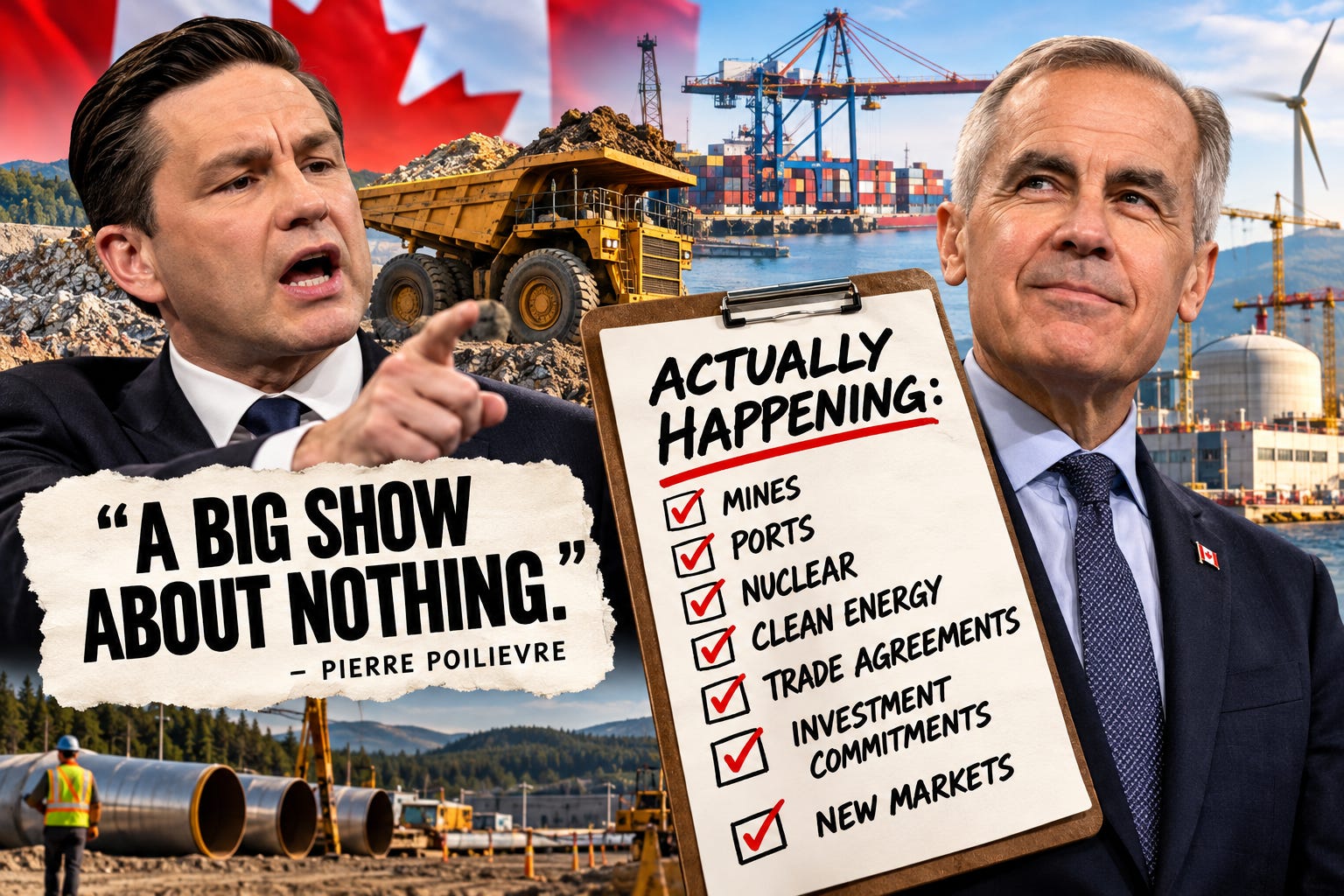
I heard Pierre Poilievre describe Mark Carney’s summer the other day.
Apparently, it was the Summer of George.
If you watched Seinfeld, you’ll remember George Costanza trying desperately to look busy while accomplishing precious little.
That was Poilievre’s comparison.
Carney, he said, had been flying around Europe, attending meetings, signing declarations, shaking hands and looking terribly busy.
Then came the line that caught my attention:
“Nothing is getting done under Mark Carney. Everything is getting worse.”
That wasn’t somebody paraphrasing him. Poilievre said it.
Fine.
So I did something terribly inconvenient.
I checked.
And there’s a fair bit happening for a country supposedly doing nothing.
Start digging holes
In May, construction officially started on Nouveau Monde Graphite’s Matawinie mine in Quebec.
This isn’t somebody announcing that someday they might think about building something.
Ground was broken.
The federal Major Projects Office says the project is expected to attract about $1.8 billion in investment, and the finished mine is expected to become the largest graphite mine in North America and the G7.
Canada has also put together a $459-million financing package through Export Development Canada and the Canada Infrastructure Bank.
Graphite happens to be rather useful stuff when you’re trying to build batteries, advanced manufacturing and secure critical-mineral supply chains.
Then there’s British Columbia.
Hudbay officially broke ground in June on the New Ingerbelle expansion at its Copper Mountain mine near Princeton.
The expansion is expected to extend the mine’s life beyond 2040 while increasing copper and gold production.
Over in Saskatchewan, Sandvik broke ground in February on a $51-million mining equipment manufacturing and servicing facility in Saskatoon, expected to create about 30 skilled positions.
And no, despite one rather enthusiastic claim in the transcript I was researching, it isn’t a $51-million-square-foot building.
It’s 51,000 square feet.
That would have been one hell of a warehouse.
We seem to be building other things too
Construction is underway on the Contrecoeur container terminal expansion at the Port of Montreal.
When completed, it is expected to increase the port’s container capacity by roughly 60%.
In-water construction began this summer.
That’s particularly interesting when Canada is trying to sell more stuff to customers who don’t live south of us.
Ontario’s Darlington New Nuclear Project isn’t imaginary either.
Canada’s nuclear regulator lists the first small modular reactor as under construction, and Ontario Power Generation reported this summer that the reactor building was progressing upward after foundation work earlier in the year.
Cedar LNG in British Columbia is also under construction.
But here’s where I’m going to correct the version I originally heard.
Construction did not begin this summer.
The project reached its final investment decision in June 2024 and construction started afterward. What is true is that 2026 is a major construction year for the project.
Facts don’t need stretching.
Then somebody found $70 billion
In August, Canada announced a nearly $70-billion clean-energy development involving Churchill Falls, Gull Island, wind power and transmission infrastructure in Newfoundland and Labrador.
The federal government is providing $10 billion in financing.
The combined projects are projected to produce 14,000 megawatts of renewable electricity and support 23,000 jobs.
The federal government describes it as the largest clean-energy investment in North American history.
That’s the government’s description, so I’m going to leave it precisely there rather than adding another adjective.
Seventy billion dollars is quite capable of looking impressive without my help.
And then there was that little meeting in Toronto
This month Canada held its first Canada Investment Summit.
Investors from nearly 30 countries attended. According to the federal government, the summit produced nearly $500 billion in investment commitments.
Notice the word commitments.
That is not $500 billion already spent.
Projects can change. Commitments can take years to materialize. Some undoubtedly will and some may not.
But the announced commitments included $50 billion for a new Maple Fund from CPP Investments and Brookfield, another $25 billion in Canadian investment planned by PSP Investments, $10 billion from Ontario Teachers’ Pension Plan and $5 billion from Sun Life.
That is somewhat more substantial than politicians exchanging business cards over coffee.
And Canada has been shopping for customers
Canada signed a free-trade agreement with Ecuador in July.
Two-way merchandise trade between the countries was already about $2 billion in 2025.
Canada’s investment protection agreement with the United Arab Emirates entered into force in May. The UAE had previously announced a $70-billion investment commitment in Canada.
Negotiations are also moving ahead with India, ASEAN, the Philippines and Mercosur.
Those are negotiations.
Not completed trade deals.
There’s a difference, and I’m not going to turn talks into victories before anybody signs the paperwork.
India and Canada are working toward concluding their Comprehensive Economic Partnership Agreement by the end of this year.
Canada and the Philippines are trying to conclude their negotiations this year as well, while ASEAN negotiations continue.
Europe is another one worth getting straight
Canada also joined the European Union’s SAFE defence procurement program this year.
Here’s another number that needed correcting from the version I heard.
SAFE itself is a €150-billion loan facility.
It sits inside the EU’s broader Readiness 2030 plan, which is valued at roughly €800 billion.
Canada’s agreement gives Canadian companies preferential access and treatment in procurement financed through SAFE.
That’s a potentially significant new market for Canadian defence companies.
But €150 billion is plenty impressive.
We don’t need to turn it into $1.3 trillion.
Which brings me back to George Costanza
None of this proves that everything is wonderful in Canada.
It isn’t.
It doesn’t settle arguments over unemployment, housing affordability, food prices, government spending or whether particular federal policies are working.
And it certainly doesn’t mean Mark Carney gets personal credit for every mine, port, nuclear reactor and LNG project being built across the country.
Some of these projects were underway before he became prime minister.
That’s how infrastructure works.
Governments inherit projects.
Companies build projects.
Provinces approve projects.
Investors finance projects.
Federal governments can accelerate, finance, regulate or occasionally get in the bloody way.
So let’s not replace one political exaggeration with another.
But that brings us back to Poilievre’s actual claim.
“Nothing is getting done.”
That’s a remarkably easy statement to test.
There are mines breaking ground.
A major port expansion is under construction.
Canada’s first commercial SMR is under construction.
A huge clean-energy development has moved forward.
New trade agreements have been signed while others are being negotiated.
Canada has entered Europe’s SAFE defence procurement system.
And investors gathered in Toronto this month and announced hundreds of billions of dollars in commitments to Canadian projects and assets.
You can argue about whether that’s enough.
You can argue about who deserves the credit.
You can argue about whether the government’s strategy will ultimately work.
Those are legitimate political arguments.
But they’re different arguments.
Because “nothing” has a meaning.
And this isn’t it.
The Recap…
Pierre Poilievre called Mark Carney’s summer a “big show about nothing.”
So I checked the “nothing.”
Mines. Ports. Nuclear. Energy. Trade agreements. European defence procurement. Investment commitments.
Plenty left to argue about.
But first, let’s argue from the same set of facts.
The Gut-Punch…
Politics works a lot better when we stop treating slogans as evidence.
Source Credit
Primary sources consulted include the Prime Minister of Canada, Global Affairs Canada, Statistics Canada, the Canadian Nuclear Safety Commission, Canada’s Major Projects Office, the Government of Saskatchewan and official project/company disclosures. Poilievre’s quoted remarks were checked against the Conservative Party of Canada’s published transcript.
If you enjoy thoughtful conversations, Canadian stories, and the occasional smart-ass observation about the world we’re living in, you’re in the right place.
Subscribe free and get new stories, insights, and observations delivered directly to your inbox.
No paywall.
No spam.
No nonsense.
Leave anytime with a single click.
I promise not to take it personally.
I'm in Australia so i don't know much about PP but he sounds like a wanker to me.
Sorry, Fred, but Pierre’s little Seinfeld speech was not intended for you. You tend to check facts and obviously possess strong critical thinking skills. I’d guess that a lot of Pierre’s followers don’t possess either attribute in very much abundance.