

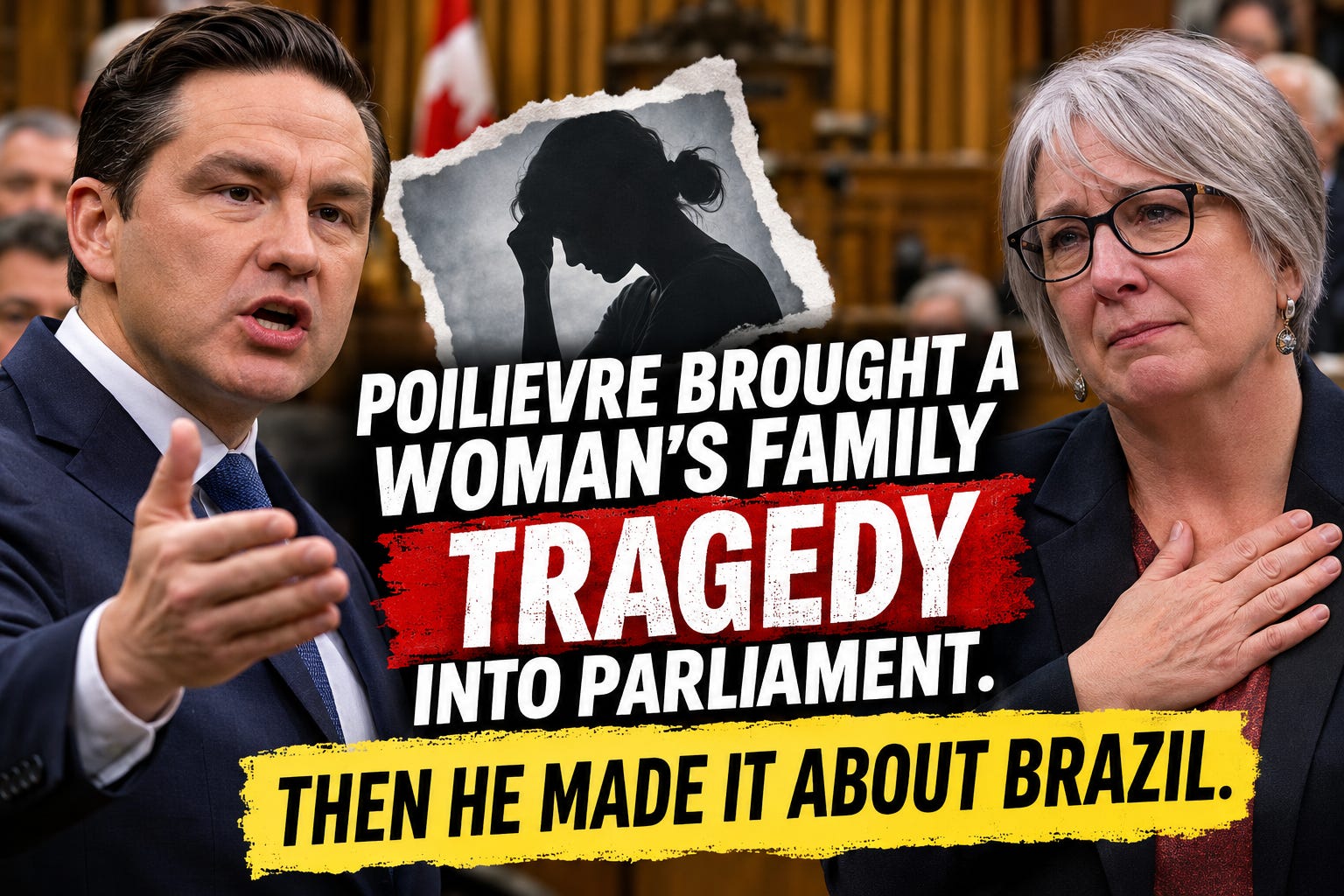
I’ve watched Pierre Poilievre go after the Liberal government plenty of times.
That’s his job. He’s the Leader of the Opposition. He’s supposed to challenge government spending, question decisions, and make the people across the aisle uncomfortable.
But something happened in the House of Commons on November 16 that bothered me.
And it wasn’t because Poilievre criticized Mark Carney.
It was how he chose to do it.
During Question Period, Poilievre told Parliament about a woman named Kim whom he said he’d met at Tim Hortons.
According to Poilievre, Kim had lost her husband to suicide because of financial pressures. She was struggling to get by.
He quoted her as saying she needed some hope and feared that the light ahead might be an oncoming train.
That’s a heartbreaking thing for anyone to say.
Then Poilievre pivoted.
He attacked the Liberal government for sending half a billion dollars to Brazil to protect forests while Canadians were struggling to feed themselves.
Just like that, a woman’s devastating personal loss became the opening argument in a political attack over international spending.
I watched the exchange and wondered something.
Was Kim’s story being told to help people understand what Canadians are going through? Or was it being used to make a political point?
Because those are two very different things.
The Woman Who Answered Him
The person responding wasn’t Mark Carney.
It was Patty Hajdu, the Minister of Jobs and Families.
And what happened next made the exchange even more uncomfortable.
Hajdu began by expressing sympathy for Kim.
Then she revealed that she had recently lost someone in her own family to suicide.
She knew that particular kind of grief firsthand.
She didn’t respond by attacking Poilievre personally. She spoke about the horror of such a loss, then turned to the government’s budget measures and support for Canadians facing financial and mental health difficulties.
Think about that for a moment.
One politician had introduced a family’s tragedy to challenge government spending.
The politician answering him had recently experienced a similar tragedy in her own family.
And suddenly Question Period wasn’t just another argument about tax dollars.
There were real people behind those words.
That’s something politicians occasionally seem to forget.
Now, About That Half-Billion Dollars
Here’s where the story takes another turn.
Poilievre was referring to a November 15 announcement by Prime Minister Mark Carney.
Canada had committed up to $560 million over four years to the Tropical Forest Forever Facility.
It’s an international initiative co-led by Brazil and Norway to protect tropical forests.
But there’s something important Poilievre left out.
Canada wasn’t simply handing Brazil a cheque for $560 million.
According to Global Affairs Canada, the contribution is structured as a loan, financed through money already allocated to Canada’s international climate finance commitments.
The facility is designed to attract public and private investment, then use investment returns to reward countries that successfully protect their tropical forests.
Those payments depend on verified conservation results.
And at least 20% must go to Indigenous peoples and local communities.
Now, Canadians can absolutely question whether this is a good investment.
We can ask whether the money would be better used here at home. We can debate the financial risks, the expected returns, and whether international climate commitments deserve this level of funding.
Those are legitimate questions.
But describing the arrangement as sending money to Brazil for forests leaves Canadians with a very different impression from what the government actually announced.
It’s a loan commitment to an international financing facility, not a straightforward gift to Brazil.
That distinction matters.
Especially when you’re using someone’s personal suffering to make the argument.
There Are Canadians Who Really Are Desperate
I don’t doubt that Canadians are struggling.
Food prices hurt. Housing costs hurt. People who worked hard all their lives are wondering how much longer their savings will last.
And financial pressure can take a terrible toll on people’s mental health.
We don’t need a politician to introduce us to someone at Tim Hortons to understand that.
We see it in our communities.
Some of us have lived through financial hardship ourselves.
And that’s precisely why I think politicians should be careful when they bring an individual’s tragedy into a public debate.
Poilievre may have believed he was giving a voice to someone who felt forgotten.
That’s a legitimate thing for an opposition leader to do.
But there’s a difference between giving someone a voice and turning their suffering into ammunition.
I don’t know Kim. I don’t know the circumstances of her husband’s death beyond what Poilievre told Parliament.
And I’m not interested in digging into a grieving family’s private life to score points against a politician.
That would make me part of the problem I’m writing about.
What I can judge is what Poilievre chose to say publicly.
And I think he could have made his argument about affordability without using a woman’s loss to deliver it.
There’s a Bigger Problem Here
Canadian politics has become awfully good at turning everything into a weapon.
A struggling family becomes an attack on the budget.
A government investment becomes proof that Ottawa doesn’t care about Canadians.
A complicated financial arrangement becomes a simple slogan.
And the people listening are expected to pick a side before anyone bothers explaining the facts.
I’m tired of that.
I want opposition politicians to challenge the government. I want them to expose waste, demand accountability, and make ministers answer difficult questions.
If Carney’s government makes a bad decision, I want to know about it.
But I also want the criticism to be accurate.
And I want the people whose stories are being told in Parliament to be treated as human beings, not convenient illustrations.
Poilievre had every right to question Canada’s $560-million commitment.
He had every right to demand more help for Canadians facing financial hardship.
What bothers me is the decision to connect those two arguments through a family’s death by suicide.
That’s not a question of Conservative versus Liberal.
It’s a question of judgment.
And judgment matters when you’re asking Canadians to trust you with the country.
The Recap…
Pierre Poilievre told Parliament about a woman whose husband had died by suicide, then used her story to attack Canadian funding for tropical forest protection.
The minister who answered had recently lost someone in her own family to suicide.
And the funding Poilievre criticized? It was a loan commitment through an existing international climate finance program, not simply a cheque to Brazil.
There’s a difference between holding a government accountable and using someone’s grief to make a point.
The Gut-Punch…
A family’s tragedy deserves compassion. Government spending deserves scrutiny. Neither deserves to be twisted to make the other more politically useful.
Source Credit
House of Commons debates — November 16, 2026 — Poilievre’s remarks and Hajdu’s response.
CPAC — Question Period, November 16, 2026 — Parliamentary video.
Prime Minister of Canada — November 15 announcement — Details of the $560-million commitment.
Global Affairs Canada — Tropical Forest Forever Facility backgrounder — Loan structure, financing and conservation requirements.
If you enjoy thoughtful conversations, Canadian stories, and the occasional smart-ass observation about the world we’re living in, you’re in the right place.
Subscribe free and get new stories, insights, and observations delivered directly to your inbox.
No paywall.
No spam.
No nonsense.
Leave anytime with a single click.
I promise not to take it personally.
Well first of all I highly doubt that PP just randomly met a woman at Timmie’s. Please , give me a break. You can bet the farm that PP never ever goes to Timmie’s, let alone talk to anyone that has not been vetted beforehand. He gave a prepared speech,trying to look like an empathetic politician, he failed. It was all BS, he’s just doing his usual lies and insults. PP is a moron.
Exactly what we were talking about a while back - sick to death of performative bs. Still waiting for us to have a competent opposition.