

There is something wonderfully convenient about political slogans.
You don’t need an economics degree.
You don’t need a chart.
Hell, you don’t even need the explanation to be true.
Just stick somebody’s name in front of the word inflation and away you go.
But Canada’s latest inflation numbers deserve more than that.
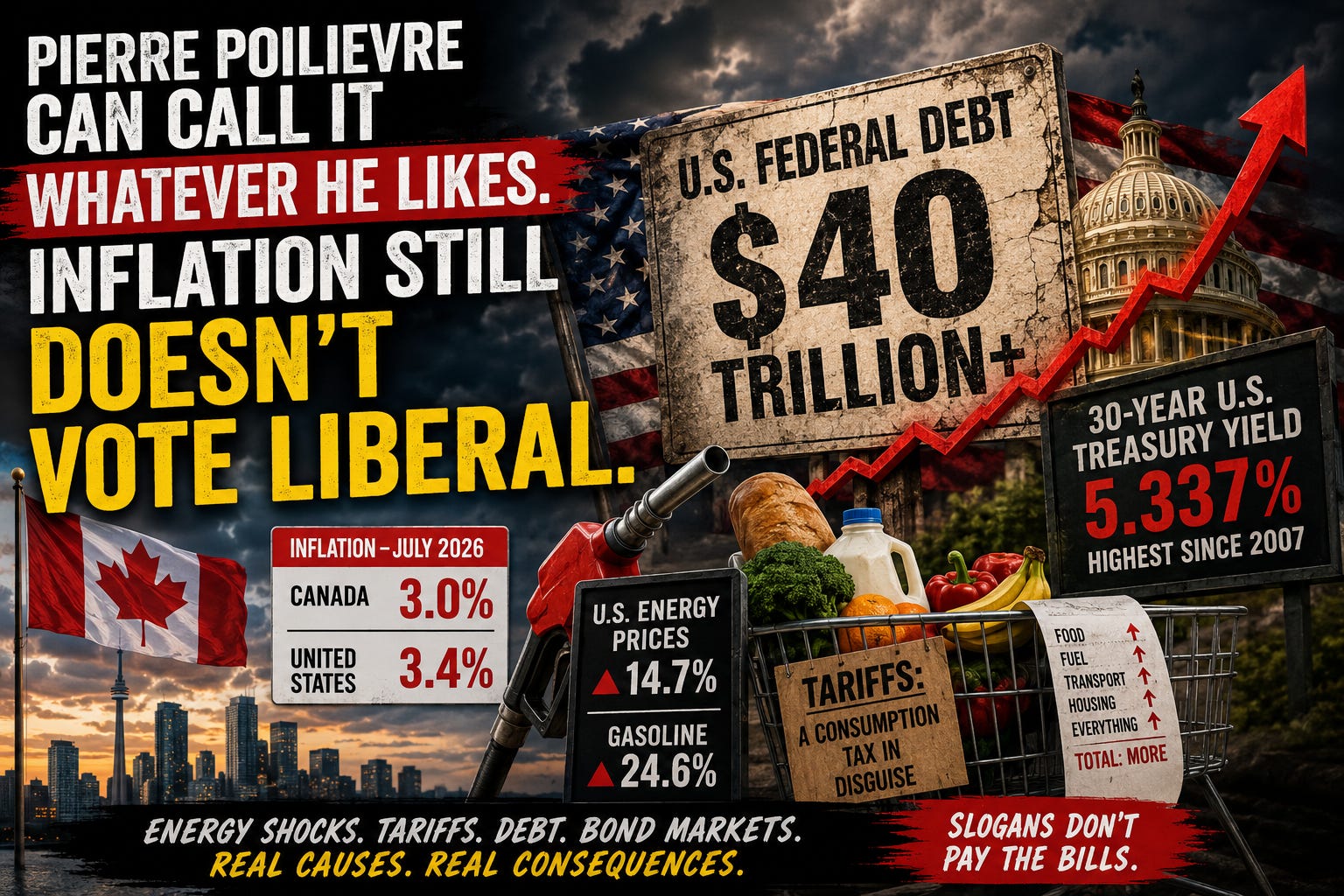
In July, Canada’s annual inflation rate rose to 3.0%, up from 2.8% in June.
Not wonderful.
Nobody paying for groceries, gasoline or housing is going to throw a parade over 3% inflation.
But here’s the part worth noticing:
American inflation was 3.4%.
So before Canadians are told this is somehow a uniquely Canadian failure… or that Mark Carney wandered into the Prime Minister’s Office and personally raised the price of everything… we ought to look beyond our own driveway.
Because something much bigger is going on.
Energy has become the troublemaker again
The United States provides a particularly useful clue.
American energy prices in July were 14.7% higher than a year earlier.
Gasoline was up 24.6%.
That’s not a rounding error.
The war involving the United States, Israel and Iran has disrupted energy markets and helped push oil prices higher.
And oil doesn’t stay politely inside your gas tank.
Higher energy costs work their way through transportation, manufacturing, agriculture, aviation, shipping and eventually the price of damn near everything somebody has to move from Point A to Point B.
Economists have a boring name for this…
A supply shock.
I prefer the plain-English version.
Something expensive happens somewhere important, businesses pay more to operate, and eventually somebody hands the bill to us.
Canada doesn’t get immunity because we’re Canadian.
Neither does Mark Carney have a magic dial underneath his desk marked PRICE OF OIL.
Now add Trump’s tariffs
Here’s where the American situation becomes even more interesting.
The United States isn’t only dealing with an external energy shock.
It has deliberately imposed additional costs on itself through tariffs.
Tariffs don’t magically make foreign companies poorer.
They are taxes collected on imported goods.
American importers pay them.
Those costs can then get absorbed, passed along, shifted through supply chains or reflected in higher prices elsewhere.
I’ve been banging this drum for months:
Tariffs are consumption taxes wearing a patriotic hat.
Trump can call them whatever he likes.
The cash register doesn’t give a damn.
So the United States is simultaneously dealing with expensive energy, tariff pressure and inflation still running above the Federal Reserve’s 2% target.
And then we get to the really interesting number.
$40 trillion
The gross U.S. national debt has now crossed:
$40,000,000,000,000.
Forty trillion dollars.
I had to give it all the zeros because sometimes the abbreviation hides the insanity.
That debt wasn’t created by Donald Trump alone.
Republican and Democratic governments have both contributed to America’s enormous fiscal problem over decades.
COVID spending accelerated it.
Tax decisions contributed.
Government spending contributed.
Interest costs are now contributing too.
But markets don’t hand out participation ribbons for assigning blame correctly.
They look at whether they’ll get their money back… and what that money will be worth when they do.
And recently the bond market has been sending Washington a message.
The bond market doesn’t attend rallies
The yield on the 30-year U.S. Treasury recently reached 5.337%.
That’s the highest level since 2007.
Think about what that means.
The United States government needs people to lend it money.
Investors look at inflation, deficits, debt, political risk and the future value of the U.S. dollar and decide what return they require.
If they become less enthusiastic about lending Washington money for 30 years, Washington has to offer them more.
That’s what rising yields tell us.
And higher long-term government borrowing costs don’t remain locked inside some Wall Street computer.
Treasury yields influence borrowing costs throughout the economy.
Mortgages.
Business loans.
Corporate debt.
Investment decisions.
Eventually ordinary Americans meet the bond market too.
Usually when somebody hands them an interest-rate quote.
Washington noticed
The U.S. Treasury has a bond-buyback program and has moved to increase purchases of longer-dated Treasury securities.
That’s worth watching.
But let’s be careful about what it means.
It does not mean America is bankrupt tomorrow morning.
It does not prove a financial collapse is around the corner.
And Treasury buybacks themselves aren’t new.
What matters is the environment in which they’re happening.
The United States now has more than $40 trillion in gross federal debt while inflation remains above target and long-term borrowing costs have climbed to levels not seen in nearly two decades.
Those three facts belong in the same conversation.
Because governments with enormous debts eventually discover something every household already knows:
Interest matters.
The more debt you refinance at higher rates, the larger the interest bill becomes.
And money spent servicing yesterday’s borrowing isn’t available for tomorrow’s priorities.
Canada isn’t sitting on another planet
This is where Canadians need to pay attention.
We can laugh at American political chaos.
We can boycott American bourbon.
We can diversify trade.
We can build new relationships with Europe, Asia and whoever else wants what Canada produces.
And I believe we should be doing every bloody bit of it.
But geography didn’t disappear when Trump arrived.
The United States remains our largest trading partner.
Our economies are deeply integrated.
Our financial markets are connected.
Our energy markets are connected.
Our supply chains are connected.
If America develops a serious inflation, debt or bond-market problem, Canada doesn’t get to watch it from the cheap seats.
We get splashed.
That’s another reason Mark Carney’s push to diversify Canada’s economic relationships matters.
It isn’t anti-American.
It’s basic risk management.
When your biggest customer starts juggling chainsaws, you don’t necessarily stop selling to him.
You find some other customers.
So whose inflation is it?
This is the part that makes political slogans look silly.
Canada’s inflation rate is 3%.
America’s is 3.4%.
Energy prices have been hit by geopolitical conflict.
Tariffs are adding costs.
Global supply chains transmit those costs across borders.
American debt has crossed $40 trillion.
Long-term U.S. Treasury yields recently reached their highest level since 2007.
Yet somewhere in Canada somebody will inevitably reduce all of this to:
CARNEY INFLATION.
Fine.
It’s catchy.
It also explains bugger all.
Inflation doesn’t carry a Liberal membership card.
It doesn’t vote Conservative.
It doesn’t know who Pierre Poilievre is.
It responds to energy, wages, demand, supply, interest rates, government policy, taxes, wars, currencies, trade barriers and about twenty other things politicians hope you won’t bother learning about.
That’s why slogans work so well.
Understanding the machinery takes longer than saying two words into a microphone.
But Canadians might want to understand the machinery anyway.
Because right now some of the most important economic warning lights aren’t flashing in Ottawa.
They’re flashing south of the border.
And unlike political slogans, those numbers don’t care who wins the argument.
The Recap…
Canada’s inflation rose to 3.0% in July.
America’s was 3.4%.
Meanwhile U.S. debt crossed $40 trillion and 30-year Treasury yields touched their highest level since 2007.
Before somebody calls it Carney Inflation, maybe we should look at what’s actually causing it.
The Gut-Punch…
You can put a politician’s name in front of inflation. You just can’t make the economics obey the slogan.
Source credit:
This article was developed from research notes based on a Canadian political/economic commentary transcript, with key figures independently checked against Statistics Canada/Canadian government data, the U.S. Bureau of Labor Statistics, U.S. Treasury information, Federal Reserve material and current financial reporting.
If you enjoy thoughtful conversations, Canadian stories, and the occasional smart-ass observation about the world we’re living in, you’re in the right place.
Subscribe free and get new stories, insights, and observations delivered directly to your inbox.
No paywall.
No spam.
No nonsense.
Leave anytime with a single click.
I promise not to take it personally.
Apparently memories are short or not many people were taught what caused the massive recession in the 70’s from 1973 to 1975.
That recession was caused by the 1973 Arab-Israeli war which led OPEC to place an oil embargo on the US and other western nations. Due to the US and other western nations supporting Israel.
That caused global oil prices to quadruple which consequently drove up the cost of EVERYTHING ELSE world wide.
Then in 1979 the Iranian revolution which overthrew the Shah reduced oil production again, and that sparked a second major energy crisis, that worsened inflation and prolonged the economic stagnation.
Plus the US Federal Reserve had allowed large monetary expansions which then in turn again fuelled what became known as the GREAT INFLATION.
Nixon attempting to control the problems implemented wage and price controls to curb inflation but instead caused widespread supply shortages long gas lines and disrupted market production and THAT caused STAGFLATION.
And then there was the 80’s recession which was caused by the US and Canada rying to bring inflation under control, by aggressively hiking bank interest rates to fight double digit inflation but that choked off borrowing and consumer spending and brought interest rates to a high of 22%.
When oil supply is interrupted the whole world pays the price of that in reduced employment, stagnant economic growth and high inflation, and for most of my life every recession or slow down that has impacted Canada and the rest of the world has ALWAYS led back to the USA!
Pollievre is such a whiney POS with no solutions . I always remember him posting in the airport " Justin... I'm waiting for my flight ..." freeken useless twit who loves to say " the easterners" while wearing his tough boy cowboy hat or "woke" emulating his hero Trump. USELESS like his buddy Michael Chong ...