

There it is.
After years of Ottawa and Alberta glaring at each other across the national dinner table, somebody finally pushed the mashed potatoes aside and said…
Fine. Let’s talk business.
Prime Minister Mark Carney and Alberta Premier Danielle Smith have signed an implementation agreement that could move a new West Coast oil pipeline closer to reality.
Not build it.
Not approve it.
Not magically drill a tunnel through British Columbia while everyone is watching hockey.
But closer.
And in Canadian energy politics, “closer” is practically a contact sport.
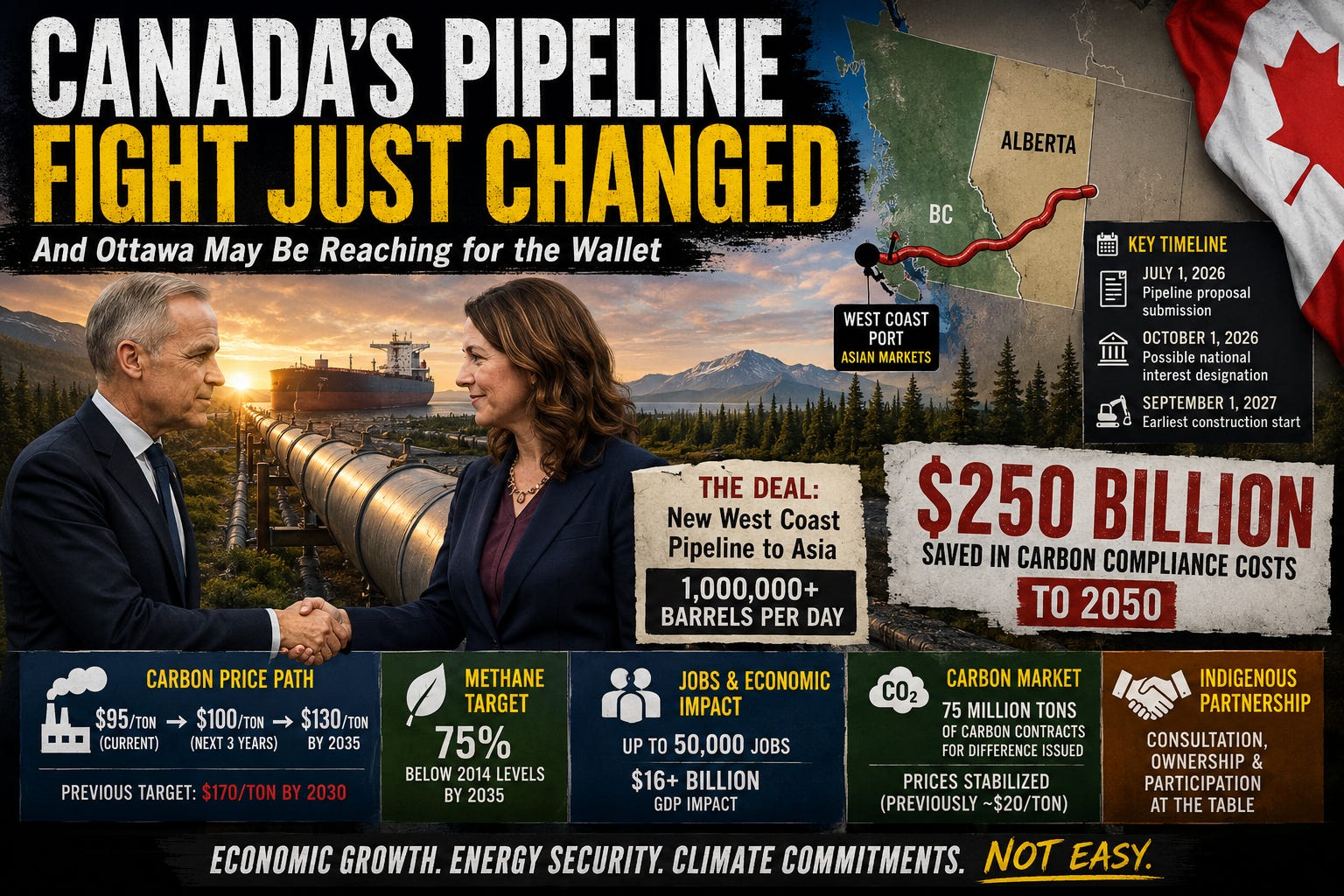
The idea is big… a new pipeline carrying more than one million barrels of Alberta oil per day to a strategic port on the West Coast, aimed at Asian markets.
Alberta is supposed to submit a full proposal to the federal Major Projects Office by July 1, 2026.
Ottawa could then pursue a “national interest” designation by October 1, 2026, with design and construction potentially starting as early as September 1, 2027.
That is the sales brochure.
The fine print is where the fun begins.
Because this deal is not just about pipe, steel, oil, and shipping lanes. It is about carbon pricing, carbon capture, Indigenous consultation, British Columbia, environmental law, investor confidence…
and Canada trying to look like it still knows how to build something larger than a committee.
Under the deal, Alberta’s industrial carbon price stays at $95 per tonne for the rest of 2026, rises to $100 in 2027, and eventually reaches about $130 per tonne by 2040.
That is a major shift from the old Trudeau-era target of $170 per tonne by 2030.
Alberta says the softer path could save the oil industry roughly $250 billion in compliance costs by 2050.
Translation?
Ottawa is still calling it climate policy.
Alberta is calling it economic survival.
Industry is calling it “better, but don’t get cute.”
Environmental groups are calling it backsliding in a hard hat.
And regular Canadians are probably wondering how many times we can rebrand the same fight before someone admits the country is trying to do two things at once…
sell more oil and still claim we’re serious about emissions.
That is the uncomfortable bit.
Canada wants the money, the jobs, the export leverage, and the geopolitical usefulness that come with energy. But it also wants the halo of climate leadership.
So now carbon capture gets dragged onto centre stage like the magical machine that is supposed to make the contradiction behave itself.
The proposed pipeline is tied to major emissions-reduction work, including the Pathways carbon capture project, which is supposed to reduce oil sands emissions.
But even that piece is not simple.
Reuters reports the carbon capture requirement may now be phased in, which could mean weaker early emissions reductions than originally promised.
And then there is British Columbia.
Small detail.
You know, the province the pipeline has to cross.
B.C. Premier David Eby remains opposed to lifting the northern oil tanker ban, and affected First Nations still have to be consulted.
Some may support ownership or partnership opportunities.
Others may fight it hard. Either way, this is not Alberta and Ottawa playing checkers by themselves. B.C. and Indigenous governments are not decorative furniture in this story.
Still, politically, this is a very big turn.
Carney is trying to reposition Canada as a country that can still build major infrastructure without needing three decades, four royal commissions, and a ceremonial apology to the stapler.
Alberta gets a federal government willing to talk pipeline again.
Ottawa gets to say it is building national wealth, diversifying exports, and reducing dependence on the American market.
And Asia gets dangled as the prize: customers beyond the U.S., more leverage for Canada, and a chance to stop selling our resources like we only have one neighbour and no imagination.
That part matters.
Because in a world where trade is getting rougher, alliances are getting shakier, and the United States is becoming less predictable by the week, Canada needs more doors. Energy is one of them.
But let’s not pretend this is clean.
This is a bargain.
A big one.
Canada is loosening the pressure on industry, slowing down carbon pricing, and trying to make the economics attractive enough for investors to stop running for the exits.
In exchange, Ottawa wants emissions reductions, carbon capture, Indigenous participation, and a pipeline that can be sold as “nation-building” instead of just “Alberta finally got what it wanted.”
Maybe that works.
Maybe it turns into another Canadian infrastructure saga where every deadline gets mugged in the parking lot.
But the direction is clear.
The Carney government is not governing like the old climate-first Liberals.
It is moving toward a harder, more practical trade-off: build the economy, keep the climate language, and hope the technology catches up before the contradiction does.
That is the real story here.
Not that Canada suddenly became Texas with snow tires.
Not that Alberta won everything.
Not that climate policy is dead.
The real story is that Canada just admitted something politicians usually avoid saying out loud:
Economic power still matters.
Energy still matters.
Pipelines still matter.
And if we want access to Asian markets, national leverage, and serious industrial strength, we may have to build things that make everyone uncomfortable.
Welcome to grown-up policy.
Nobody gets everything.
Everybody gets mad.
And somewhere in the middle, Canada either builds a future — or spends another decade arguing over the shovel.
The Recap…
Canada and Alberta just signed a deal that could move a new West Coast oil pipeline closer to reality.
Not approved.
Not built.
But no longer imaginary either.
The real story? Ottawa is softening carbon rules while trying to keep the climate halo polished.
That’s not policy purity.
That’s a bargain.
The Gut-Punch…
Canada wants to sell more oil, cut emissions, please Alberta, calm investors, respect Indigenous rights, get through B.C., reach Asia, and still call itself a climate leader.
That is not a plan.
That is a juggling act with a lit match in each hand.
Source credit:
Source notes based on the provided research brief plus current reporting from Reuters, Financial Times, Wall Street Journal, Government of Alberta materials, and related Canadian coverage.
🔎 The GeezerWise Standard
This space is built on disciplined thinking.
Facts over spin.
Verification before amplification.
Good-faith discussion over tribal noise.
I use AI tools to help shape my spoken drafts into clear writing.
The judgment, conclusions, and final message are mine.
If you’re new here, this explains how I decide what’s worth sharing:
How I Decide What’s Worth Sharing → [link]
💌 Subscribe at GeezerWise.com to receive future letters:
www.geezerwise.com/subscribe
— Fred Ferguson
GeezerWise
#CanadaStrong
A few things. My mom always said make hay when the sun shines. So Alberta has oil they want to get out to the world cause profits, massive profits. That's some nice hay. Carney gets stability with Alberta and buy in to his other interests which are far more embracing beyond Alberta and increased cash flow for other projects. Nothing says investment haven than a country that can get things done. Cha ching for Canada. Leverage is creating the investible environment. This man is a genius and the oil will be the cleanest ever as substantial carbon capture investments will offset a large chunk of the increased production if I heard that part right. If we want to bring other countries to a Canadian maker party we need to put some nuggets on the table. LNG is around the corner. Canada is going to be an amazing place in 10 years. This fall after CUSMA's future is made clear there will be a sting of actionable projecf announcements the like of which has never been seen before. Gonna be fun. Canada Strong.
Another excellent episode of "Taming the bitch" & making a switch! Well done Fred haha