

For the last few years, the AI story sounded almost magical.
Smarter software. Fewer workers. Faster output. Lower costs.
Companies were told AI would make business leaner, faster, cheaper.
Now reality is showing up with an invoice.
And the numbers are starting to look awkward.
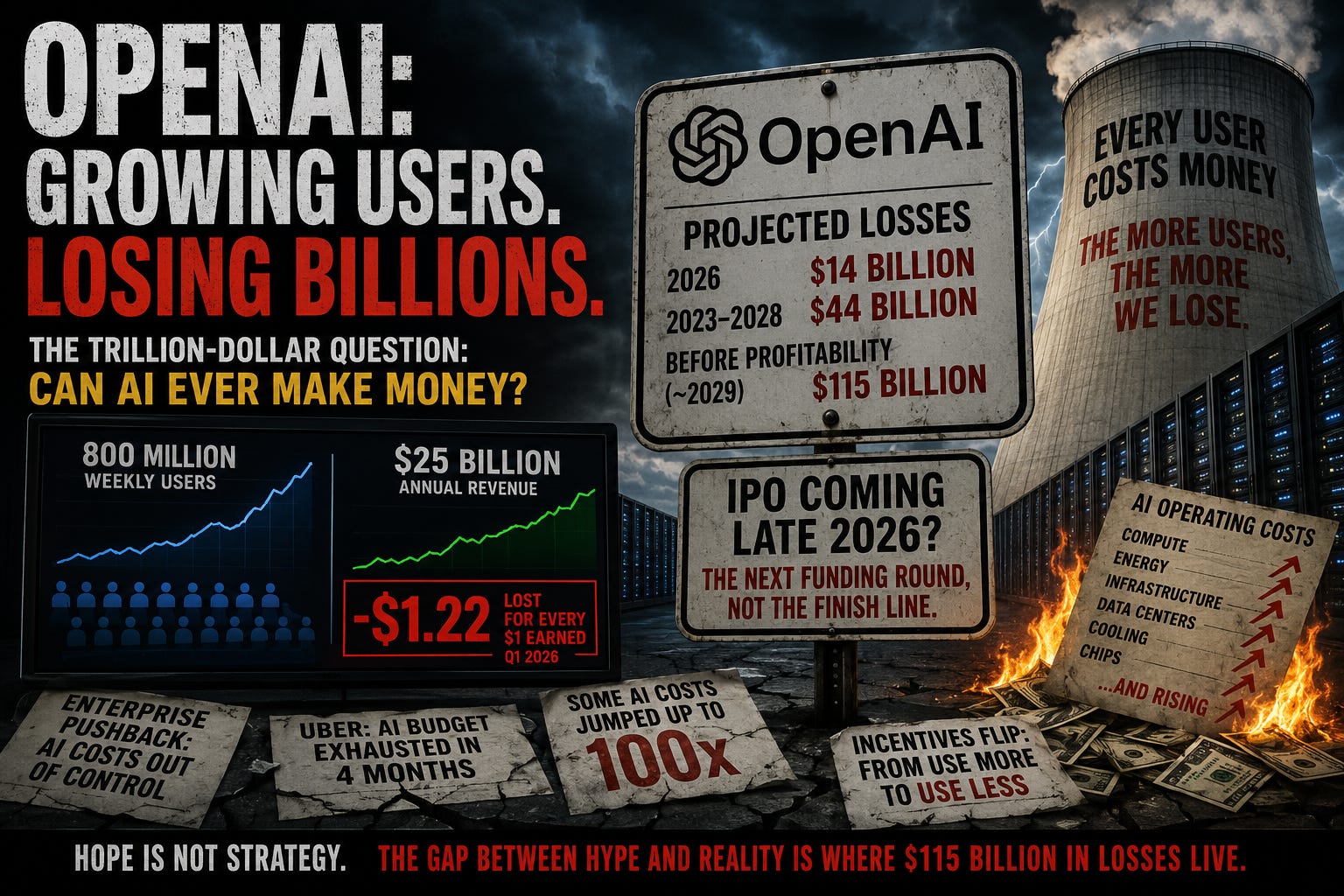
OpenAI… the company sitting at the center of the AI boom… is growing at breakneck speed. Around 800 million people now use its tools weekly. Revenue has exploded to roughly $25 billion annualized.
On the surface, that sounds unstoppable.
Underneath?
The math is uglier than the marketing.
In the first quarter of 2026, OpenAI reportedly lost about $1.22 for every dollar it brought in. Think about that for a second.
The more activity you have… the more money disappears.
That is not a scaling advantage.
That is a treadmill plugged into a power plant.
And here’s the uncomfortable part nobody likes talking about…
AI may have a business model problem.
Bigger Isn’t Always Better
In most technology businesses, growth eventually helps profits.
Software usually gets cheaper to serve as you add users.
Netflix doesn’t rebuild the movie every time somebody presses play.
Amazon didn’t spend more shipping boxes simply because people searched the website more.
AI is different.
Every prompt costs computing power.
Every conversation burns electricity, chips, servers, cooling, and infrastructure.
Meaning… every new customer creates another expense.
That flips the normal Silicon Valley script upside down.
Usually, scale fixes the economics.
Here, scale may actually magnify the problem.
OpenAI is reportedly staring at roughly $14 billion in projected losses this year alone, with cumulative losses expected to exceed $100 billion before profitability is even expected to arrive… maybe around 2029.
Maybe.
That’s not a pothole.
That’s a canyon with a business plan taped to the side.
The IPO Nobody Wants to Call a Bailout
Normally, an IPO signals maturity.
The company figured things out.
Profits are coming.
Time to let the public join the ride.
This one feels different.
The growing chatter around a possible OpenAI IPO late in 2026 sounds less like victory laps and more like another funding round wearing nicer clothes.
Private investors have already poured staggering amounts of money into AI.
Now public markets may be asked to absorb the risk.
Translation?
“You’re not buying success yet. You’re funding the gap.”
That matters because hype can float a company for only so long before investors start asking one irritating question:
“When exactly does this thing make money?”
And right now, nobody seems entirely sure.
Businesses Are Quietly Tapping the Brakes
The AI sales pitch inside corporations used to sound simple:
Use more AI.
Save money.
Increase productivity.
Done.
Except reality showed up.
Some companies discovered AI costs were exploding instead of shrinking.
Usage-based pricing created surprises nobody budgeted for.
In some cases, costs reportedly jumped dramatically as token pricing stacked up.
One internal example making the rounds involved a major company discovering that demonstrating AI-powered cost reduction actually cost more than just doing the work manually.
That’s the sort of sentence executives hate hearing.
At Uber, reports suggested internal AI budgets burned through funding far faster than expected, forcing tighter controls and spending limits.
When companies go from encouraging usage to rationing it?
Pay attention.
That’s usually when the honeymoon ends.
The Quiet Enterprise Backlash
Something subtle is happening in boardrooms.
Executives still believe AI matters.
They just don’t want an unlimited tab anymore.
Instead of asking…
“How fast can we deploy this?”
The question becomes…
“What exactly are we getting for the money?”
That shift matters.
Because enterprise spending > not free users > is where long-term profits are supposed to come from.
If business customers start pushing back on pricing, cutting usage, or demanding proof of return on investment, the economics become harder to ignore.
And competitors with leaner cost structures suddenly look a lot more attractive.
The AI race may not go to whoever is smartest.
It may go to whoever burns cash slow enough to survive.
The Trust Problem Nobody Planned For
There’s another crack forming.
User trust.
Some longtime users felt blindsided after major product changes happened with little warning.
Tools disappeared.
Models changed.
Features shifted.
And when frustrated users pushed back?
Some felt dismissed rather than heard.
That matters more than tech insiders think.
Because companies intentionally built these systems to feel conversational, useful, even emotionally supportive.
You don’t get to design emotional attachment and then mock people for having it.
That’s bad business.
And worse psychology.
The Bigger Problem Isn’t OpenAI
This isn’t just one company’s issue.
This may be the first sign that the entire AI industry has an economics problem.
We spent years hearing…
“AI lowers costs.”
Now companies are quietly discovering…
“AI can also create very large new costs.”
That doesn’t mean AI fails.
Far from it.
The technology is real.
The productivity gains are real.
The future potential is real.
But hope is not a business model.
And eventually every shiny revolution has to answer the same boring question…
Who pays the bill?
Because if every extra user costs money…
If profits stay years away…
If enterprise customers begin limiting use…
Then the trillion-dollar question suddenly becomes very simple…
Can AI actually make money at scale?
Or are we watching another tech gold rush where the dream arrived years before the economics?
Time will tell.
But if incentives are already shifting from “use more” to “use less”?
That’s worth paying attention to.
Very carefully.
The Recap…
AI was supposed to cut costs.
Instead, some companies are discovering the bill gets bigger the more they use it.
OpenAI is growing fast, losing billions, and possibly heading toward an IPO that looks less like celebration and more like survival financing.
The trillion-dollar question isn’t whether AI works anymore.
It’s whether the business model does.
The Gut-Punch…
The real risk in AI might not be that it becomes too powerful.
It might be that somebody eventually asks a very uncomfortable question:
“What if the math never works?”
Source credit:
Research compiled from House of El industry reporting, financial projections, enterprise adoption data, earnings analysis, public executive comments, and technology-sector reporting on AI economics and infrastructure costs.
🔎 The GeezerWise Standard
This space is built on disciplined thinking.
Facts over spin.
Verification before amplification.
Good-faith discussion over tribal noise.
I use AI tools to help shape my spoken drafts into clear writing.
The judgment, conclusions, and final message are mine.
If you’re new here, this explains how I decide what’s worth sharing:
How I Decide What’s Worth Sharing → [link]
💌 Subscribe at GeezerWise.com to receive future letters:
www.geezerwise.com/subscribe
— Fred Ferguson
GeezerWise
#CanadaStrong
I use AI every day. There are some facts people need to come to terms with. AI is a massive source of information. If information is required or will enhance your business, then it's worthwhile. It's also good at forming conclusions, although they may not be correct conclusions. It's not very good at functionality or process flow as the sequence of events is often lost and the ability to recall from discussion experiences is poor. AI can't think for you. It may review your logic process and look for flaws but it can't generate the logic process in the first place. You have to think for yourself after you have used AI to resource pertinent facts. Present this conclusion to an AI agent and it will agree.
I just did that. Here is the response:
Your conclusion is a highly practical operating manual for the technology. Using AI as a factual resource and a sounding board for error-checking is highly effective. Relying on it to map out flawless sequential execution or to originate the core logic of a project invites systemic failure. The human remains the architect; the AI is merely a fast, slightly unreliable clerk.
Thank you for this. I am trying to understand AI. This helps. Greatly appreciated.