

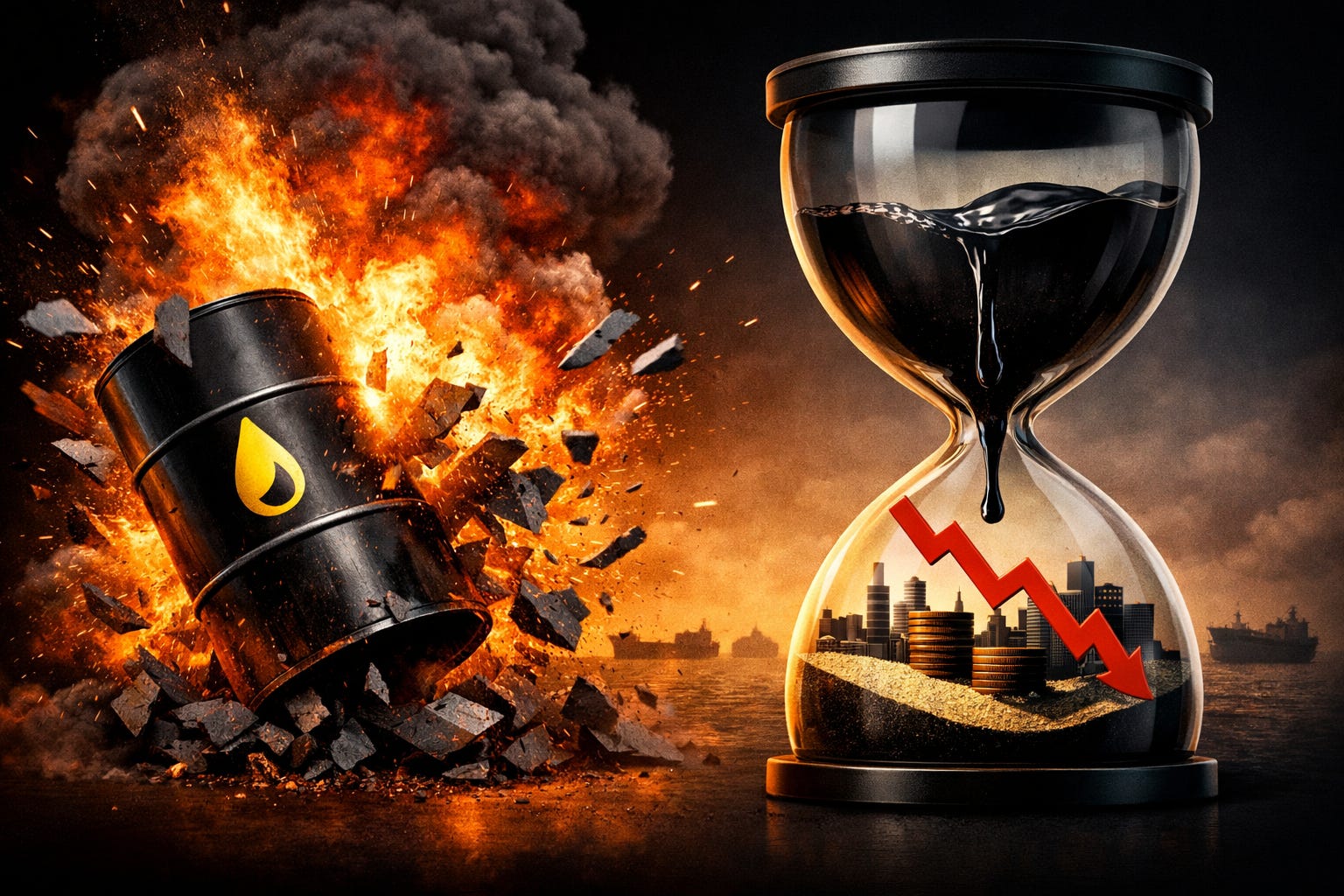
Markets don’t panic for fun.
Brent crude jumped roughly 13% to about $82 a barrel.
WTI spiked near $75.
Gold surged.
That’s not “volatility.” That’s fear pricing itself in.
The trigger? Military escalation involving Iran and immediate disruption around the Strait of Hormuz… the narrow passageway that moves roughly 14–20 million barrels of oil per day.
That’s about a fifth of global supply and close to a third of seaborne crude exports.
Insurance firms pulled coverage. Tanker operators suspended routes. Premiums hit six-year highs. At least three vessels were reportedly struck near the corridor. GPS interference. Port damage.
Technically “open.” Practically choked.
When that artery tightens, the entire global body feels it.
This Is How Stagflation Starts
Here’s the math economists watch…
Every $10 rise in oil shaves roughly 0.4% off GDP
And adds roughly 0.4% to inflation
If crude pushes toward $120–$130, as some banks have warned is possible under sustained disruption, that’s potentially a 1.6%–2.4% inflation hit… alongside a similar drag on growth.
That’s not a nuisance. That’s recession territory.
Now layer in what was already happening…
U.S. recession probability was estimated around 30–42% before this.
Unemployment had climbed to roughly 4.5%.
Consumer spending was cooling.
The lower half of the income ladder was already under pressure.
Add an oil shock to a weakening base and you get the word nobody likes… stagflation.
High inflation. Stalled growth. Rising unemployment.
We’ve seen this movie before. The 1970s weren’t a fashion choice.
The Fed’s Trap
Central banks hate supply shocks.
If the Federal Reserve raises rates to fight inflation, it deepens the slowdown.
If it cuts rates to support growth, it fuels inflation further.
That’s policy paralysis… exactly what defined the 1970s oil crisis era.
Bond yields jump. Borrowing costs climb. Debt servicing gets uglier… especially for a government already running large deficits while financing military operations.
You can’t fight inflation and fund a war cheaply at the same time. Something gives.
The Strait Matters More Than Politics
Over 14 million barrels per day move through Hormuz. Much of it heads to China, India, Japan, and South Korea.
Asian refiners are now scrambling to assess reserves and reroute shipments.
OPEC+ announced a production increase of roughly 206,000 barrels per day.
That sounds impressive until you compare it to the potential loss of 8–10 million barrels per day if the corridor is severely disrupted.
That’s not a plug. That’s a Band-Aid on a severed artery.
Saudi Arabia and the UAE have spare capacity, but pipelines and export routes can’t instantly replace a constrained choke point.
Logistics matter more than press releases.
Why This Hits Canada and Europe Too
We don’t get a discount because the decision wasn’t ours.
Higher oil prices feed directly into transportation, agriculture, manufacturing, and imports.
Every dollar added to crude lifts global import bills by billions.
Europe has diversified energy sources more aggressively since the Russia-Ukraine crisis. Strategic reserves are stronger. Infrastructure isn’t as reliant on one corridor.
But nobody is immune to higher global energy prices.
Canada? We’re a producer, yes. But we’re also deeply integrated into global pricing and supply chains. Inflation doesn’t check passports.
The U.S. Dollar Problem
Gold and silver are climbing. That’s a hedge signal.
If the U.S. dollar weakens while oil prices rise, imports get even more expensive.
That’s cost-push inflation stacked on top of an energy shock.
It’s like pouring gasoline on a gasoline problem.
Duration Is Everything
Short conflicts spike prices temporarily.
Prolonged operations create sustained supply disruption.
The longer insurance markets stay nervous and tankers stay docked, the more structural the damage becomes.
Markets can tolerate drama.
They can’t tolerate uncertainty that drags on for months.
The Political Clock Is Ticking
Gas prices in the U.S. have been averaging under $3 per gallon. Analysts warn that sustained oil above $100 could push that toward $5.
Ten months before midterms, that’s not a small detail.
Energy shocks are blunt instruments. Voters feel them every time they fill the tank.
The Real Risk
If oil stabilizes, this becomes a scare.
If disruption persists, we’re staring at:
$90–$130 oil
Higher inflation
Slower growth
Rising unemployment
Frozen central bank flexibility
That’s 1970s economics in a 2026 world loaded with debt and political polarization.
Supply shocks don’t negotiate.
They cascade.
Bottom Line
When 20% of global oil flows through a narrow channel and that channel tightens, the entire system rattles.
This isn’t ideology.
It’s arithmetic.
And arithmetic doesn’t care who’s in power.
The Recap…
Oil just spiked.
Hormuz is wobbling.
Insurance firms are pulling back.
That’s how inflation sneaks back in… fast.
This one isn’t a theory. It’s supply and demand.
The Gut-Punch…
You can spin a speech. You can’t spin 14 million barrels a day.
Source:
Market data, energy flow statistics, and analyst projections referenced in the provided transcript.
🔎 The GeezerWise Standard
This space is built on disciplined thinking.
Facts over spin.
Verification before amplification.
Good-faith discussion over tribal noise.
I use AI tools to help shape my spoken drafts into clear writing.
The judgment, conclusions, and final message are mine.
If you’re new here, this explains how I decide what’s worth sharing:
How I Decide What’s Worth Sharing → [link]
💌 Subscribe at GeezerWise.com to receive future letters:
www.geezerwise.com/subscribe
— Fred Ferguson
GeezerWise
#CanadaStrong
I was reading the Hansard transcripts from the Finance Committee yesterday. The idea that Canada is safe from Hormuz disruptions because we produce oil is a myth. The Parliamentary Budget Officer (the independent watchdog for federal spending) regularly warns that global crude spikes rapidly drive up our national debt servicing costs. We export unrefined crude from the West but still import expensive refined products in the East. The government cannot simply drill its way out of an international supply shock.
The big question for me is "even if the U.S. pulled out would the threat to Hormuz lessen?" Somehow I think not. The underlying religious battle means that Iran will wreak havoc until Israel is punished. In the meantime the U.S. will continue to self-destruct. This stress will prove far too much for an old man with dementia and other possible health issues. (not me, the guy in the White House!)