

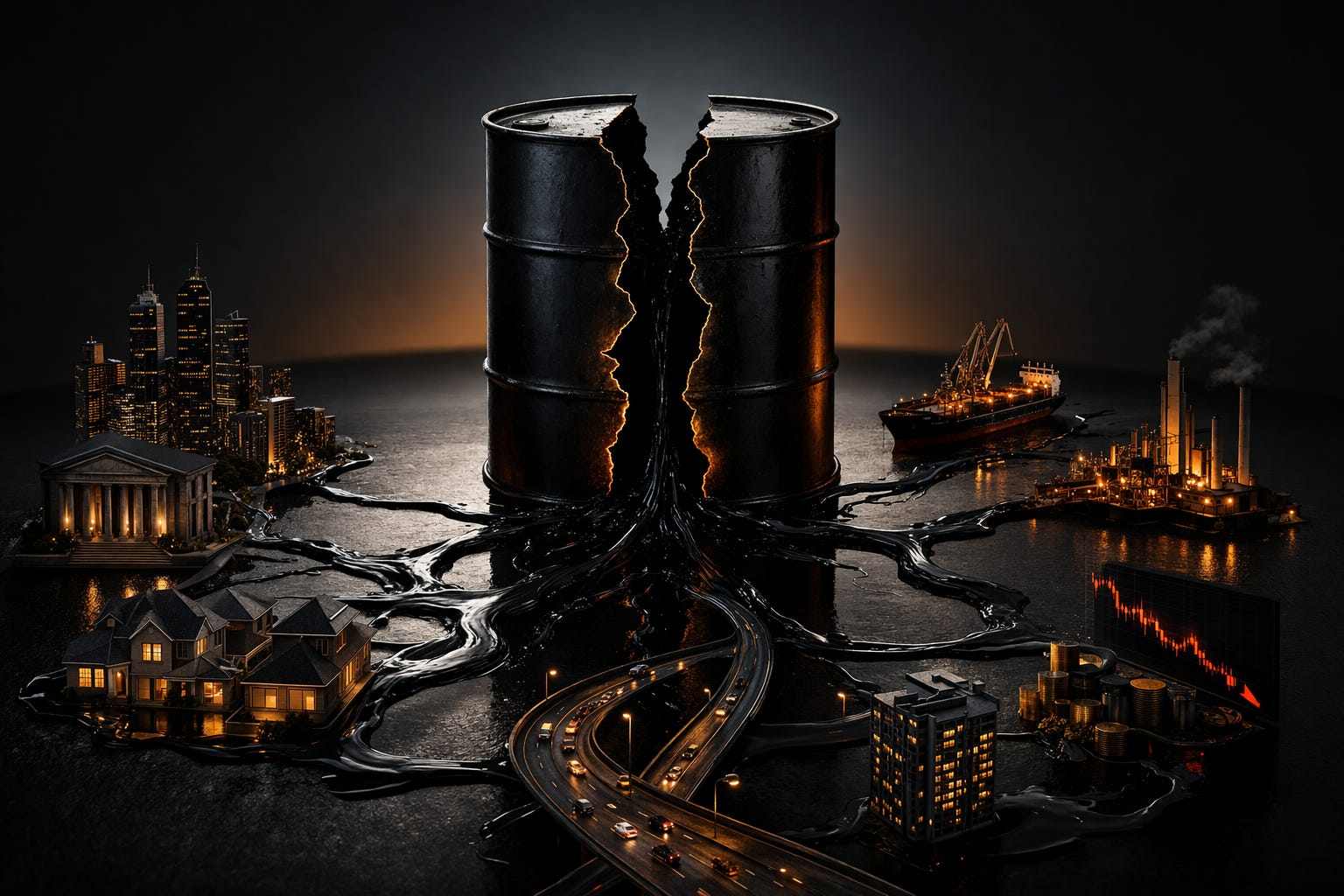
Everyone’s watching the missiles.
Nobody’s watching the math.
And that’s the part that’s going to hurt.
The moment tensions with Iran escalated, oil didn’t “creep up”… it jumped. From around $60 a barrel to roughly $110… and still climbing.
That’s not a price move. That’s a shockwave.
Most people feel it first at the pump. You go to fill up and suddenly your wallet takes a punch. Annoying? Sure.
But that’s just the surface.
The Part Everyone Gets Wrong
Canada should be fine… right?
We export oil. Higher prices = more money.
Sounds logical.
It’s also incomplete.
Yes, oil companies make more. Governments collect more. But regular people? We still pay global prices for fuel, food, shipping… everything.
And when energy costs spike, everything downstream gets more expensive.
That’s inflation.
Again.
Why Oil Spikes Turn Into Recessions
Here’s the pattern most people miss…
Oil spikes
Costs rise across the economy
People spend less
Inflation kicks up
Central banks raise interest rates
Economy slows… or breaks
It’s not theoretical. It’s historical.
Different triggers. Same ending.
Every time oil jumps hard, a recession isn’t far behind.
And right now? We’re staring at nearly a 100% price increase.
That’s not noise. That’s a warning.
The Real Crack… Confidence Is Slipping
Here’s where things get interesting.
In past crises, investors ran to U.S. bonds. Safe haven. Stability.
This time?
They’re selling.
Yields are rising… which means confidence is dropping.
And that ripples out fast…
• Mortgage rates climb
• Loans get more expensive
• Housing slows down
• Consumers pull back
That’s how a war “over there” ends up squeezing someone trying to refinance their home.
Canada vs. The U.S. (For Now)
Canada isn’t immune… but it’s not getting hit the same way.
Our bond yields have moved… but not nearly as violently.
Translation?
We might dodge the worst of the mortgage shock the U.S. is heading into.
But inflation?
That doesn’t respect borders.
The Strait That Runs the World
Now let’s talk about the real pressure point.
The Strait of Hormuz.
A massive chunk of the world’s oil flows through that narrow corridor. If it’s disrupted… even partially… you don’t get a slow squeeze.
You get panic.
And here’s the kicker…
High oil prices actually benefit major producers in the region.
So even if the shooting stops, the incentive to keep supply tight doesn’t magically disappear.
That’s how temporary conflicts turn into long economic hangovers.
The Cycle We Never Learn From
We’ve seen this movie before…
• Supply shock → prices spike
• Producers profit → supply stays tight
• Inflation rises → central banks react
• Economy slows → demand collapses
• Prices crash → recession hits
Then we reset… and do it again.
Over and over.
Meanwhile… China Is Playing a Different Game
While North America argues about pipelines and reserves…
China is building an exit.
Massive investment in solar, wind, and EVs.
Hundreds of gigawatts added in a single year.
Electric vehicles already dominating new sales.
Why?
Because the best way to survive oil shocks…
Is to need less oil.
Simple. Not easy… but simple.
The Part Nobody Wants to Say Out Loud
You don’t fix this by stockpiling more oil.
You fix it by reducing your exposure to the system that keeps breaking.
Because as long as the global economy runs on a fragile supply chain…
Every geopolitical flare-up becomes an economic event.
And eventually…
A financial one.
Where This Could Go
If oil pushes toward $150… $200… and stays there?
That’s not just inflation.
That’s pressure on…
• Housing
• Debt markets
• Consumer spending
• Global growth
And once those start cracking, it doesn’t stay contained.
It spreads.
The Recap…
Oil just doubled.
That’s not a headline… it’s a chain reaction.
Gas, groceries, mortgages… it all connects.
And history says what comes next isn’t pretty.
This isn’t about war.
It’s about what war does to everything else.
The Gut-Punch…
Missiles make the news… but oil prices make the damage.
Source Credit:
Based on Claus Kellerman POV economic analysis of oil price shocks, bond market movements, and global energy trends.
🔎 The GeezerWise Standard
This space is built on disciplined thinking.
Facts over spin.
Verification before amplification.
Good-faith discussion over tribal noise.
I use AI tools to help shape my spoken drafts into clear writing.
The judgment, conclusions, and final message are mine.
If you’re new here, this explains how I decide what’s worth sharing:
How I Decide What’s Worth Sharing → [link]
💌 Subscribe at GeezerWise.com to receive future letters:
www.geezerwise.com/subscribe
— Fred Ferguson
GeezerWise
#CanadaStrong
Thanks for a good article, Geezer. If this war escalates, then we’re all in for a world of hurt!
Do you think Fred, that you might be able to get this article to Danielle Smith in Alberta? She certainly could use a wake up because it looks like she is completely missing the boat.