

Artificial intelligence isn’t just changing computers anymore.
It’s changing the electricity business.
That may not sound exciting until your next power bill lands in the mailbox.
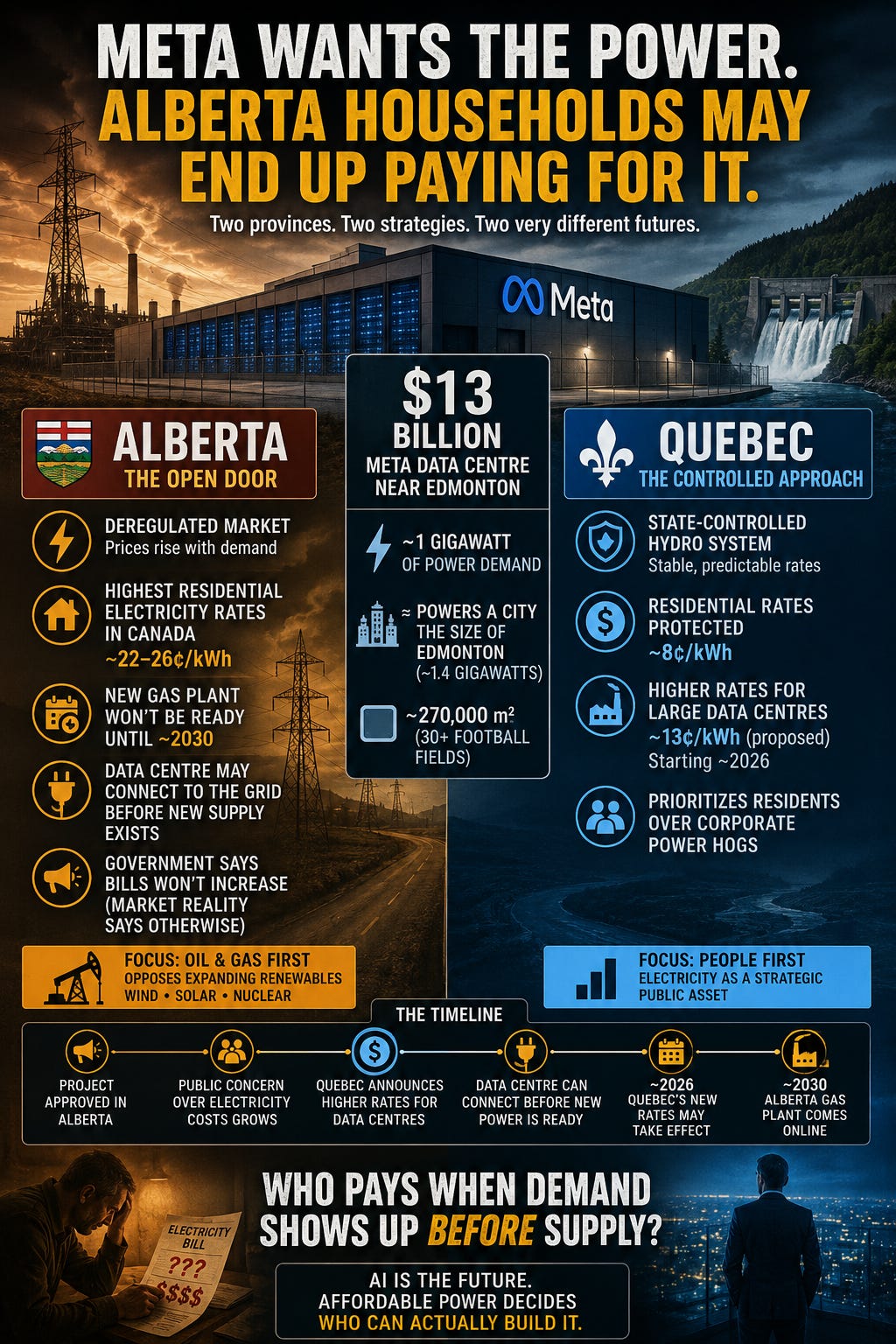
Alberta has approved Meta’s massive new data centre near Edmonton… a project worth roughly $13 billion.
It’s expected to consume about one gigawatt of electricity, an amount approaching what it takes to power an entire city the size of Edmonton.
That’s where the questions begin.
The province’s new gas-fired generating station, intended to help support this kind of demand, isn’t expected to be operating until around 2030.
Yet the data centre could be connected to Alberta’s electrical grid years before that additional supply exists.
In plain English, demand arrives first. Supply catches up later.
That’s an uncomfortable order of events in any market.
The Alberta government insists the project won’t increase residential electricity bills.
But Alberta also operates Canada’s most deregulated electricity market.
Prices move with supply and demand.
More demand without matching supply is exactly the kind of situation that normally pushes prices higher.
That’s why many Albertans are wondering how those two statements fit together.
The concern isn’t Meta.
Canada needs AI infrastructure. Data centres create jobs, attract investment and become part of the country’s digital backbone.
The real question is who carries the cost of feeding these enormous facilities.
Now compare Alberta’s approach with Quebec’s.
Quebec also wants data centres. It simply isn’t offering electricity at bargain prices.
Instead, Hydro-Québec plans to charge large AI facilities higher industrial rates… around 13 cents per kilowatt-hour…
while continuing to protect lower residential rates that average about 8 cents per kilowatt-hour.
The message is simple.
If you’re going to consume extraordinary amounts of electricity, you’ll pay accordingly.
That’s a very different philosophy from Alberta’s, where residential rates already sit roughly between 22 and 26 cents per kilowatt-hour, among the highest in Canada.
Both provinces want investment.
Only one appears to be putting guardrails around who pays for it.
This debate is much bigger than one Meta project.
AI data centres are becoming the new heavy industry.
They’re enormous electricity consumers, often operating around the clock. As more companies build them, provinces will increasingly face the same choice:
Do you treat electricity as a commodity to sell at almost any cost?
Or do you manage it as a strategic public asset that has to balance economic growth with affordability for residents?
Those decisions won’t just shape the AI economy.
They’ll shape household budgets.
Because electricity isn’t like office space or warehouse land.
If demand outruns supply, somebody eventually pays.
Governments can promise otherwise.
Markets usually have the final say.
Canada isn’t entering an AI race anymore.
It’s entering an energy race.
The provinces that plan for both may end up winning.
The ones that don’t may discover that attracting billion-dollar investment is the easy part.
Keeping the lights affordable is much harder.
The Recap…
Meta is bringing a $13-billion AI data centre to Alberta—but its electricity demand is close to adding another city to the grid.
Quebec is charging big tech more to protect residents.
Alberta says households won’t pay more.
The real test won’t be the announcement.
It’ll be the next few years of electricity bills.
The Gut-Punch…
The future of AI won’t be limited by computing power.
It’ll be limited by electrical power—and by who politicians expect to pay for it.
Source credit:
Based on publicly reported information regarding Meta’s proposed Alberta data centre, Alberta electricity market policies, Hydro-Québec’s industrial electricity pricing proposals, and provincial energy planning announcements.
If you enjoy thoughtful conversations, Canadian stories, and the occasional smart-ass observation about the world we’re living in, you’re in the right place.
Subscribe free and get new stories, insights, and observations delivered directly to your inbox.
No paywall.
No spam.
No nonsense.
Leave anytime with a single click.
I promise not to take it personally.
If I were an Albertan I'd be very nervous. I recall instances of deregulated electrical systems in Texas where costs went through the roof due to unexpected surges in demand. Regardless of cheap promises made by MAGA Smith, I'd insist on a written legal contract that residential consumer rates will be locked in until the new power plants come online. On the flipside, why isn't META building their own power source like is happening in many US communities.
The UK is an example of what happens to energy bills when fuel sources vary..the Guardian had a surprising article on how the cost is shared by all not just the high consumer’s. Seems that country has a few hard lessons Alberta could learn from