

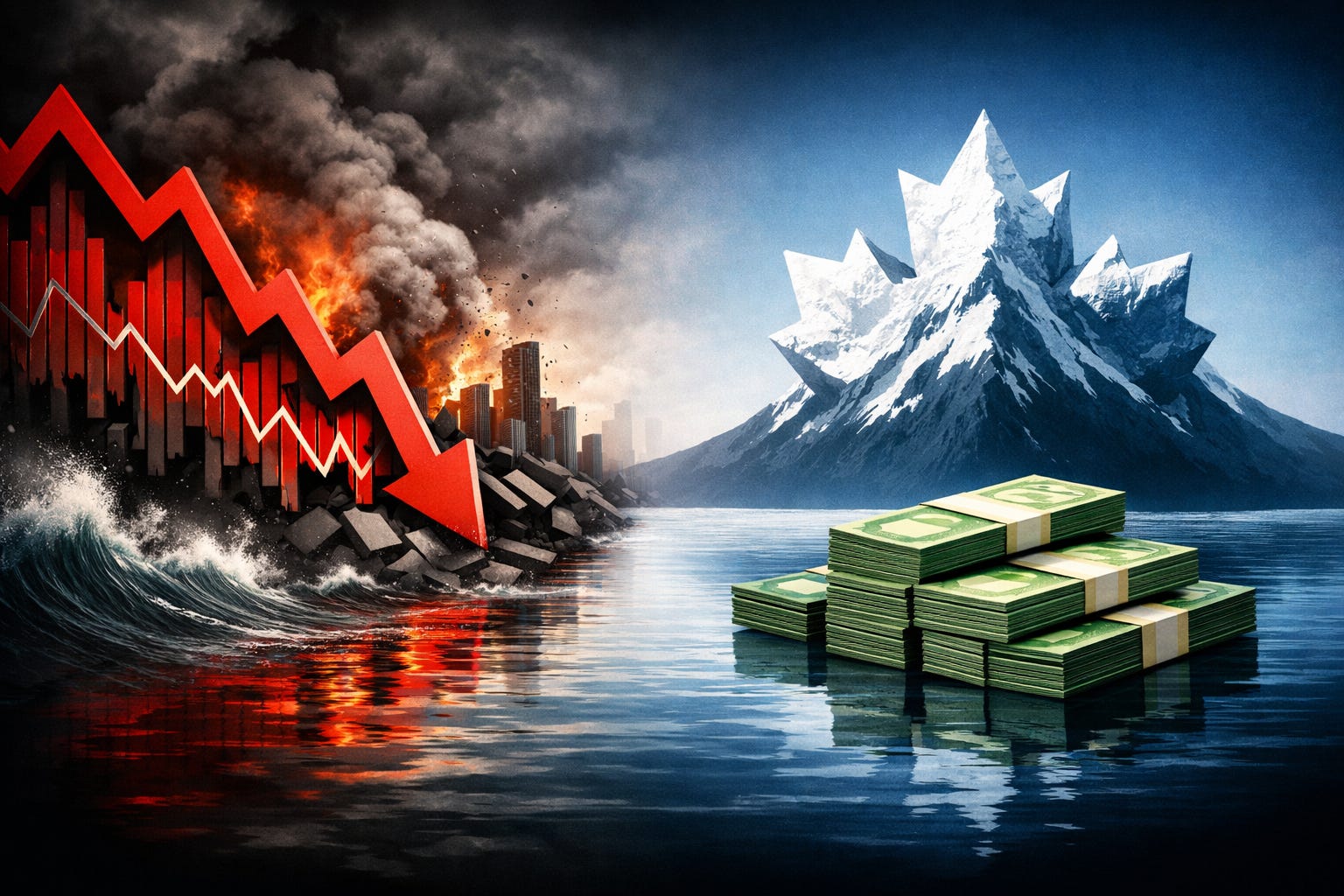
There’s a rule in global finance that rarely gets mentioned in political speeches.
Money hates chaos.
It doesn’t argue. It doesn’t wave flags. It doesn’t debate ideology.
It simply leaves.
And lately, a lot of it has been packing its bags and heading north.
The Warning Lights Are Flashing
The latest U.S. economic numbers are not pretty.
Roughly 92,000 jobs disappeared last month, and the unemployment rate climbed to 4.4%, the highest level in several years.
To make matters worse, earlier reports were quietly revised downward… another 69,000 jobs erased from previous months.
That’s not a blip. That’s momentum.
The layoffs are scattered across the economy…
Restaurants and bars: about 30,000 jobs lost
Healthcare: roughly 28,000 positions cut
Manufacturing: 12,000 jobs gone, continuing a trend that has lasted 14 out of the last 15 months
Construction: 11,000 layoffs
Administrative services: nearly 19,000 cuts
Courier and delivery services: about 17,000 jobs eliminated
When losses hit this many sectors at once, it usually means something bigger is going on under the hood.
And investors are noticing.
The Snowball Effect
Economic slowdowns don’t arrive all at once. They roll downhill.
A factory cuts workers. Those workers stop spending. Local businesses lose customers. More jobs disappear.
The ripple spreads outward.
Tariffs have played a role here as well. When governments slap taxes on imported goods, the bill doesn’t magically get paid by foreign countries.
It lands on companies and consumers inside the country imposing the tariff.
Businesses importing parts suddenly face higher costs. Some raise prices. Others cut payroll.
Either way, the pressure spreads.
And when hiring freezes turn into layoffs, consumer spending slows… which is exactly what recent data is showing.
Markets Are Already Reacting
The financial world moves faster than politics.
Major U.S. stock indexes have taken sharp hits, including a drop of roughly 900 points in the Dow during one volatile trading session as energy prices spiked and economic data weakened.
Meanwhile, something else is happening quietly behind the scenes.
Investment funds are pulling money out of U.S. equities.
In fact, U.S. equity funds recently saw their largest capital outflows in roughly two months.
That’s the global investment community saying one thing…
Risk is rising.
Meanwhile… Canada
While American markets wrestle with uncertainty, Canada is seeing a different trend.
Foreign investment into Canada recently surged to its strongest level since 2007.
That’s not because Canada suddenly became a perfect economy. We still have our own problems.
But in global finance, relative stability matters more than perfection.
If investors have to choose between turbulence and predictability, they’ll take predictability every time.
Canada right now looks like a comparatively calm harbour in a very stormy ocean.
Tariffs, Taxes, and the $166 Billion Question
One of the biggest misconceptions in the tariff debate is who actually pays them.
Recent data shows the U.S. government collected about $166 billion in tariff revenue through customs duties.
But those funds weren’t coming from foreign governments writing cheques.
They were paid by importing companies and American consumers.
And now the situation has become even messier.
After legal challenges, companies are lining up for potential refunds following a U.S. Supreme Court decision striking down parts of the tariff program.
That opens the door to massive reimbursement battles that could drag through the courts for years.
A Bigger Economic Story
None of this means the U.S. economy is collapsing tomorrow.
It’s still one of the largest, most diverse economies on Earth.
But policies have consequences.
Trade tensions, unpredictable tariff changes, rising geopolitical spending, and global uncertainty all add friction to an economic system that depends on stability.
When friction increases, growth slows.
And when growth slows in the world’s largest economy, the effects don’t stop at its borders.
Canada, Europe, Asia… everyone feels the waves.
The Recap…
Economic systems are deeply interconnected.
A tariff here. A supply disruption there. A diplomatic breakdown somewhere else.
Each one seems small on its own.
But together they form the kind of chain reaction that can knock workers out of jobs hundreds or thousands of miles away from the original decision.
That’s the butterfly effect of economic policy.
And it’s why stability — boring, predictable stability — is often the most valuable asset a country can offer.
Right now, global investors seem to be rediscovering that.
And for the moment, Canada is benefiting.
The Gut-Punch…
Capital doesn’t care about speeches. It follows stability.
Source Credit:
Source material compiled from reporting by Reuters, CNN, Canadian Press, Financial Post, and labour market data referenced in the transcript.
🔎 The GeezerWise Standard
This space is built on disciplined thinking.
Facts over spin.
Verification before amplification.
Good-faith discussion over tribal noise.
I use AI tools to help shape my spoken drafts into clear writing.
The judgment, conclusions, and final message are mine.
If you’re new here, this explains how I decide what’s worth sharing:
How I Decide What’s Worth Sharing → [link]
💌 Subscribe at GeezerWise.com to receive future letters:
www.geezerwise.com/subscribe
— Fred Ferguson
GeezerWise
#CanadaStrong
I checked StatsCan after this. Foreign direct investment into Canada reached 96.8 billion dollars in 2025. Highest since 2007. It lines up with investors chasing calm while U.S. layoffs hit 92,000 in a month and tariffs bite consumers. Stability really pulls the cash. See the release here: https://www150.statcan.gc.ca/n1/daily-quotidien/260226/dq260226a-eng.htm
Apparently a judge has ordered them to start paying back the tariffs. I believe Netflix is another, Costco too just sued as well. We’ll see.