

Something shifted in Toronto this week.
Not quietly either.
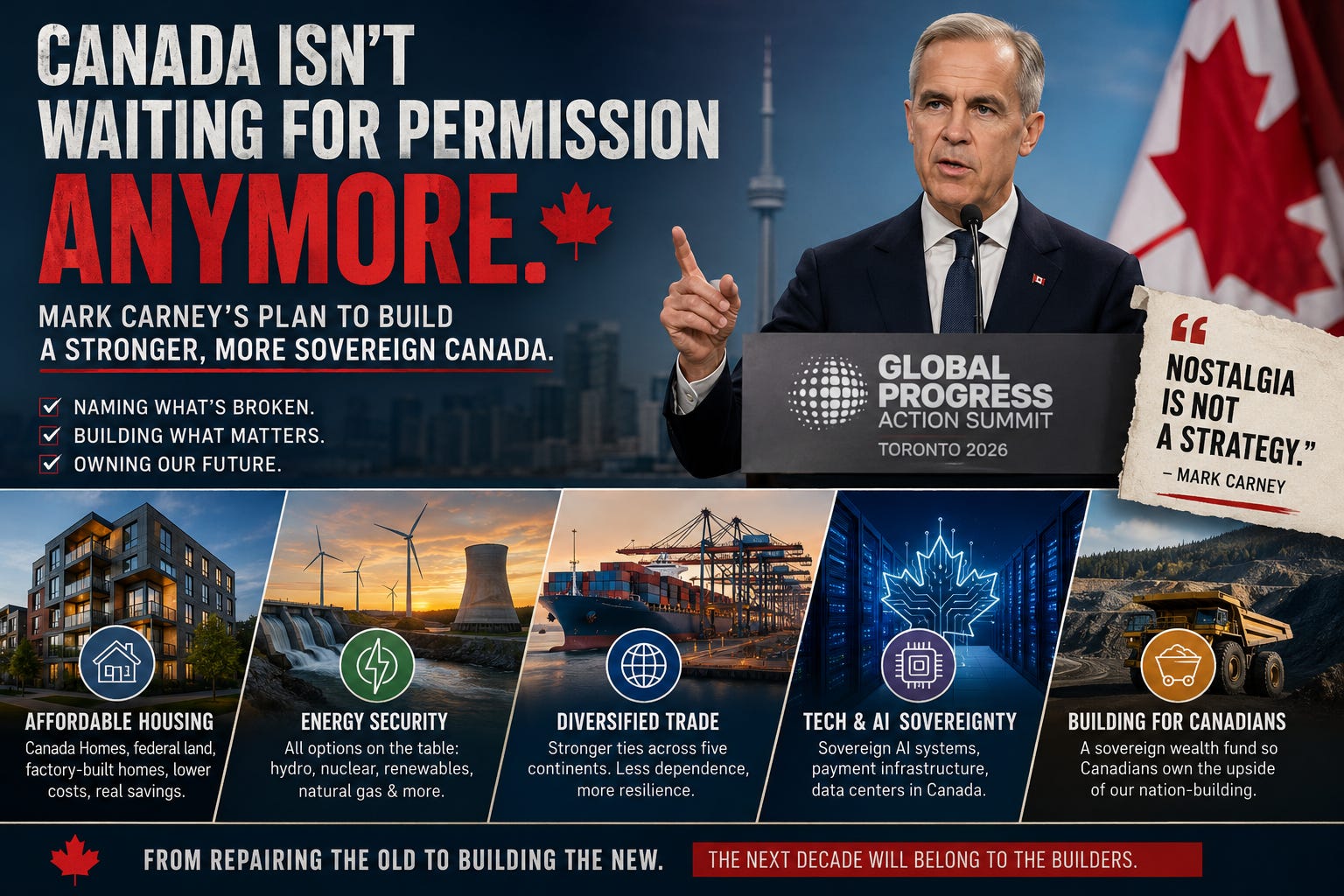
At the 2026 Global Progress Action Summit, Prime Minister Mark Carney delivered what might end up being one of the clearest declarations yet that Canada is preparing for a very different future than the one most people grew up with.
Not just economically.
Psychologically.
This wasn’t the usual political oatmeal about “moving forward together.”
This sounded more like…
The old system is breaking. Stop pretending otherwise. Build the next one before someone else does.
And honestly?
That’s probably the bluntest and most realistic political framing Canadians have heard in years.
Carney kept returning to one idea over and over…
People feel like they’ve lost control.
Control over prices.
Control over borders.
Control over technology.
Control over information.
Control over whether their jobs still exist five years from now.
And he’s right.
You can feel it everywhere now.
Kitchen tables.
Comment sections.
Union halls.
Facebook groups.
Family dinners where nobody talks politics anymore because everybody’s exhausted.
What stood out wasn’t just the diagnosis.
It was the fact he openly admitted the old global order isn’t functioning the way it used to.
That matters.
Because for years, politicians kept trying to duct-tape the same crumbling systems back together while pretending everything would magically stabilize if people just stayed calm long enough.
Carney basically said…
Nope.
That era’s over.
And then he did something most politicians avoid…
He started talking about actual building again.
Not slogans.
Not hashtags.
Real things.
Homes.
Ports.
Energy systems.
Trade corridors.
Defense infrastructure.
AI systems.
Critical minerals.
Rail.
Power grids.
Industrial policy.
Concrete.
Steel.
Electricity.
Ownership.
That’s a completely different tone than the neoliberal “service economy solves everything” script Canadians have been fed for decades.
One of the biggest tells came when he talked about housing.
He flat-out admitted Canada stopped building affordable housing properly about 30 years ago.
No dancing around it.
No consultant language.
No blaming ordinary people for buying avocado toast.
Just…
“We stopped building.”
That honesty alone probably shocked half the room.
Then came the part that’ll make a lot of Bay Street types nervous…
The federal government intends to get directly involved again through a new public agency called Canada Homes.
Using federal land.
Factory-built housing.
Canadian lumber.
Canadian workers.
Faster construction.
Lower costs.
Lower emissions.
That’s not small-government orthodoxy.
That’s state-capacity language.
And whether people love or hate that idea, at least somebody is finally acknowledging that markets alone weren’t solving this mess.
Same thing with energy.
Carney wasn’t preaching purity politics.
He openly said Canada will need…
hydro
nuclear
small modular reactors
geothermal
renewables
carbon capture
yes… even some natural gas
That sentence alone probably caused three separate Twitter meltdowns before lunch.
But politically, it signals something important…
Canada may be entering a “pragmatic sovereignty” phase.
Less ideology.
More resilience.
Less performative politics.
More “what actually keeps the lights on.”
Then came the trade section.
And this is where the speech really stopped sounding like the old Canada.
Carney acknowledged something most Canadians are now painfully aware of…
Our relationship with the United States changed.
Not emotionally.
Structurally.
He repeatedly emphasized that Canada still wants strong integration with the U.S., even mentioning “Fortress North America” options with both the U.S. and Mexico.
But he also made it clear Canada is preparing for a future where dependence becomes vulnerability.
That’s a major shift.
Especially coming from a Prime Minister.
He talked about…
expanding trade with India
deeper ASEAN ties
new agreements across five continents
European defense procurement
critical minerals partnerships
sovereign AI systems
strategic autonomy
A few years ago, language like that would’ve sounded academic.
Today it sounds like survival planning.
And honestly?
That may be exactly what it is.
One of the most interesting moments came when Carney described sovereignty itself.
Not just military sovereignty.
Economic sovereignty.
Technological sovereignty.
Payment-system sovereignty.
AI sovereignty.
Resource sovereignty.
That’s the kind of thinking countries move toward when they no longer fully trust the stability of the old system underneath them.
Then came the line that probably deserves the biggest spotlight…
“Nostalgia is not a strategy.”
That one landed.
Because a huge chunk of global politics right now is basically people trying to rewind the clock to a world that no longer exists.
Carney’s argument was different.
He wasn’t promising restoration.
He was promising reconstruction.
Big difference.
And maybe the most politically explosive part of the entire speech?
The sovereign wealth fund idea.
Now that is interesting.
Not because sovereign wealth funds are new.
But because Canada has historically allowed enormous amounts of national wealth to flow upward, outward, or sideways while average Canadians got little direct ownership from nation-building projects.
Carney openly referenced the original Canadian Pacific Railway era and pointed out that most of the upside ended up enriching a small class of powerful investors.
This time?
He says Canadians themselves should directly own part of the upside from major national projects.
Energy.
Ports.
Critical minerals.
Infrastructure.
Data centers.
That’s a very different conversation than Canadians are used to hearing federally.
Especially from a former central banker.
Will all of this happen exactly the way it was described?
Who knows.
Politics and reality are two different animals.
But politically, the speech mattered because it acknowledged something ordinary Canadians already feel…
The world changed.
The old assumptions cracked.
And the next decade is going to be about who can actually build things again.
Not just financially.
Nationally.
Psychologically.
And for the first time in a long time, Canada sounded less like a middle manager inside somebody else’s empire…
…and more like a country trying to decide what it wants to become next.
The Recap…
Mark Carney’s speech in Toronto wasn’t about tweaking the old system.
It was about admitting the old system no longer works the way it used to.
Housing.
Energy.
Trade.
Defense.
AI.
Infrastructure.
Ownership.
This wasn’t nostalgia politics.
It was a blueprint for rebuilding national resilience in a world that’s getting rougher by the month.
The Gut-Punch…
The countries that survive the next decade won’t be the ones shouting the loudest about the past.
They’ll be the ones quietly rebuilding the future while everyone else is still arguing online.
Source:
CPAC transcript from the 2026 Global Progress Action Summit in Toronto
🔎 The GeezerWise Standard
This space is built on disciplined thinking.
Facts over spin.
Verification before amplification.
Good-faith discussion over tribal noise.
I use AI tools to help shape my spoken drafts into clear writing.
The judgment, conclusions, and final message are mine.
If you’re new here, this explains how I decide what’s worth sharing:
How I Decide What’s Worth Sharing → [link]
💌 Subscribe at GeezerWise.com to receive future letters:
www.geezerwise.com/subscribe
— Fred Ferguson
GeezerWise
#GeezerWise #GeezerWiseSays
I am *so* jealous of Canadians!
As usual, Geezer, another wonderful article! I hope the provinces pay attention to the feds housing plans as the provinces need to step up on their constitutional obligation for housing.
Off topic but it would be great to see an article on housing, energy, food comparisons for similar countries. Certainly, these issues don’t exist solely in Canada.