

America has a borrowing problem.
Not a little one. Not a “tighten the belt and skip dessert” problem.
A full-blown, keep-the-lights-on-by-selling-more-debt problem.
And for decades, one of the most reliable buyers in the room was Japan.
Japan bought U.S. Treasuries. Japan bought U.S. bonds. Japan helped finance the machine.
Quietly. Steadily. No drama.
Like the dependable neighbour who always shows up with jumper cables when your truck won’t start.
But now Japan is starting to look at the truck and say…
“Maybe you should fix the damn battery.”
The Bank of Japan is expected to raise rates to around 1%, the highest level in decades. That may sound tiny to anyone used to North American interest rates, but in Japan, that’s not tiny.
That’s a cultural event with a balance sheet.
For years, Japanese investors had a simple problem… money at home paid next to nothing.
So they borrowed cheap yen, sent capital overseas, and bought higher-yielding American assets. U.S. bonds. U.S. stocks. U.S. debt.
That trade helped support American markets for a generation.
But now Japanese bonds are becoming attractive again.
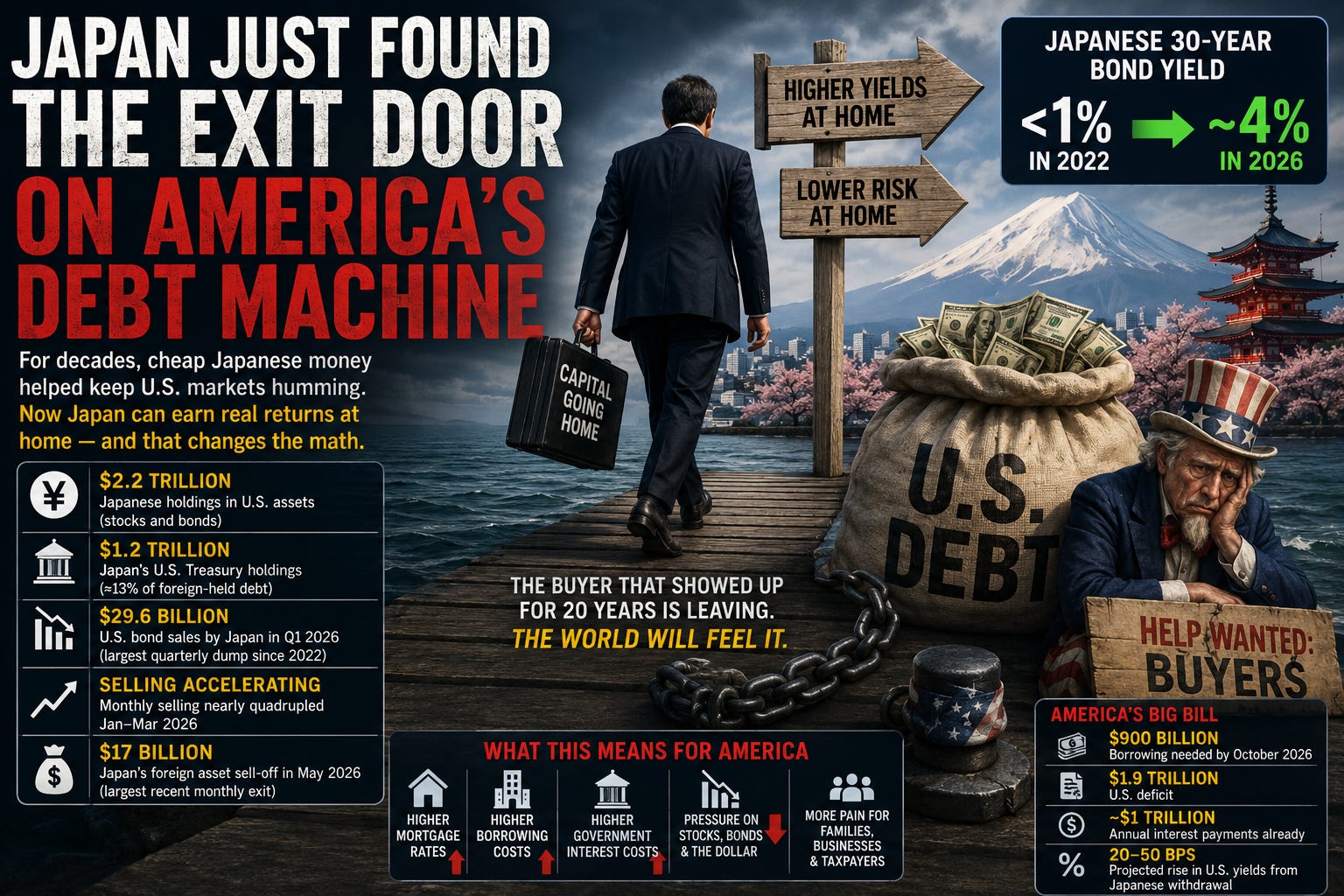
Long-term Japanese yields have climbed hard, with 30-year bonds pushing near 4% after being under 1% back in 2022.
That changes everything.
Because for the first time in a long time, Japanese institutions can stay home and earn a return without taking on U.S. currency risk, political risk, and whatever circus happens next in Washington.
And they’re already moving.
Japanese investors reportedly sold about $29.6 billion in U.S. bonds in the first quarter of 2026… the biggest quarterly dump since 2022.
Selling accelerated through the quarter, with February and March showing heavier exits.
This is not panic.
That’s what makes it more important.
Panic is loud. Panic gets headlines. Panic has flashing screens and sweaty anchors pretending they understand bond markets.
This is quieter.
This is institutional money looking at the math and calmly walking toward the door.
Japan still holds roughly $1.2 trillion in U.S. Treasuries, making it America’s largest foreign creditor. Add stocks and other bonds, and Japanese exposure to U.S. assets runs into the trillions.
So even a partial shift matters.
America needs buyers. Lots of them.
The U.S. Treasury expects to borrow hundreds of billions more in the coming months. The deficit is massive. Interest payments are already chewing through around $1 trillion a year.
That’s before rates rise further.
Here’s the ugly part: when a major buyer steps back, the market does not send a sympathy card.
It demands higher yields.
Higher yields mean higher mortgage rates. Higher corporate borrowing costs. Higher government interest payments. Lower stock valuations. More pressure on taxpayers.
In plain English… the bill gets passed down the line.
To homeowners.
To businesses.
To retirees.
To workers.
To anyone living inside an economy built on cheap credit and official reassurance.
Washington can pretend this is manageable. It may even be manageable for a while.
But the old arrangement is cracking.
The U.S. got used to the world funding its deficits. Japan got used to earning more abroad than at home. Both sides treated that setup like gravity.
It wasn’t gravity.
It was a deal.
And deals change when the numbers change.
Japan is not declaring war on America.
It is not “dumping the dollar” overnight. It is doing something much more dangerous to the old system:
It is acting rationally.
If Japanese bonds pay enough, why keep feeding the U.S. debt machine?
If currency risk eats the return, why bother?
If Washington keeps borrowing like tomorrow got cancelled, why be the quiet foreign buyer standing underneath the piano?
This is the real story.
Not a crash.
Not a conspiracy.
Not a financial apocalypse with theme music.
A repricing.
The slow, grinding kind. The kind that doesn’t arrive as one big bang, but as higher rates, tighter credit, weaker markets, and politicians suddenly discovering “fiscal discipline” five minutes after the barn burns down.
For Canada, this matters too.
When U.S. borrowing costs rise, the shock does not politely stop at the border. Mortgage markets feel it. Currency markets feel it. Trade feels it. Investment decisions feel it.
We live beside the elephant. When it rolls over, we check the foundation.
Japan is quietly reminding the world of something simple:
Foreign capital is not a birthright.
It goes where the return makes sense.
And after decades of helping finance America’s debt habit, Japan may finally have a reason to bring more of its money home.
That is not just a bond market story.
That is a power shift.
A quiet one.
Which usually means the people in charge will notice it right after everyone else has already paid the price.
The Recap…
Japan helped finance America’s debt machine for decades.
Now Japanese rates are rising, domestic bonds look attractive again, and Japanese investors are starting to pull money out of U.S. assets.
This isn’t panic.
It’s worse.
It’s math.
The Gut-Punch…
America didn’t lose Japan because Japan got angry.
America may lose Japan because Japan finally found a better deal.
Source credit:
House of El, Reuters, U.S. Treasury borrowing estimates, Treasury foreign holdings data, Japan bond yield data, and market reports on Japanese investor flows.
🔎 The GeezerWise Standard
This space is built on disciplined thinking.
Facts over spin.
Verification before amplification.
Good-faith discussion over tribal noise.
I use AI tools to help shape my spoken drafts into clear writing.
The judgment, conclusions, and final message are mine.
If you’re new here, this explains how I decide what’s worth sharing:
How I Decide What’s Worth Sharing → [link]
💌 Subscribe at GeezerWise.com to receive future letters:
www.geezerwise.com/subscribe
— Fred Ferguson
GeezerWise
#CanadaStrong
It had to happen sooner or later. The one thing I know for sure is IQ47 is not going to like this birthday present. That is if his sycophant toadies have even told him yet.
As always Fred, it is so easy to read and listen to your posts/articles. There is no word salad. And you address one thing or issue or point, and don’t belabour it with a lot of “stuff.” You have good information and don’t need to “prove” that you’re good and know your “stuff.” Short and to the point. I always appreciate that. Cheers my friend!