

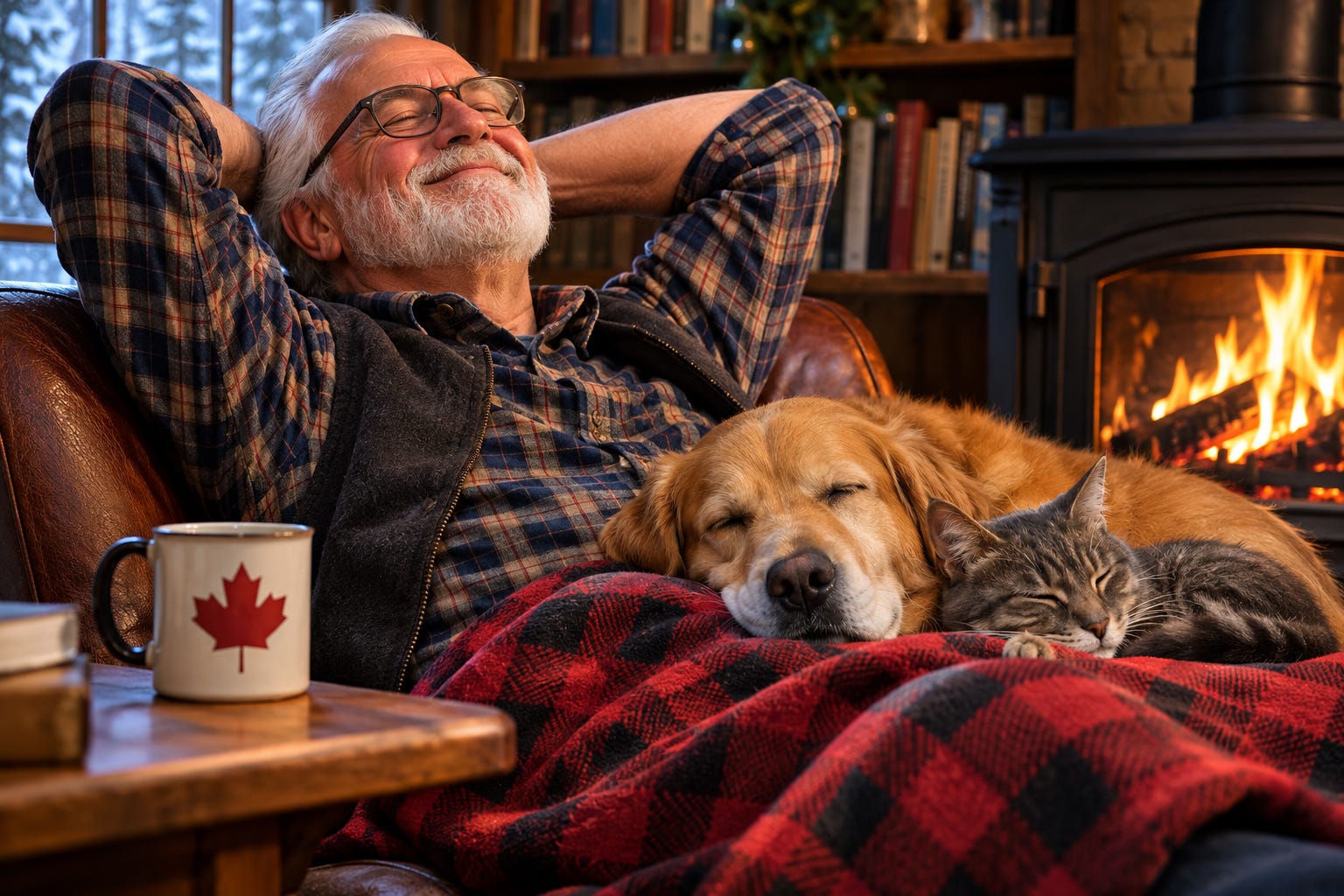
I’ve reached an age where an evening at home sounds a whole lot more appealing than an evening out.
And apparently, that’s something we’re supposed to worry about.
We’re told to get out more. Join something. Meet people. Keep busy. Don’t become one of those old folks who sit around the house.
Well, I’ve got news for you.
(Inspired by this video…)
After spending most of my life working, heading a family, paying bills, meeting obligations, and showing up where I was expected, I’ve discovered something rather wonderful.
I don’t have to go anywhere.
And I don’t feel the slightest bit guilty about it.
Turns out, there’s some interesting psychology behind that feeling.
Maybe we’re not withdrawing. Maybe we’re choosing.
A psychologist at Stanford University named Laura Carstensen has spent decades studying how our priorities change as we get older.
Her research produced something called socioemotional selectivity theory.
That’s a fancy name for something most of us old geezers probably figured out without a university degree.
When we’re young, we tend to believe we’ve got all the time in the world.
We meet people. Make acquaintances. Attend gatherings. Build networks. Say yes to invitations because we never know what opportunities might come along.
Then the years start adding up.
We begin to understand that time isn’t an unlimited resource.
And something changes.
We become more interested in spending time with people who actually matter to us.
Carstensen’s research suggests that older adults often maintain their close relationships while becoming less interested in casual social connections.
Think about that.
Maybe we’re not becoming antisocial.
Maybe we’re just getting better at deciding who deserves an afternoon of our lives.
At 25, I might have gone to a party because everybody else was going.
At 74, I’d rather spend an evening with someone whose company I genuinely enjoy.
And if that someone happens to be me?
Well, I’ve learned to live with the fellow.
There’s something to be said for a quiet house.
Remember when life was one long list of things you had to do?
Get up. Go to work. Deal with people. Solve problems. Come home. Deal with more problems.
Then do it all over again.
For decades.
Retirement changes that arrangement.
For the first time in years, you might actually have control over how you spend a Tuesday afternoon.
Want to read a book?
Read it.
Want to spend three hours tinkering with something on the computer?
Go ahead.
Want to sit with a cup of coffee and watch the world go by?
Nobody’s stopping you.
And here’s something else I’ve noticed.
The world has become awfully noisy.
Everybody wants your attention. Your opinion. Your money. Your password. Your email address.
Even buying groceries can turn into a technological obstacle course.
Do you have the app?
Are you collecting points?
Would you like to donate?
Would you like your receipt emailed?
Good grief. I came in for a loaf of bread.
Sometimes the nicest thing about being home is that nobody’s asking you to make another decision.
Except perhaps what to have for supper.
And I’ve been married long enough to know that can still be a complicated question.
But there’s one important difference.
I don’t want anybody reading this and deciding that shutting themselves away from the world is automatically a good thing.
It isn’t.
There’s a difference between enjoying solitude and suffering from loneliness.
And it’s an important one.
Solitude is when you’re alone because that’s where you want to be.
Loneliness is when you’re missing the human connection you wish you had.
You can feel lonely in a room full of people.
And you can feel perfectly content sitting alone in your favourite chair.
Researchers have studied this distinction extensively.
A major report from the U.S. National Academies of Sciences, Engineering, and Medicine found that social isolation and loneliness are associated with serious health risks.
And here’s a detail worth remembering.
You can be socially isolated without feeling lonely. That doesn’t necessarily mean the isolation is harmless.
So enjoying your own company doesn’t mean you should stop maintaining relationships.
We still need people.
Not necessarily a crowd.
Just people who matter.
Someone to laugh with. Someone who notices when you haven’t called. Someone who can tell you when you’re being a stubborn old fool.
Preferably someone who doesn’t enjoy that last job quite so much.
Maybe getting older means finally knowing what we want.
I think there’s another part of this that doesn’t get enough attention.
For much of our lives, we measure ourselves by what we’re doing.
How busy we are.
How productive we are.
How many people need us.
Then retirement comes along and suddenly we’re supposed to find new ways to stay just as busy.
Why?
Who decided a successful retirement requires a packed calendar?
If somebody wants to travel the world, join five clubs, play pickleball every morning, and spend every evening socializing, good for them.
I hope they enjoy every minute.
But if somebody else wants to garden, read, write, work on a hobby, or simply enjoy the peace of their own home, why should that be considered less fulfilling?
There’s no single correct way to enjoy the years we’ve got left.
And after a lifetime of other people setting our schedules, perhaps we’ve earned the right to set our own.
I still enjoy good company.
I still enjoy a good conversation.
And thanks to the internet, I can have conversations with people across Canada and around the world without putting on a coat or finding my car keys.
That’s not a bad arrangement for an old geezer.
But I’ve also learned that an invitation isn’t an obligation.
Sometimes the answer is simply, “Thanks, but I think I’ll stay home.”
No excuse required.
No elaborate explanation.
Just a perfectly reasonable decision about how I want to spend my time.
And if somebody thinks that means I’m getting old?
Well, they’re about 74 years late with that observation.
The Recap…
Some of us enjoy staying home more as we get older.
Psychology suggests we often become more selective about how we spend our time and who we spend it with.
There’s nothing wrong with enjoying solitude, provided we don’t lose the human connections that matter.
Maybe retirement isn’t about finding more things to do.
Maybe it’s about finally having the freedom to do less.
The Gut-Punch…
I spent most of my life being where I was supposed to be. Now I get to be where I want to be.
And quite often, that’s home.
GeezerWise Says: What about you? Have you found yourself enjoying home more as you’ve gotten older? Or are you one of those people who can’t wait to get out the door every morning?
I’d love to hear how retirement has changed your idea of a good day.
Sources and further reading…
Laura Carstensen, Stanford University… Socioemotional Selectivity Theory
National Academies of Sciences, Engineering, and Medicine… Social Isolation and Loneliness in Older Adults
U.S. Centers for Disease Control and Prevention… Health Effects of Social Isolation and Loneliness
Research inspiration… YouTube transcript, “The Psychology of Retirees Who Love Staying at Home.” Independently researched and parts of my own life written for GeezerWise Says.
If you enjoy thoughtful conversations, Canadian stories, and the occasional smart-ass observation about the world we’re living in, you’re in the right place.
Subscribe free and get new stories, insights, and observations delivered directly to your inbox.
No paywall.
No spam.
No nonsense.
Leave anytime with a single click.
I promise not to take it personally.
Well, everyone I know who have ties to physiotherapy, they all point out the importance of keeping the body moving.
But having said that, I don't think one's whole social life needs to exist the way it used to. Far easier to have a community of friends, family, colleagues, etc., etc. on line these days.
At least, that's what I expect will happen to me more than the in-person (though I'm sure some of us will get together every now and again . . . .)
Sorry, gotta run - I need to brush-up on my "emboldenment." ;-)
And the journey continues. 😊