

For a country dealing with housing costs, food inflation, tariffs, trade wars, and economic uncertainty, you’d think the political conversation would be getting more sophisticated.
Instead, we’re arguing about hamburgers.
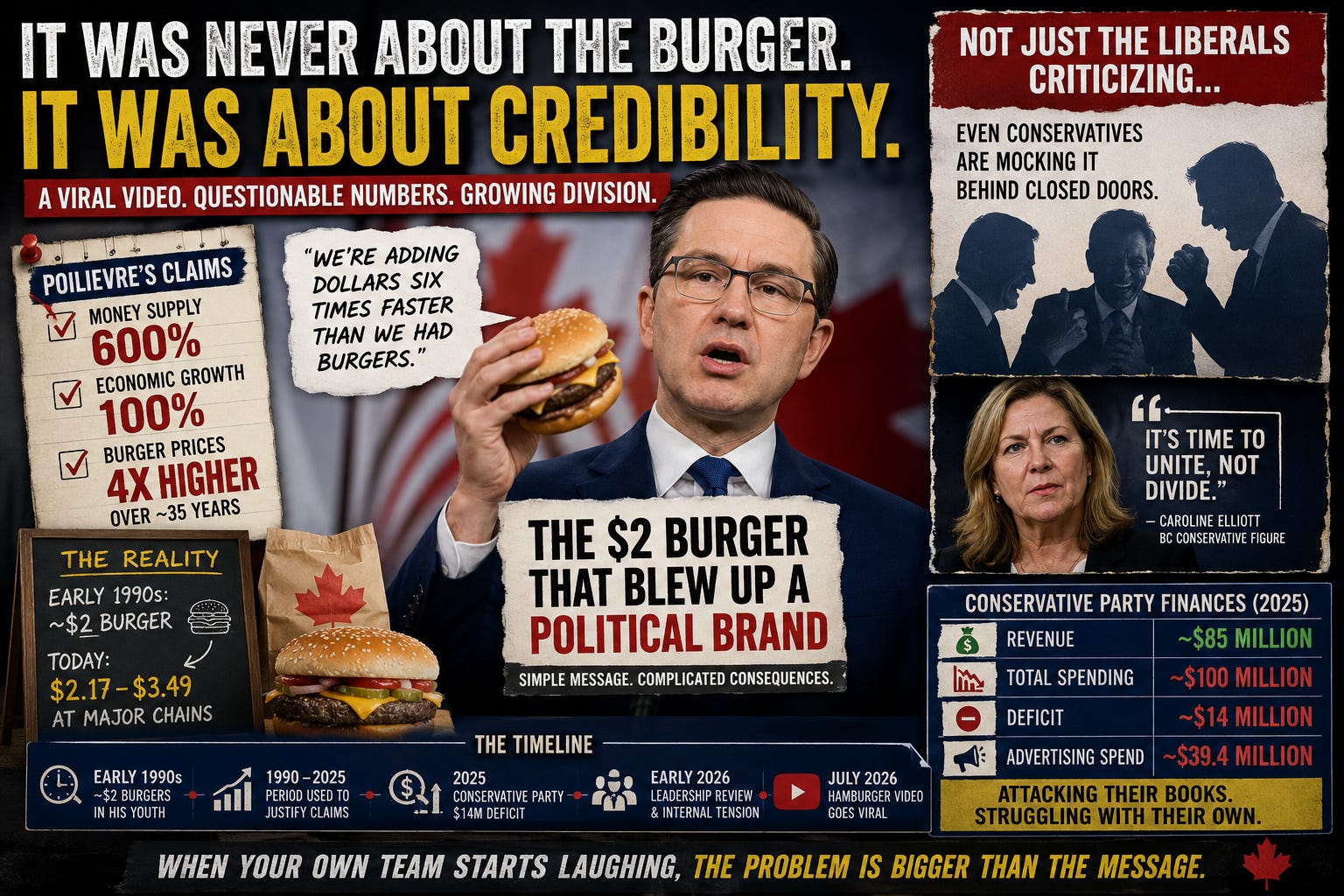
Pierre Poilievre recently released a video using the price of a burger to explain inflation and blame Liberal policies for shrinking Canadians’ purchasing power.
The goal was obvious… take a complicated issue and make it simple enough for anyone standing in line at a drive-thru to understand.
That’s good politics.
The problem is that good politics still has to survive contact with reality.
Poilievre argued that Canada’s money supply grew dramatically over the past few decades while the economy grew far more slowly.
He used that comparison to suggest Canadians have been robbed of their purchasing power and pointed to burger prices as evidence.
The trouble started when people began checking the numbers.
The burger example didn’t hold up particularly well.
Prices have certainly risen over the years… every Canadian knows that… but critics pointed out…
that the increases weren’t anywhere near as dramatic as the video implied.
Some media outlets even managed to confuse his claims while trying to fact-check them, creating a bizarre situation where both supporters and critics ended up spreading different versions of the same argument.
But the real story isn’t whether a burger costs two dollars, three dollars, or four dollars.
The real story is what happened afterward.
Because the backlash didn’t come only from political opponents.
Reports started surfacing that some Conservatives were privately mocking the video themselves.
That’s a much bigger warning sign.
Political leaders can survive criticism from the other side. In fact, many thrive on it. What becomes dangerous is when people inside your own tent start rolling their eyes.
That’s when a messaging problem becomes a leadership problem.
At the same time, Poilievre has increasingly directed criticism not only toward Liberals but toward people within the broader conservative movement.
That shift has not gone unnoticed.
When political allies begin publicly calling for unity rather than escalation, they’re sending a message without necessarily saying it outright.
The message is simple…
Slow down.
We’re starting to look divided.
For a party trying to present itself as a government-in-waiting, public infighting is rarely a good look.
Then there’s the money.
The Conservative Party remains one of the strongest fundraising machines in Canadian politics.
In 2025 it reportedly brought in roughly $85 million in revenue.
Impressive.
But it also reportedly spent close to $100 million and finished the year with a significant deficit.
Advertising alone accounted for nearly $40 million.
That creates an awkward contradiction.
You can spend every day attacking government spending, but voters will eventually notice if your own organization struggles to balance its books.
Fair or unfair, credibility works that way.
People judge whether leaders practice what they preach.
The broader danger here is something we’re seeing across Western democracies.
Complex problems are increasingly being reduced to social-media-sized explanations.
Housing becomes a slogan.
Inflation becomes a burger.
Trade becomes a meme.
Government debt becomes a thirty-second video.
The audience gets something easy to understand, but usually loses most of the important details along the way.
Real inflation isn’t caused by one thing.
It’s affected by government spending, interest rates, global supply chains, energy prices, labour shortages, wars, demographics, consumer demand, corporate pricing decisions, and central bank policy.
That’s not a great TikTok.
But it’s reality.
And reality tends to be stubborn.
What makes this episode interesting isn’t that Poilievre made an oversimplified argument. Every politician does that.
What makes it interesting is that the reaction revealed growing tension inside his own political coalition.
That’s harder to dismiss.
The burger video may be forgotten in a month.
The questions it raised won’t be.
Can Poilievre unite his party?
Can he move beyond grievance politics and present a governing vision?
Can he persuade Canadians he’s offering solutions instead of slogans?
Those are leadership questions.
And unlike hamburgers, they’re not measured at the drive-thru.
The Recap…
A burger was supposed to explain inflation.
Instead, it started a debate about credibility, leadership, and growing divisions inside Canada’s Conservative movement.
When your opponents laugh, that’s politics.
When your own side starts laughing, that’s something else.
The Gut-Punch…
A politician can survive a bad video.
What they can’t survive for long is when their own team stops believing the story they’re trying to sell.
Source credit:
Research compiled from public reporting, political commentary, party financial disclosures, and analysis of recent statements and reactions surrounding Pierre Poilievre’s July 2026 inflation messaging campaign.
If you enjoy thoughtful conversations, Canadian stories, and the occasional smart-ass observation about the world we’re living in, you’re in the right place.
Subscribe free and get new stories, insights, and observations delivered directly to your inbox.
No paywall.
No spam.
No nonsense.
Leave anytime with a single click.
I promise not to take it personally.
Can Poilievre unite his party?
Can he move beyond grievance politics and present a governing vision?
Can he persuade Canadians he’s offering solutions instead of slogans?
Simple answer based on 20 years of observation? NOT A HOPE IN HELL!
He is nothing more than someone who suffers from arrested mental development and still has the mental maturity of a 14 year old!
Hilarious!
What might have given him the inspiration for this, is The Economist magazine (based out of Europe). Every year, they do a "Big Mac Index" - comparing and ranking the world's major economies based upon the relative pricing of a McDonald's Big Mac -- using it as a simple means of expressing pricing parity -- they convert the local currency's price of a Big Mac to US$, then compare that value to the US price of a Big Mac. If your country's US$-equivalent hamburger costs more than the US burger, your currency is overvalued (and by extension, supposedly, everything is "inflated" in relative cost)
If your Big Mac is cheaper (Canada's is about 9% cheaper than a US Big Mac right now), then presumably your country's currency is undervalued.
This is too simplistic -- a Canadian Mac might be cheaper right now because BEEF is cheaper here (comparatively), due to issues happening in the US supply chain and herd health risk (screwworms).
This started off as a joke -- But it's one of their most popular articles.
Anyway, someone might have shown the article to PP (Harper? He probably has a subscription . . . .) and that inspired the story. But that's also why it falls apart -- the price of the burger doesn't properly capture all of the supply chain issues, general inflation issues, and numerous other things. Harper probably tried to explain it to him, but PP (who, is smarter than everyone else, right?) said "naw, let's just go with how more expensive a burger is now than x years ago (just make sure it only covers the Trudeau era, not earlier! ;-) ).
But I mention this in support of what Fred said: a burger might cost more now, but if ours is CHEAPER than USA . . . well, doesn't that imply that we're doing something right?? And of course, that's NOT what he wants to portray.