

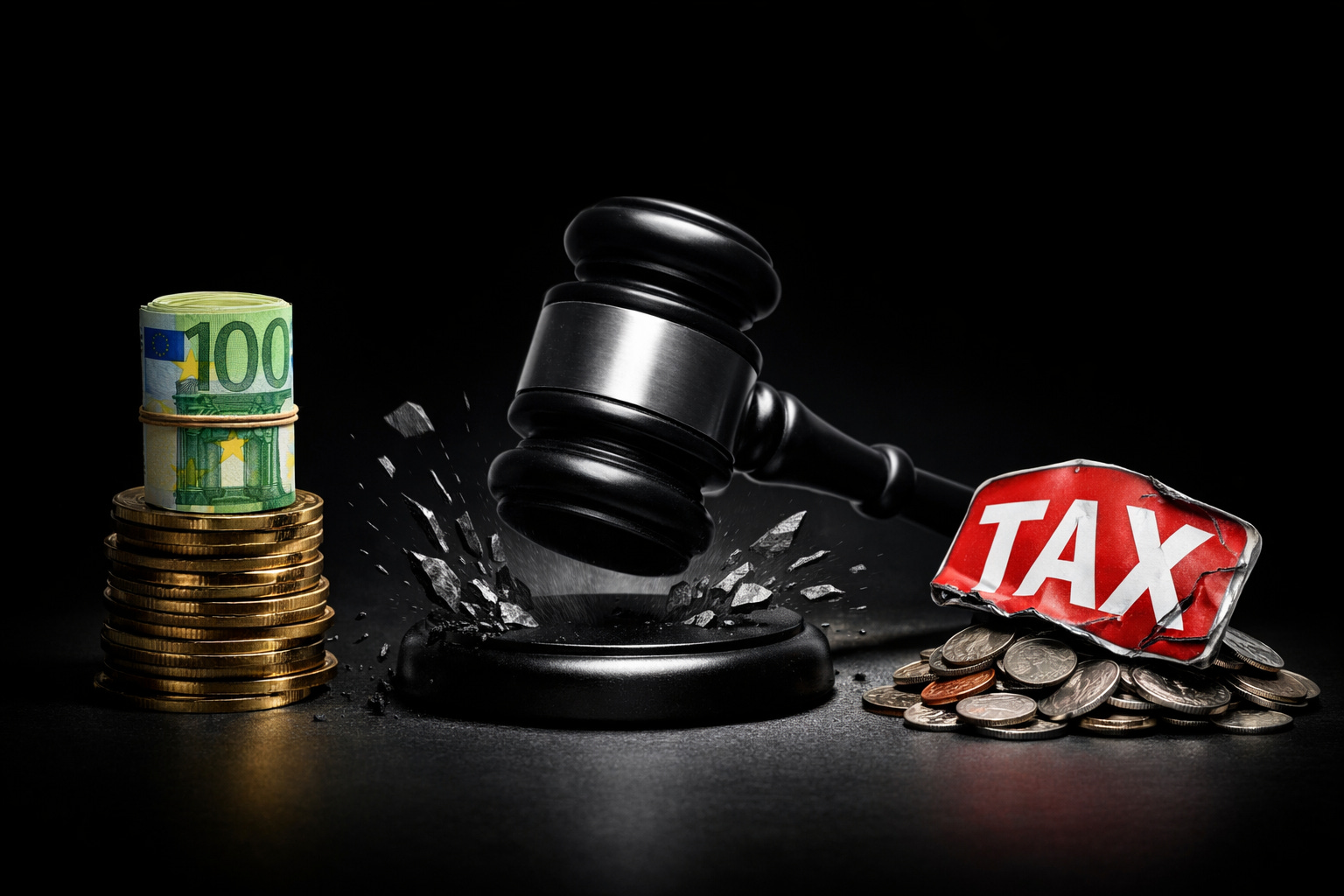
Let’s strip this down to brass tacks.
The U.S. Supreme Court ruled on February 20, 2026 that sweeping Trump-era tariffs were illegal.
By mid-December 2025, Washington had already collected more than $130 billion from those tariffs.
Total refunds could climb as high as $175 billion, according to budget model estimates.
That money is now being sent back.
The U.S. Court of Appeals for the Federal Circuit just rejected a 90-day delay request from the Justice Department.
The case goes back to the U.S. Court of International Trade. Refund processing begins.
Over 900 refund claims have already been filed. Companies include FedEx, Costco, Revlon… plus a long list of European and Canadian firms.
They’ll get their money back.
With interest.
Now here’s the part nobody wants to say out loud.
Tariffs are paid at the border by importers. But businesses don’t absorb big costs out of charity. They pass them on. Higher shelf prices. Higher equipment costs. Higher everything.
American consumers paid those tariffs through inflation.
The harm already happened.
There is no mechanism to refund the family that paid more for appliances, groceries, building materials or cosmetics. The refund goes to the corporation that wrote the cheque at customs — not to the household that paid at checkout.
So corporations get made whole.
Consumers don’t.
And it gets better. Or worse.
If up to $175 billion has to be refunded, that’s not pocket change sitting in a vault somewhere.
That’s a Treasury problem. Governments solve Treasury problems one way…
They raise revenue.
After the original tariffs were struck down, a new 10% import duty was imposed under a different legal authority. There’s talk of increasing it to 15%.
So let’s recap…
Round one:
Illegal tariffs imposed.
Corporations pay.
Consumers pay higher prices.
Round two:
Court says refund the corporations.
Treasury needs cash.
New tariffs imposed.
Consumers pay higher prices again.
Same people. Twice.
This is what economists call concentrated benefits and diffused costs. The refund is large, visible, enforceable. The consumer loss is spread thinly across millions of people, legally unrecoverable.
Corporate balance sheets get repaired.
Household purchasing power does not.
And here’s the geopolitical kicker.
If you’re a European or Canadian exporter, what did you just learn?
You learned U.S. trade policy can swing wildly, get overturned in court, and take years to unwind. You learned that accessing the American market now comes with litigation risk.
That encourages diversification.
Canada recently signed a $70 billion trade deal with India. Europe continues building independent trade and digital infrastructure. None of this happens in a vacuum.
When a major market becomes legally unstable, partners hedge.
All of this is unfolding while American consumers are already dealing with recession risks, stagnant real wages, and oil price spikes tied to geopolitical tensions.
Inflation hits.
Refunds go out.
New tariffs land.
Lather. Rinse. Repeat.
Policy failure doesn’t just cost money. It costs credibility.
And credibility, once dented, doesn’t bounce back easily.
The big winners? Corporations that get refunds with interest.
The big losers? The people who paid at the register and have no legal claim.
That’s not ideology.
That’s arithmetic.
The Recap…
Illegal tariffs collected over $130B.
Courts now say refund up to $175B — with interest.
Corporations get paid back.
Consumers get higher prices.
And new tariffs may be coming.
The bill always finds a home.
The Gut-Punch…
Consumers paid for an illegal policy — and they’re about to pay again to unwind it.
The Source:
U.S. Supreme Court ruling (Feb 20, 2026), U.S. Court of Appeals for the Federal Circuit decision, federal refund filings, and public budget model estimates.
🔎 The GeezerWise Standard
This space is built on disciplined thinking.
Facts over spin.
Verification before amplification.
Good-faith discussion over tribal noise.
I use AI tools to help shape my spoken drafts into clear writing.
The judgment, conclusions, and final message are mine.
If you’re new here, this explains how I decide what’s worth sharing:
How I Decide What’s Worth Sharing → [link]
💌 Subscribe at GeezerWise.com to receive future letters:
www.geezerwise.com/subscribe
— Fred Ferguson
GeezerWise
#CanadaStrong
Let's follow the money. US company ABC paid $10 in tariffs to bring in a product. US consumer paid ABC $8 more to buy the product (benefit of the doubt, for appearances ABC might have 'eaten' some of the cost delta). ABC didn't suffer (much), the consumer did though. Now, ABC gets the $8 back, with interest - but can't give it back to the consumer - where did they go?
So, ABC makes $8 unearned money in payback at the end of the day(wanna bet there will be taxes on it? Doubt it, because it's just 'recovered', not new income...), which helps their bottom line, which ultimately boosts, you guessed it, either the owner's income, or the stock market, because I doubt they'll convert it into better conditions for their wage slaves; this is America. After all, the griftocracy 'earned' that money, not the slaves.
So, with the paybacks, one cycle is complete. The new 10/15% game begins it again; in due time, the courts will reverse the flow again, and ABC will cash in again. The tariffs are more universal, simply because every company wants in on the game now. ChaChing, ChaChing, ChaChing. The goose (taxpayer) just keeps layin' those golden eggs.
The grift just keeps getting griftier; the poor Joe on the street, who can either have healthcare, or a home, but not both, just gets poorer; soon, he'll have neither. Add to that, they've dumbed the education system down so far, he can't even tell he's getting the shaft anymore, and his favorite news channel can't or won't explain it to him, because... the grifters own it.
Eventually, company ABC will pledge $$$ to help the Orange Grifter, or some new trained monkey, get elected, because, well, why not? It's the American Dream! "Money for nuthin", indeed. What a lovely shell game. PT Barnum is green with envy.
The Assatollah is doing everything he can to make America a third-world country.