

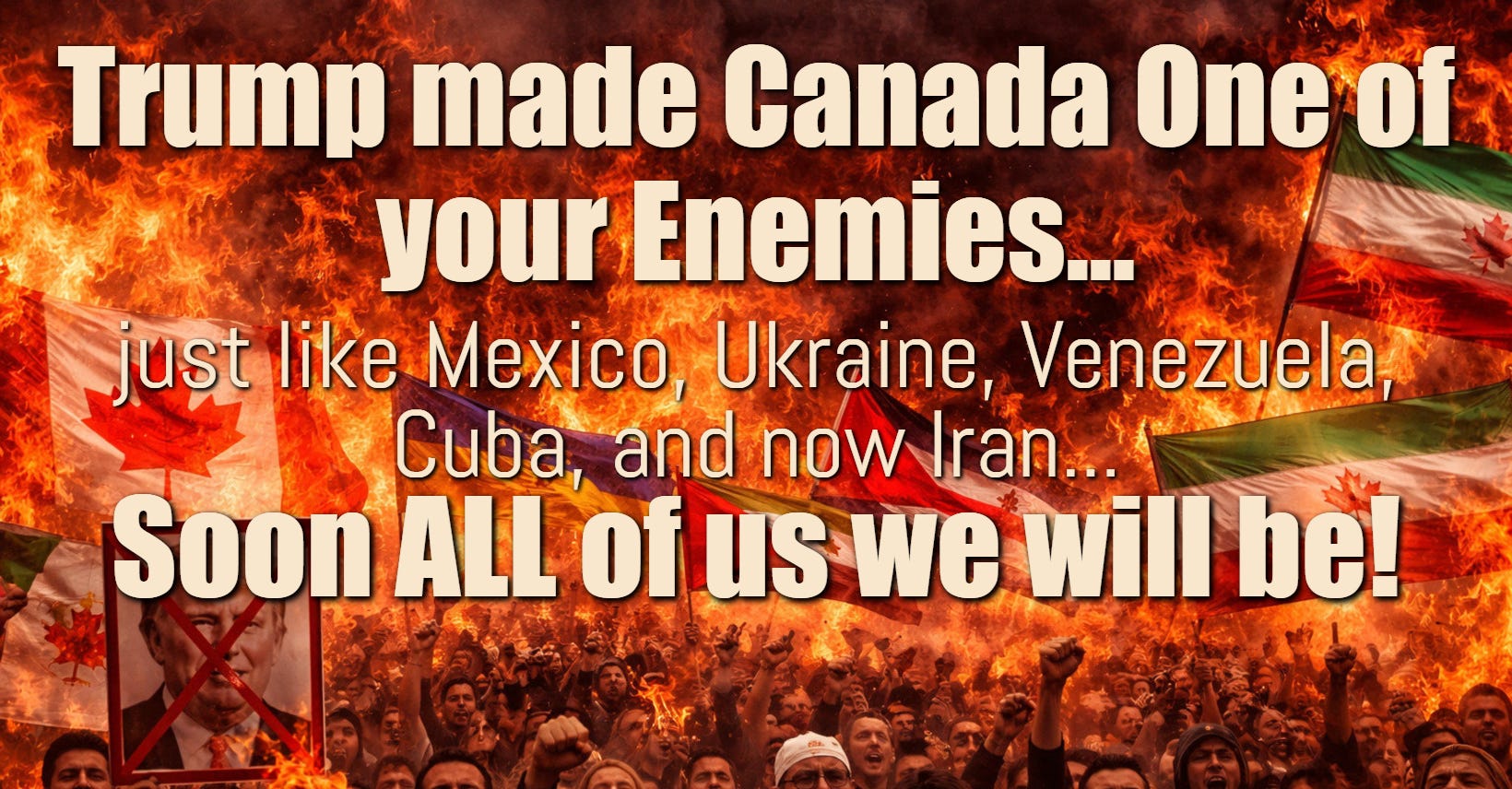
Let me give you a number that should make every Canadian sit up a little straighter.
About 1 in 5 Americans now view Canada unfavorably.
Not China.
Not Russia.
Canada.
That didn’t happen by accident.
For decades, Canada sat comfortably near the top of America’s “liked countries” list.
Same with the UK. Familiar, friendly, predictable. The kind of neighbours you don’t lock your door against.
Then the numbers shifted.
Recent polling shows Canada’s favourability in the U.S. has dropped to just under 80%, and the UK sits even lower around 76%.
Still decent on the surface… until you look under the hood.
That’s where things get interesting.
This Isn’t a Country Divide… It’s a Political One
When you break it down, you’re not looking at “Americans vs Canada.”
You’re looking at two completely different Americas.
Democrats: ~95% favourable toward Canada
Republicans: ~62% favourable
That’s not a gap.
That’s a canyon.
Same story with the UK.
So what changed?
Not geography.
Not trade.
Not culture.
Narrative.
The Power of Repetition (Even When It’s Wrong)
If you repeat something long enough…
“Canada is ripping us off”
“They’re getting a free ride”
“They should be the 51st state”
eventually, people stop questioning it.
They absorb it.
And once that happens, reality becomes optional.
We’ve seen this movie before. It’s not about facts… it’s about framing.
Paint your neighbour as a freeloader long enough, and suddenly decades of cooperation look like exploitation.
Here’s the Part Nobody Wants to Say Out Loud
This isn’t really about Canada.
Canada just happens to be collateral damage in a domestic political war.
Look at the broader pattern…
Huge opinion gaps on Mexico, Ukraine, Cuba, Canada
Independents drifting in the same negative direction
Fewer countries viewed positively overall
That’s not foreign policy.
That’s internal division spilling outward.
And Then Comes the Blowback
You can’t spend years telling people the rest of the world is “nasty,” “cheating,” or “lesser”… and then act surprised when that energy comes back at you.
There was a story floating around about an American traveler shocked to get pushback overseas.
That’s not culture shock.
That’s echo shock.
You exported the message.
Now you’re hearing it reflected back.
Let’s Get Something Straight (Because This Matters)
Most Canadians don’t hate Americans.
We never have.
If anything, we’ve spent decades being the polite neighbour… sometimes to a fault.
But we’re not blind either.
We can see the difference between…
Americans who still believe in cooperation
And those being fed a steady diet of grievance and blame
Those are not the same group.
And pretending they are?
That’s how you misread the moment.
The Real Risk Isn’t the 20%
It’s the trend.
Because once perception shifts, policy follows.
And once policy shifts, relationships change.
What used to be automatic trust becomes… conditional.
What used to be “of course we’ll work together” becomes
“Let’s wait and see.”
That’s a dangerous downgrade between neighbours who share the longest undefended border on Earth.
The Bigger Question
Could one person really influence tens of millions of people to rethink allies this quickly?
A decade ago, that would’ve sounded ridiculous.
Today?
We’re watching it happen in real time.
And here’s the kicker…
It didn’t require evidence.
It didn’t require policy change.
Just a microphone…
and a message repeated often enough.
The Recap…
20% of Americans now view Canada unfavorably.
That didn’t come from trade deals or policy shifts.
It came from something far more powerful… narrative.
This isn’t about countries.
It’s about what happens when politics rewires perception.
The Gut Punch…
“When you train people to see enemies everywhere, eventually they start seeing them next door.”
Source Credit:
Source: Analysis of recent Gallup polling trends and political breakdowns
🔎 The GeezerWise Standard
This space is built on disciplined thinking.
Facts over spin.
Verification before amplification.
Good-faith discussion over tribal noise.
I use AI tools to help shape my spoken drafts into clear writing.
The judgment, conclusions, and final message are mine.
If you’re new here, this explains how I decide what’s worth sharing:
How I Decide What’s Worth Sharing → [link]
💌 Subscribe at GeezerWise.com to receive future letters:
www.geezerwise.com/subscribe
— Fred Ferguson
GeezerWise
#CanadaStrong
You’re pointing at something real — but I’d frame it slightly differently.
It’s rarely “one man” who turns a country against itself.
What happens instead is that one figure exposes and accelerates divisions that were already there.
The U.S. didn’t suddenly become polarized.
It had:
long-standing institutional mistrust
media fragmentation
economic divergence between regions and classes
and a political culture increasingly built on identity rather than compromise
A strong political figure doesn’t create that from scratch —
but he can weaponize it, simplify it, and make it visible.
That’s the key shift.
What used to be underlying tension becomes daily political reality.
And once that happens, the system starts feeding itself:
outrage drives attention
attention drives media incentives
media incentives deepen division
So the question isn’t really who caused it —
but why the system was so ready for it.
That’s the more uncomfortable — and more important — answer.
“As of early 2026, roughly 63% to 64% of Canadians hold an unfavourable view of the United States, with some data suggesting up to 69% feel the U.S. is a "potential threat" or requires a cautious approach. This historically high level of negativity is driven by trade disputes, with 55% of Canadians in recent polling identifying the U.S. as a top threat to their national security, even surpassing Russia and China.”
Pew Research Center