

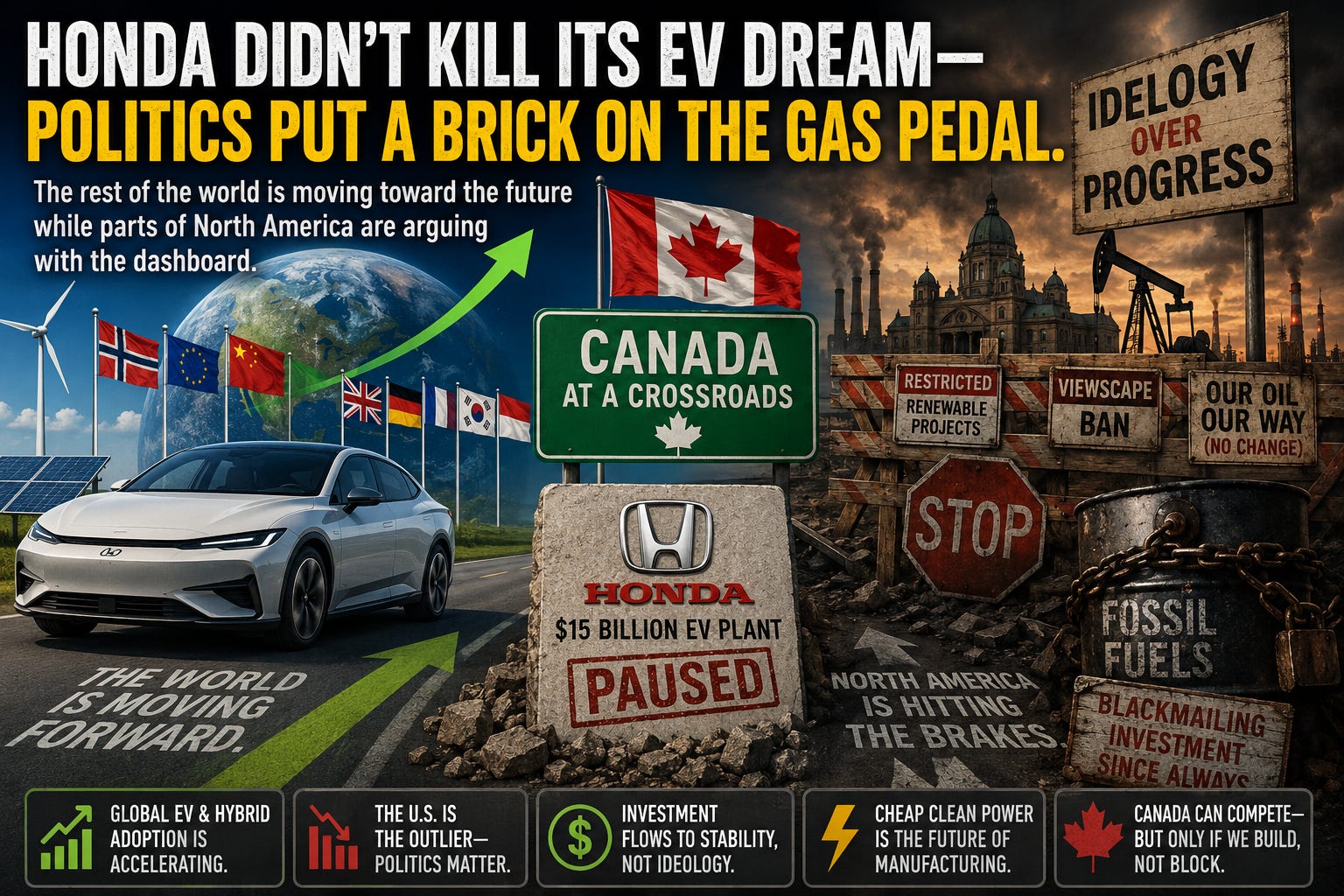
Canada just got another reminder that ideology can be expensive.
Honda has paused its massive $15 billion EV expansion project in Ontario. Predictably, the usual crowd immediately started cheering like they’d just won an argument from 2019.
“See? Nobody wants EVs.”
Except that’s not what the numbers say.
Honda isn’t shutting down existing Canadian plants. They aren’t fleeing Canada. They aren’t firing everybody and running to Texas with a convoy of pickup trucks.
What changed is the market around them.
And more specifically, the political climate around the market.
Across most of the world, electric vehicles and hybrid adoption keeps climbing. Norway is essentially all-electric now for new car sales.
China… the biggest auto market on Earth… has been rapidly shifting toward EVs and hybrids.
Europe keeps moving in the same direction. Even countries people never talk about in these debates are making the transition.
The outlier?
The United States.
And that matters because Canada’s auto industry is welded directly onto the American market whether we like it or not.
Here’s the part nobody wants to say out loud…
This isn’t just consumer preference anymore.
This is political identity.
In parts of North America, driving a giant gas-burning truck has somehow become a cultural loyalty oath.
Renewable energy gets treated like a personal insult. Wind turbines offend people more than billion-dollar oil subsidies.
That’s not economics.
That’s ideology wearing a hardhat.
Meanwhile, governments aligned with fossil-fuel politics keep actively kneecapping renewable development while pretending the slowdown proves renewables “failed.”
That’s like smashing your own furnace with a sledgehammer and then declaring heating technology unreliable.
Alberta is the clearest example.
Not long ago, Alberta was attracting serious renewable investment.
Then came restrictions, delays, “viewscape” rules, approval barriers, and political hostility toward wind and solar projects. Investment reportedly cratered.
Corporate renewable investment in Alberta reportedly dropped by 99% after policy changes scared capital away.
Capital hates uncertainty.
And investors especially hate governments that treat emerging industries like enemies.
At the exact same time, Alberta households continue dealing with some of the highest electricity costs in Canada while still relying heavily on natural gas generation.
That creates a nasty long-term problem nobody in the bumper-sticker crowd wants to discuss:
Manufacturing goes where energy is stable, scalable, and affordable.
Not where politicians hold press conferences beside pipelines.
If Canada wants to protect and grow its manufacturing sector over the next 20 years, cheap clean electricity isn’t some “woke fantasy.”
It’s industrial strategy.
Hydro in Quebec and BC.
Nuclear in Ontario.
Wind and solar potential in Alberta and Saskatchewan.
An interconnected grid.
Domestic battery supply chains.
Modern transportation infrastructure.
That’s how countries future-proof themselves.
The irony is almost painful.
Conservative politicians often scream about government getting “out of the way”… unless the project involves renewables.
Then suddenly there are bans, restrictions, political interference, and culture-war speeches about pickup trucks.
Meanwhile China is quietly building the industrial base of the next generation.
They’re not arguing online about whether EVs are masculine enough.
They’re building.
And here’s the real kicker…
The global shift away from fossil-fuel dependence isn’t just environmental anymore.
It’s geopolitical.
Every oil shock, every Middle East conflict, every shipping disruption, every price spike at the pump reminds countries how vulnerable petroleum dependence really is.
The smarter economies aren’t reacting by tattooing “I ❤️ Oil” onto their foreheads.
They’re reducing exposure.
Electrification isn’t about virtue signalling.
It’s about insulation.
If your transportation system depends entirely on volatile oil markets controlled by geopolitical chaos, your economy becomes hostage to every crisis on the planet.
Canada actually has the resources to avoid that trap.
But only if we stop fighting the future long enough to build it.
Honda’s pause should not be read as “EVs failed.”
It should be read as a warning about what happens when political narratives distort markets, delay infrastructure, and create uncertainty around long-term investment.
The rest of the world isn’t slowing down.
They’re just driving around North America while we argue in the parking lot.
The Recap…
Honda didn’t abandon Canada.
It paused a massive EV expansion because the North American market… especially the U.S…. is becoming politically hostile to the very technology the rest of the world is embracing.
Meanwhile, countries everywhere are accelerating toward electrification while parts of North America are still trying to restart the carburetor.
This isn’t just about cars anymore.
It’s about whether Canada plans to compete in the next economy… or nostalgically cosplay the last one.
The Gut-Punch…
You can’t attract tomorrow’s industries while politically declaring war on tomorrow’s technology.
At some point, reality sends the invoice.
And the countries still arguing with progress usually end up paying the highest price.
Source credit:
Research and reporting inspired by economic commentary and public reporting discussed in the supplied transcript.
🔎 The GeezerWise Standard
This space is built on disciplined thinking.
Facts over spin.
Verification before amplification.
Good-faith discussion over tribal noise.
I use AI tools to help shape my spoken drafts into clear writing.
The judgment, conclusions, and final message are mine.
If you’re new here, this explains how I decide what’s worth sharing:
How I Decide What’s Worth Sharing → [link]
💌 Subscribe at GeezerWise.com to receive future letters:
www.geezerwise.com/subscribe
— Fred Ferguson
GeezerWise
#CanadaStrong
EV's are the future. The existing oil war is breaking barriers and the world is starting to move at speed to renewable energy solutions. Canada needs a champion which I expected would be a subset of his infrastructure projects. A robust EV infrastructure build out and made in Canada EV's are still missing links. I likely will take a long hard look at the entry level Chinese EV's when they become available. The Honda situation is mired in the uncertainty of the Trump 232 tariffs. They counted on exporting 90% of their production to the US and that possibility died with the instability the tariffs presented. So the old model isn't working and as long as America decends further into an autocracy controlled by oligarchs the stability that previous agreements provided may be lost for a long time. That does not mean there wont be a reinvention. It will happen in tandem with upgraded ports, pipelines, new submarines and military equipment (Korea), fighter jets and surveillance aircraft (Saab) electrical system upgrades, expanded LNG export capacity (several partners), a myriad of rare earth projects, and exploding AI everywhere, however it will need a champion to see a path to investment in our new reality. That piece wont be figured out while there is hope that Cusma can be renewed. If its not renewed then new deal type investments may be the path forward to Canada's auto industry. There are ways but baby and bathwater issues prevent clarity. I believe it won't be long though and in 3 or 4 years EV's will be a large share of the Canadian auto market.
Most of the U.S. infrastructure was built pre-WWII. (Yes Interstates are mostly post WWII but the routes are almost the same as the highways that preceded them.)
I think most people forget how little has changed in the U.S. since that war. The main highways (now Interstates) go past most small towns without an exit to let travelers know there’s a town near by. About all that has changed is most of the train tracks that moved people and materials for the war effort have been torn up. Not replaced and upgraded like in Europe and elsewhere. Interstate highways are in need of constant repair these days because of the heavy trucks that need to be on the Interstate because there is no other way to deliver the good to the small towns (or even some cities). Because no one had the forethought to see how much those tracks could save in wear and tear on the roads and efficiency of scale the railroads provided.
EV’s are a great idea if you live (a) in a city, (b) have your own charging station and don’t travel beyond your local area, or (c) carry a gas generator to recharge as needed for those long stretches with no population centers large enough for a public charging station. (Although I have seen gas stations that have added EV charging stations.)
Here’s hoping we can survive this administration and start being better neighbors again.