

You know the economy is in a weird place when good news causes a panic attack.
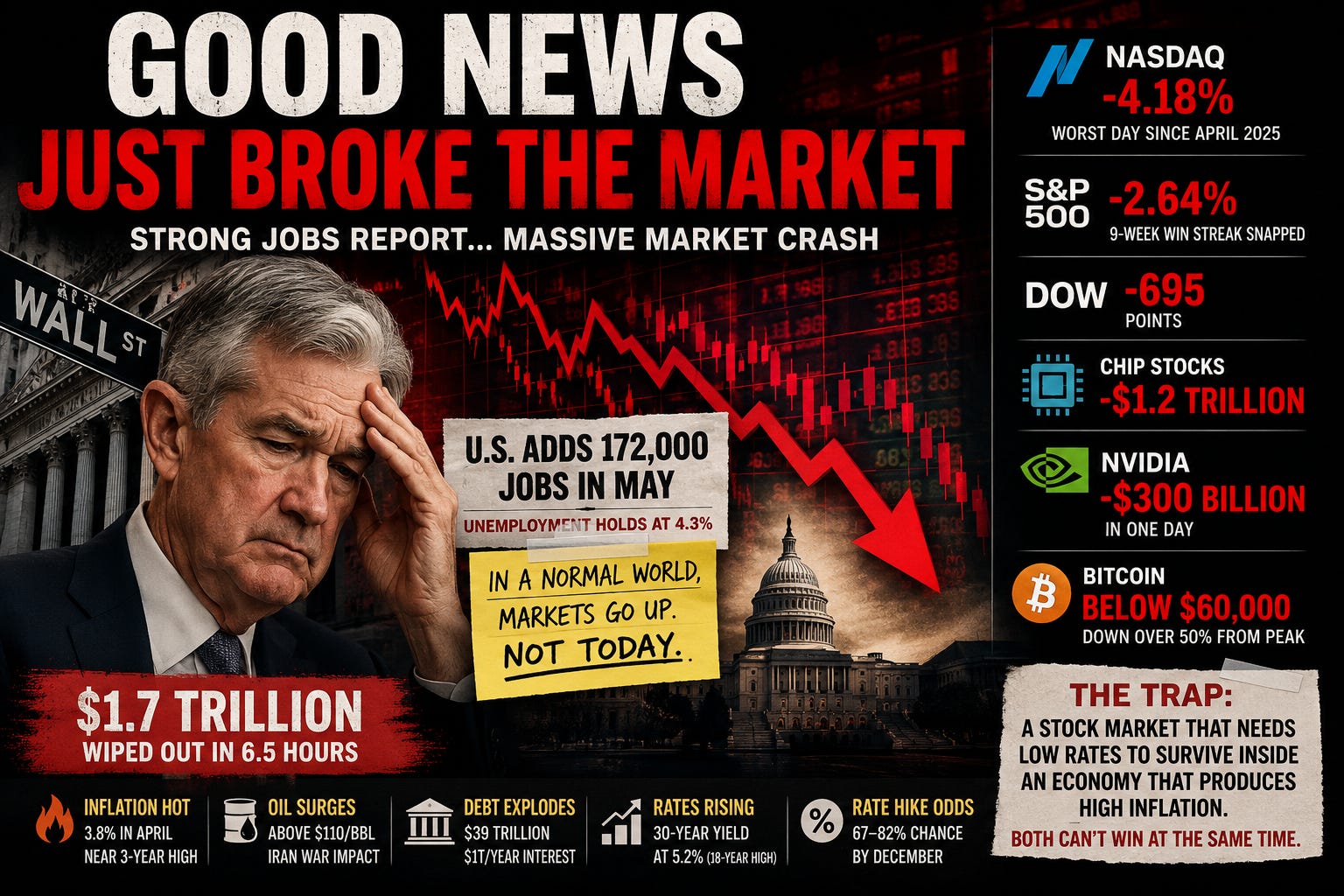
On Friday, the United States added 172,000 jobs in May… more than double what economists expected. Unemployment held steady at 4.3%. Earlier job numbers were revised upward too.
In a normal economy?
That would be the kind of report politicians brag about and stock markets celebrate.
Instead?
Wall Street got hit with a shovel.
The NASDAQ dropped over 4%, its worst day in more than a year. The S&P 500 snapped a nine-week winning streak. The Dow lost nearly 700 points.
And the biggest names in tech… the companies everyone has been treating like unstoppable money machines… suddenly looked very mortal.
Chip stocks lost over $1.2 trillion in value in one trading session. Nvidia alone lost roughly $300 billion.
Let that sink in.
That’s not a typo.
That’s one company losing enough value in a single day to buy entire countries.
So what happened?
Simple.
The market got the exact thing it didn’t want…
Proof the economy is still too strong.
Welcome to the Economic Twilight Zone
For decades, strong job growth meant optimism.
People working = people spending = companies growing.
That was the formula.
But Wall Street has changed.
Today’s market isn’t reacting to the economy.
It’s reacting to interest rates.
And that changes everything.
The problem is this:
A strong labour market usually keeps inflation alive.
Inflation staying high means the Federal Reserve can’t lower interest rates.
And low interest rates have been the financial oxygen keeping this whole market inflated since 2020.
Cheap money built the boom.
Cheap borrowing helped fuel tech stocks, crypto speculation, housing inflation, and the AI gold rush.
Take away cheap money?
Suddenly everybody starts checking whether the emperor’s suit actually exists.
The AI Party Has a Very Expensive Bar Tab
For the past two years, investors have been throwing money at anything remotely connected to artificial intelligence.
Why?
Because the story sounded irresistible.
“AI will change everything.”
Maybe it will.
But here’s the uncomfortable part nobody likes talking about:
AI runs on borrowed money.
Massive data centres.
Semiconductor manufacturing.
Infrastructure.
Electricity demands.
Server farms.
This stuff costs fortunes.
And fortunes usually get financed through debt.
When interest rates are low, companies borrow cheaply and nobody worries much.
When borrowing gets expensive?
Suddenly the math gets ugly.
Fast.
Markets were expecting rate cuts this year.
Now investors are increasingly betting the opposite:
Rate hikes.
That’s a full reversal in narrative.
And markets hate narrative changes almost as much as they hate reality.
The Bigger Problem Nobody Wants to Talk About
Here’s where things get messier.
The U.S. government already sits on roughly $39 trillion in national debt.
Interest payments alone are approaching $1 trillion a year.
That’s money being spent just servicing debt.
Not roads.
Not healthcare.
Not schools.
Just interest.
Now add higher borrowing costs to that equation.
You can see why policymakers are trapped.
If the Fed lowers rates too soon?
Inflation could flare up again.
If the Fed keeps rates high… or raises them?
Markets wobble harder, borrowing gets more painful, and government debt becomes even more expensive to carry.
That’s not a menu full of good options.
That’s choosing which wall to crash into.
Oil Is Making Everything Worse
As if inflation wasn’t sticky enough already, oil prices have surged above $110 a barrel thanks to geopolitical tensions.
Higher oil prices bleed into everything:
Shipping.
Food.
Manufacturing.
Travel.
Groceries.
You don’t need an economics degree to notice this stuff.
You feel it every time you tap your debit card.
That’s one reason inflation climbed back toward 3.8%, near a three-year high.
And if inflation stays hot?
The Fed’s hands stay tied.
The Real Story Isn’t the Crash
Here’s the part I think matters most.
Friday wasn’t really about stocks.
It was about something deeper.
It exposed the growing disconnect between Wall Street and ordinary people.
For years, stock markets soared while consumer confidence sank.
People felt poorer.
Housing got ridiculous.
Groceries exploded.
Debt piled up.
Yet markets kept partying.
Why?
Because investors believed cheap money would never end.
Friday was the first serious reminder that maybe the party comes with a bill after all.
And when markets become dependent on low interest rates just to survive…
That’s not strength.
That’s dependency.
So What Happens Next?
Nobody knows.
Anybody pretending certainty is selling something.
But here’s what markets are watching now:
Inflation numbers in mid-June
The next Federal Reserve meeting
Oil prices
Whether the AI spending frenzy slows down
And whether investors finally start questioning sky-high valuations
Because here’s the contradiction sitting at the centre of all this:
The economy is strong enough to keep inflation high… but markets need weakness to justify lower rates.
And both things can’t win at the same time.
Friday was the day investors remembered that.
The bigger question now?
Was this just a bad day…
Or the first crack in something much larger?
The Recap…
America added 172,000 jobs.
Unemployment stayed low.
In a normal world?
That should’ve sent markets higher.
Instead, Wall Street lost $1.7 trillion in a single day.
Why? Because strong jobs mean inflation stays hot… and hot inflation means interest rates may stay painful.
Translation:
The market suddenly realized the cheap-money party might actually be over.
The Gut-Punch…
When a country gets strong economic news and investors panic instead of celebrate, you’re not looking at a healthy system anymore.
You’re looking at a system addicted to cheap money… and suddenly wondering what withdrawal feels like.
Source Credit:
This article was inspired by economic reporting and analysis from House of El, multiple financial commentators, including publicly available market data and research material.
🔎 The GeezerWise Standard
This space is built on disciplined thinking.
Facts over spin.
Verification before amplification.
Good-faith discussion over tribal noise.
I use AI tools to help shape my spoken drafts into clear writing.
The judgment, conclusions, and final message are mine.
If you’re new here, this explains how I decide what’s worth sharing:
How I Decide What’s Worth Sharing → [link]
💌 Subscribe at GeezerWise.com to receive future letters:
www.geezerwise.com/subscribe
— Fred Ferguson
GeezerWise
#CanadaStrong
I had to reread this multiple times to imprint my understanding. A head scratcher, for sure. But this also carries the hallmarks of a well written, and thoughtful message. Thanks Fred, because in some small capacity (my limitation, not yours), my perceptions were stretched, and understanding grew.
Personally, I no longer care about the rich and their stock market. To me it’s all manipulation for profit, nothing more. There are at least two different economies in the USA. One for the rich and their stock market and the other, a reality of the not rich. Not enough money for daily necessities. And the wall st one cares nothing for the little people. Wasn’t there a Star Trek DS9 episode about where this kind of thing ends up? Why yes there was. So STAR trek, in its many versions, is more of a predictor of human behaviour not science fiction