

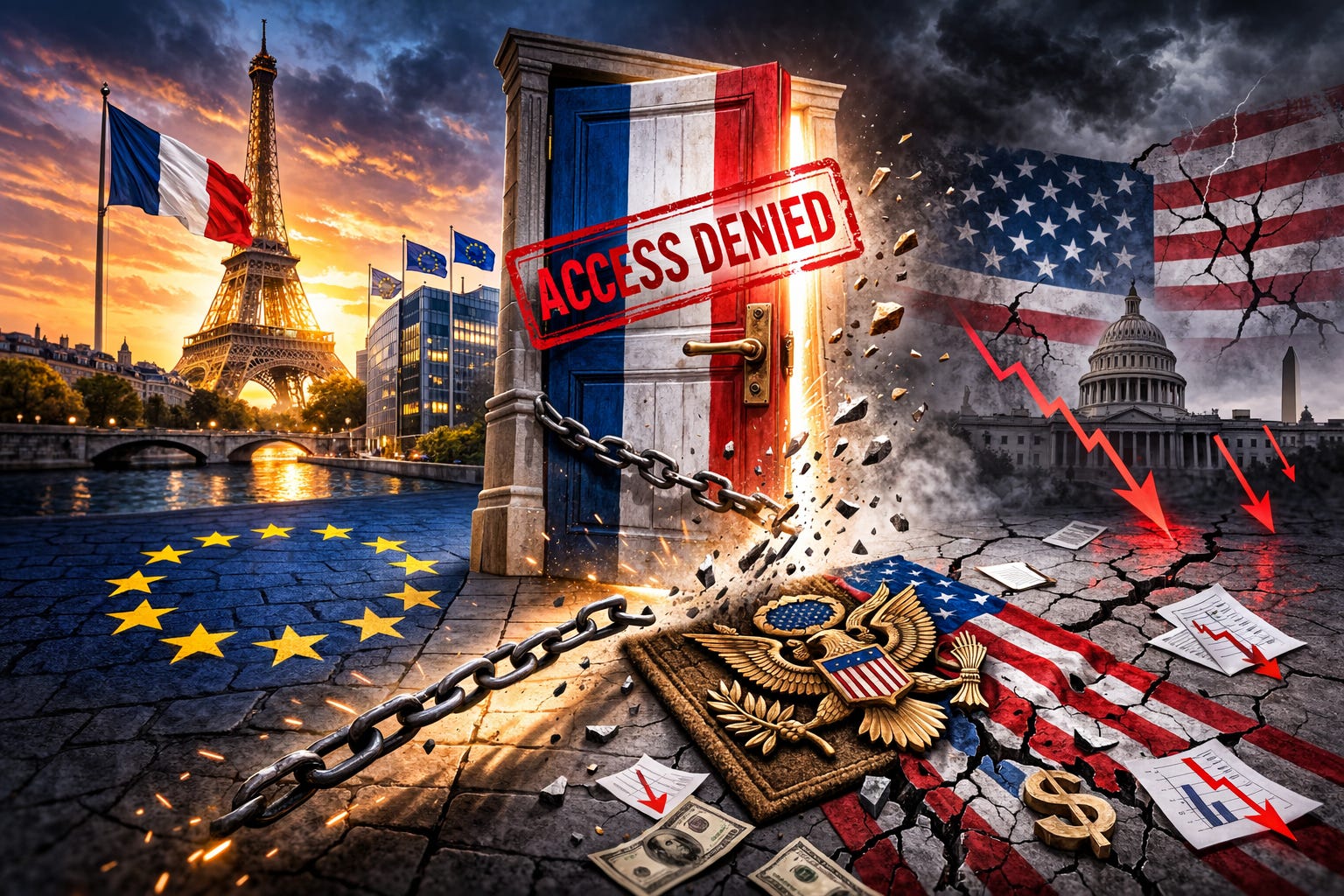
There are moments in geopolitics when the polite language stops…
and the real message begins.
France just sent one of those messages.
The United States ambassador to France… Charles Kushner… has effectively been cut off from direct access to senior French government officials.
Not expelled.
Not recalled.
Just… shut out.
In diplomacy, that’s about as close as you get to being told to sit in the waiting room indefinitely.
Why This Happened
The immediate trigger was a public statement from the U.S. embassy commenting on unrest in France after the death of a right-wing activist in Lyon.
French officials saw it as interference in domestic affairs.
France summoned the ambassador to explain.
He didn’t show up.
Instead, a deputy was sent… and according to reports, it wasn’t the first time he had skipped a summons. A previous dispute involved accusations that France wasn’t doing enough to combat antisemitism.
That pattern mattered.
France’s foreign ministry response was blunt… because the ambassador had failed to meet the basic expectations of his role, he would no longer have direct access to government ministers.
Translation… you’re still technically here… but you’re no longer part of the conversation.
Why This Is Bigger Than One Diplomat
Ambassadors are not ceremonial figures.
They are the primary communication channel between governments… and between corporate interests and regulators.
When that channel is restricted…
• Political influence weakens
• Negotiations slow down
• Businesses lose leverage
American tech giants, defense firms, pharmaceutical companies… all rely on diplomatic relationships to navigate European regulation and policy decisions.
Cutting access doesn’t stop those relationships.
It just makes them harder and less effective.
And that matters in a region already tightening rules through laws like the EU Digital Markets Act and Digital Services Act.
The Timing Is Not Random
This move comes during escalating tensions between the United States and Europe.
Recent pressure points include…
• U.S. tariff increases up to 15% globally
• Threat rhetoric involving Greenland
• Legal chaos after U.S. courts struck down tariffs only to see new ones imposed quickly under different authority
From Europe’s perspective, predictability… the foundation of trade agreements… is eroding.
And markets are noticing.
On the same day tensions intensified:
• The Dow dropped more than 800 points
• The S&P 500 fell over 1%
Investors price risk.
Diplomatic instability increases risk.
The Trade Fallout Risk
Europe has already frozen ratification of a major EU-U.S. trade agreement negotiated last year.
That deal involved enormous numbers…
• $750 billion in energy purchases
• $600 billion in EU investment
• Reduced tariffs across sectors
Now European officials are questioning whether U.S. commitments can be trusted if policies change overnight.
That’s not ideology.
That’s risk management.
Europe Is Building Independence
France’s move also fits a broader pattern: European strategic autonomy.
European countries are increasingly building…
• Independent defense coordination
• Industrial policy frameworks
• Technology sovereignty initiatives
Reports even indicate European troop deployments to Greenland involving France, Germany, Norway, and Sweden… a signal that security planning is no longer assumed to run through Washington.
This isn’t anti-American sentiment.
It’s hedging.
The Financial Layer
U.S. tariffs generated roughly $287 billion in revenue in 2025… a massive increase from the prior year.
But revenue doesn’t equal stability.
Erratic policy combined with diplomatic friction raises questions about long-term trust in American economic leadership.
Central banks and sovereign investors watch those signals carefully when deciding how much to hold in dollar-denominated assets.
Trust is currency.
And currency can weaken.
The Real Message
France didn’t restrict access because of one missed meeting.
They did it because the cost-benefit equation changed.
If diplomatic norms aren’t respected…
If allies feel pressured or ignored…
If agreements appear unstable…
Then maintaining traditional deference stops making sense.
So consequences begin.
What Comes Next
The real risk isn’t France alone.
It’s precedent.
If other European countries adopt similar restrictions, American influence across Europe could shrink quickly… not through confrontation, but through simple exclusion.
Influence doesn’t always disappear with a bang.
Sometimes it fades because the door stops opening.
The Recap…
France just cut off direct access to the U.S. ambassador.
That’s not diplomatic drama.
That’s a signal.
When allies start closing doors, markets… and power — follow.
The Gut Punch…
Influence doesn’t collapse overnight.
It erodes the moment allies stop picking up the phone.
Source Credit:
Source context: international reporting including France 24, Euronews, Bloomberg, CNBC, and public economic data.
🔎 The GeezerWise Standard
This space is built on disciplined thinking.
Facts over spin.
Verification before amplification.
Good-faith discussion over tribal noise.
I use AI tools to help shape my spoken drafts into clear writing.
The judgment, conclusions, and final message are mine.
If you’re new here, this explains how I decide what’s worth sharing:
How I Decide What’s Worth Sharing → [link]
💌 Subscribe at GeezerWise.com to receive future letters:
www.geezerwise.com/subscribe
— Fred Ferguson
GeezerWise
#CanadaStrong
Can we do the same with the current obnoxious 🇺🇸 ambassador to 🇨🇦 please? 🙏
Fred, as a Brit I love your musings on politics and the world in general, don't stop. Your a breath of fresh air.
Live long and prosper.