

For months, the headlines made it sound simple.
America pushed. Europe folded.
Tariffs were threatened. Europe blinked. A trade deal got signed.
Case closed.
Except… I don’t think that’s what actually happened.
Because sometimes the smartest move in a fight isn’t winning the round.
It’s buying time to change the game.
And that’s what Europe appears to be doing.
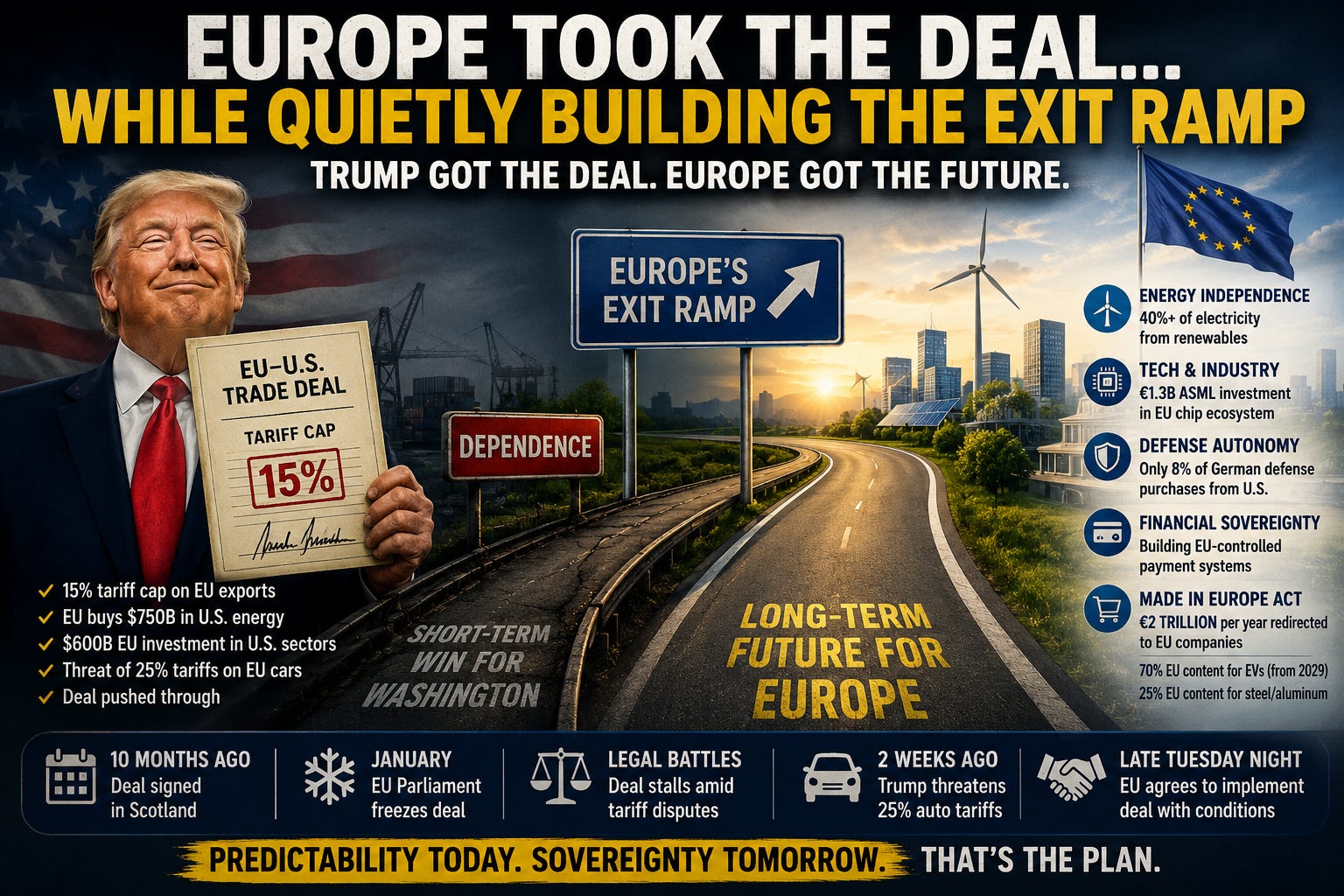
The headlines say the European Union accepted a deal capping U.S. tariffs at 15% after Washington threatened to hammer European cars with 25% tariffs. Europe also agreed to buy massive amounts of American energy and increase investment into U.S. sectors.
On the surface?
Looks like Europe got squeezed.
But underneath the hood, something much bigger has been happening.
While everyone was arguing over tariffs, Europe quietly started building systems designed to make itself less dependent on the United States altogether.
That’s the real story.
And if you zoom out far enough, this deal starts looking less like surrender…
…and more like a temporary truce while Europe renovates the house.
Because Europe isn’t just reacting anymore.
It’s planning.
Big difference.
The trade agreement creates short-term stability. Businesses hate uncertainty more than almost anything.
A predictable 15% tariff ceiling is painful — but manageable. Companies can price products, make investment decisions, and stop playing economic roulette every week.
Predictability matters.
Especially when political whiplash has become part of the business model south of the border.
But here’s the twist…
Europe appears to be treating this deal like a bridge… not a destination.
While agreeing to major U.S. energy purchases reportedly worth around $750 billion, Europe is simultaneously pouring money into renewables, electrification, and energy independence.
That shelf life matters.
Because buying energy today while building a system that needs less of it tomorrow?
That’s strategy.
Not surrender.
Europe now gets more than 40% of its electricity from renewables, EV adoption continues climbing, and heat pump installations are reducing fossil fuel dependence in households.
In plain English?
They’re rewiring the machine while keeping the lights on.
And energy isn’t the only thing changing.
The EU has also been quietly shifting procurement rules toward a “Made in Europe” approach that could redirect roughly €2 trillion a year toward domestic industries.
That number should make people sit up.
Because procurement is power.
Who gets government contracts shapes entire industries.
Steel. Batteries. Semiconductors. AI. Manufacturing.
The future doesn’t just appear out of nowhere.
Governments build it.
Europe’s proposed rules increasingly favour local suppliers… including content requirements for EV procurement and industrial materials over the coming years.
Again…
Not confrontation.
Construction.
That’s the pattern.
Instead of throwing punches every day, Europe seems to be building alternatives…
Alternative payment systems.
Alternative cloud infrastructure.
Alternative satellite systems.
More domestic defense production.
Less dependence.
More control.
Even politically, the tone has shifted.
The European Parliament reportedly delayed and resisted this trade deal multiple times, showing Europe is becoming more willing to challenge Washington instead of automatically falling in line.
That matters.
Because this isn’t really about tariffs.
Tariffs are just the symptom.
Trust is the story.
And if you listen carefully, the message coming out of Europe sounds increasingly clear…
“We still want to work together…
…but we’re not betting the future on unpredictability.”
That’s a different relationship.
Less partnership.
More managed coexistence.
The irony?
America may have won the negotiation and still lose long term influence.
Because the real power move wasn’t the tariff deal.
The power move was what Europe built while everybody was staring at the tariff drama.
That’s the part people miss.
Trump may have gotten the deal.
Europe may have gotten the runway.
The Recap…
Europe may have accepted the trade deal…
…but I’m not convinced they accepted dependence.
The tariffs bought predictability.
Europe used the time to build alternatives.
Energy. Tech. Defense. Payments.
Trump got the deal.
Europe may have gotten the future.
The Gut-Punch…
Sometimes losing the argument is cheaper than staying trapped in the relationship.
Europe may have figured that out before everyone else.
Source credit:
Based on House of El reported developments surrounding EU–U.S. trade negotiations, tariff agreements, procurement shifts, energy transition policies, and EU industrial strategy.
🔎 The GeezerWise Standard
This space is built on disciplined thinking.
Facts over spin.
Verification before amplification.
Good-faith discussion over tribal noise.
I use AI tools to help shape my spoken drafts into clear writing.
The judgment, conclusions, and final message are mine.
If you’re new here, this explains how I decide what’s worth sharing:
How I Decide What’s Worth Sharing → [link]
💌 Subscribe at GeezerWise.com to receive future letters:
www.geezerwise.com/subscribe
— Fred Ferguson
GeezerWise
#CanadaStrong
It seems this is the same path that prime minister Carney is taking Canada “built for Canadians by Canadians”.
I am so confused about the tariffs - the courts keeps telling him they are illegal but the threats and penalties continue?