

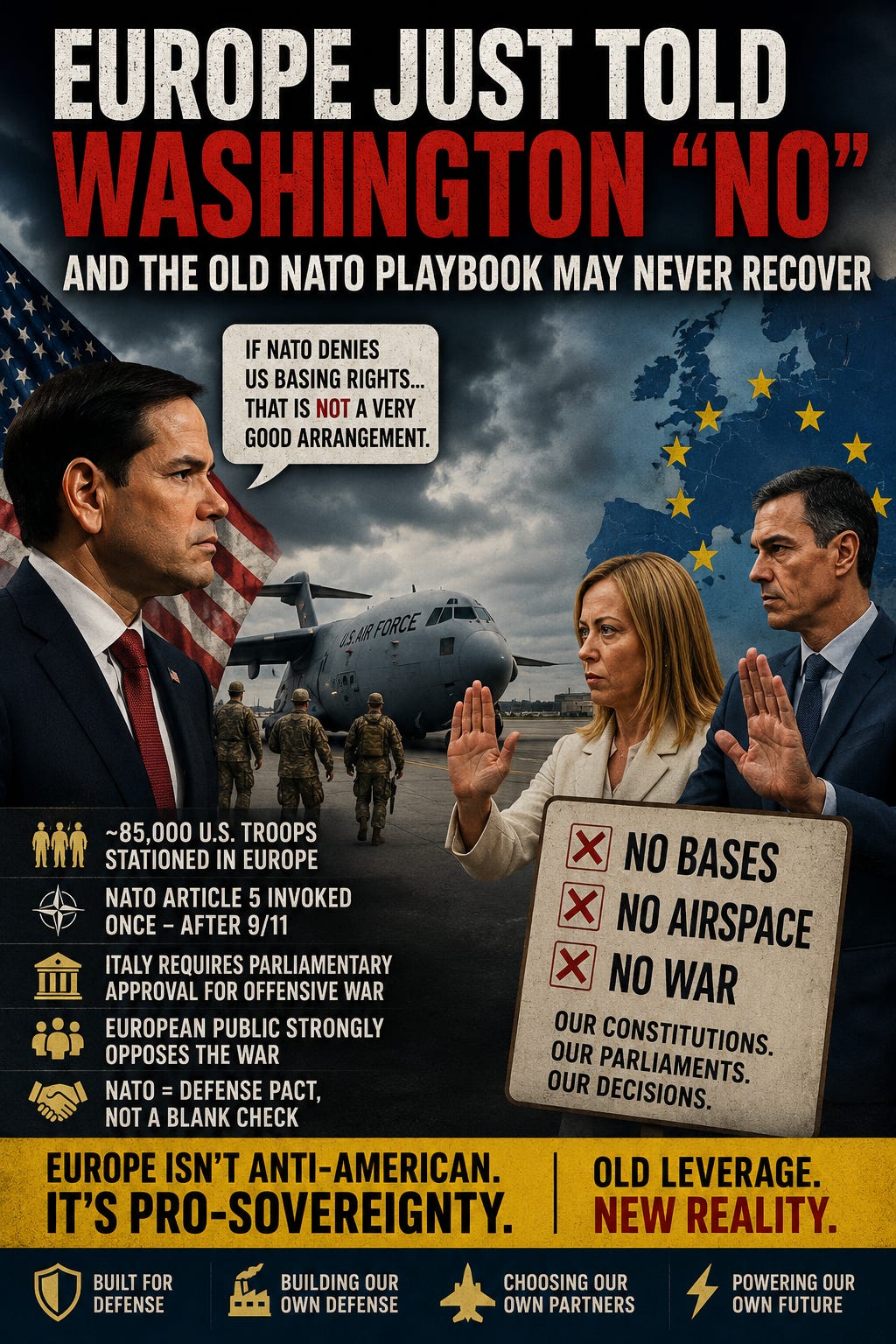
For decades, the formula was simple.
Washington applied pressure.
Europe grumbled a little.
Then eventually fell in line.
That pattern may have just cracked wide open.
Because while the U.S. was trying to build support for military action tied to Iran, several European allies quietly did something that would’ve been almost unthinkable twenty years ago…
They refused.
Not with dramatic speeches.
Not with chest-thumping press conferences.
They simply said…
“No.”
No bases.
No airspace.
No automatic participation.
And that one little word may end up being more important than the entire diplomatic trip itself.
The real story here isn’t Iran.
It’s that America is discovering the rest of the alliance no longer sees NATO as a blank cheque for every geopolitical fight Washington wants to enter.
That’s a major shift.
And you can hear the frustration leaking out already.
U.S. officials reportedly questioned what value NATO even has if allies won’t provide operational access during moments like this. That’s a remarkable statement when you think about it carefully.
Because NATO was designed as a defensive alliance.
Not a standing approval system for offensive military campaigns.
Europe knows that.
Its populations know that.
And increasingly, its governments are acting like they know that too.
Italy reportedly leaned on constitutional limits requiring parliamentary approval for offensive military action. Spain also refused cooperation tied to bases and airspace access.
Notice what’s happening here…
European governments are no longer framing resistance as “anti-American.”
They’re framing it as lawful. Constitutional. Democratic.
That matters.
Because it changes the psychology of the relationship.
This wasn’t emotional rebellion.
It was bureaucratic defiance.
The kind that’s very hard to punish without looking like the aggressor.
And underneath all of it sits the bigger issue Washington probably doesn’t want to admit out loud:
The leverage isn’t working like it used to.
The United States still has roughly 85,000 troops stationed across Europe. For years, that military footprint acted like both protection and influence.
Now?
Threatening troop withdrawals sounds less like leverage… and more like a bluff Europe may finally be willing to call.
That’s the dangerous part for Washington.
Once allies realize they can say “no” without immediate consequences, the balance changes permanently.
And Europe appears to be preparing for exactly that future.
We’re already seeing growing discussions around…
domestic weapons manufacturing
alternative fighter suppliers
regional defense production
independent supply chains
energy diversification
strategic autonomy
In plain English?
Europe is slowly building an insurance policy against American unpredictability.
Not because it suddenly hates America.
But because governments survive by reducing dependency when trust becomes unstable.
That’s what this looks like.
And honestly?
You can understand why European voters aren’t eager to get dragged into another conflict the public doesn’t support.
The war fatigue is real.
The skepticism is real.
The memory of “temporary” wars that somehow lasted decades is very real.
So when Washington pushes hard… and Europe responds with constitutional procedures, parliamentary approval requirements, and legal frameworks…
That’s not weakness.
That’s democratic friction.
Something the U.S. usually celebrates… right up until it interferes with military objectives.
And that contradiction is becoming harder to hide.
You can already see the quiet redefinition happening in real time…
NATO = collective defense
NOT = automatic operational compliance
That distinction matters enormously.
Because once alliance members start acting like sovereign partners instead of subordinate extensions of U.S. foreign policy…
The old model starts breaking apart.
Slowly at first.
Then all at once.
The most fascinating part?
Europe didn’t need to “win” anything here.
It simply needed to resist long enough for Washington to leave empty-handed.
And that may be the real turning point.
Not the refusal itself.
But the realization that refusal worked.
The Recap…
For years, the formula was simple:
Washington pressured.
Europe complied.
This time?
Europe said no.
No bases.
No airspace.
No automatic participation.
And suddenly NATO looks a lot less like a chain of command… and a lot more like sovereign countries rediscovering they can refuse.
That psychological shift matters more than the headlines.
The Gut-Punch…
The biggest crack in an empire rarely starts with rebellion.
It starts the first time someone quietly realizes they’re allowed to say “no.”
Source credit:
Analysis based on reported diplomatic developments involving U.S. pressure on European allies regarding Iran, NATO operational access debates, and public statements surrounding alliance obligations and sovereignty.
🔎 The GeezerWise Standard
This space is built on disciplined thinking.
Facts over spin.
Verification before amplification.
Good-faith discussion over tribal noise.
I use AI tools to help shape my spoken drafts into clear writing.
The judgment, conclusions, and final message are mine.
If you’re new here, this explains how I decide what’s worth sharing:
How I Decide What’s Worth Sharing → [link]
💌 Subscribe at GeezerWise.com to receive future letters:
www.geezerwise.com/subscribe
— Fred Ferguson
GeezerWise
#CanadaStrong
I am proud of Europe and the UK . As you said NATO. Is a defensive alliance, not part of trumps private army to order around as he wishes. Mark Carney is a strong leader and is showing the way for the rest of the world. America has thought it was top dog for far too long. It is time now to show it that it is no longer number one in the world. China and Japan, India and southern Korea are becoming the power houses of manufacturing in the world. Watching what is happening in Britain , I can see more and more Chinese made cars and few Fords. I look to other sites rather than use Amazon, I know Bezos will not miss the few hundred I used to spend on Amazon, but if more and more people do the same perhaps he might realise what is happening.
NATO was formed as a defensive alliance, one for all and all for one, not as an extension of American aggression in sandy places.
Trump may moan about NATO but NATO has given America a long-reach into the Middle East without flying vast distances in one go. Let Trump close their bases and withdraw their personnel, they pay zero rent or taxes to the host nation, yet they enjoy the infrastructure of said country.