

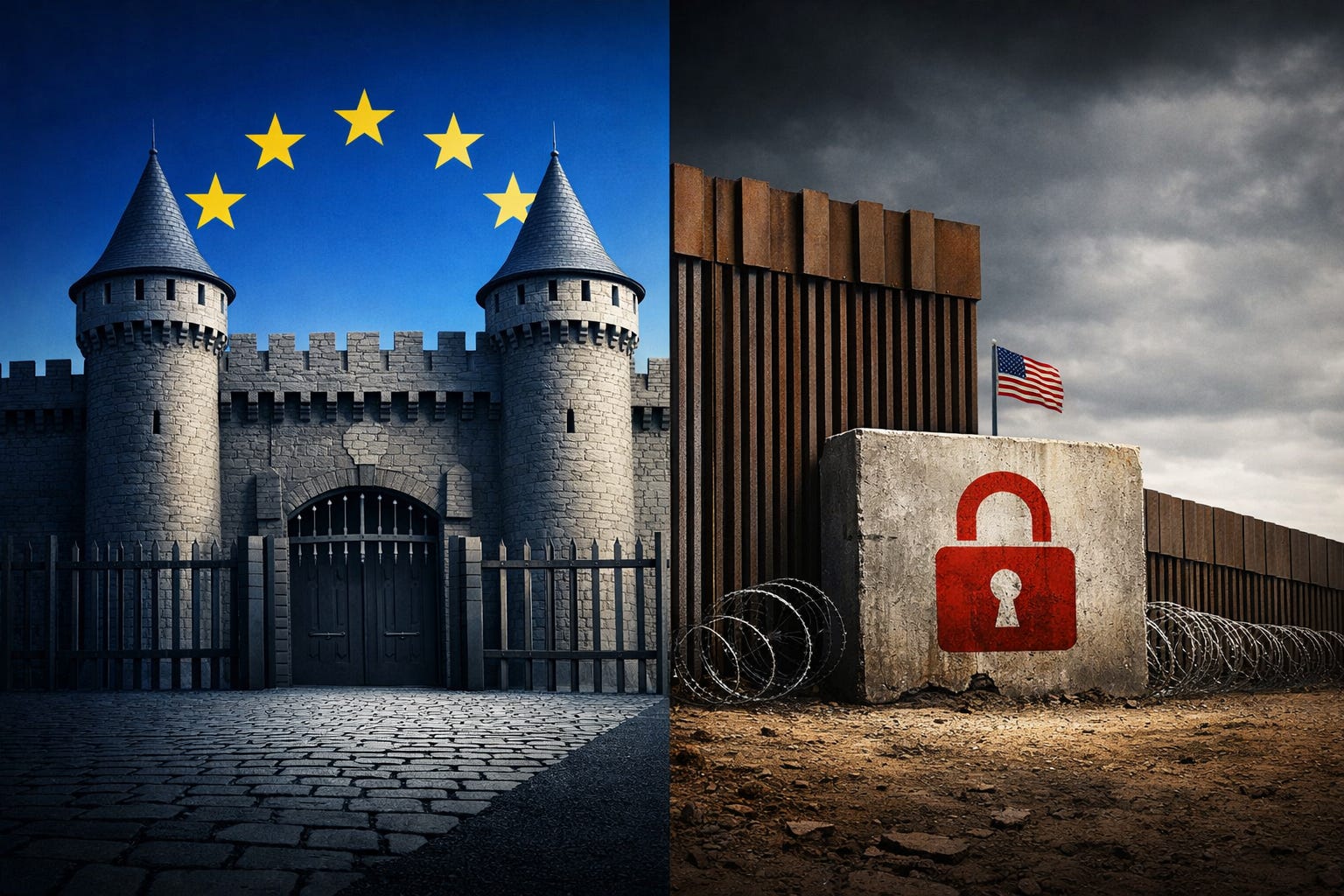
Let’s stop pretending this is just another trade spat.
Europe just made a structural decision.
At a summit in Belgium, EU leaders agreed to advance a “Buy European” framework. Not a slogan. Not a tweet. A policy architecture.
European Council President António Costa confirmed broad agreement to reinforce strategic sectors… defense, space, clean tech, artificial intelligence, and payment systems.
European Commission President Ursula von der Leyen promised an action plan by March.
And this isn’t symbolic.
An Industrial Accelerator Act is expected February 25. It will set defined European-content requirements in products like electric vehicles and solar panels.
These won’t be vague preferences. They’ll be binding rules tied to public procurement. If you want EU money, you meet EU thresholds.
That’s called industrial policy.
Now contrast that with Washington.
The U.S. imposed metal tariffs at 50%. Then rolled them back after the EU threatened €93 billion in retaliation.
Courts have ruled some tariff authorities illegal.
The U.S. House voted 219–211 to terminate Canada tariffs, with six Republicans crossing the aisle. That resolution is headed to the Senate. A veto showdown looms.
That’s not industrial policy.
That’s improv theatre.
What Europe Is Actually Doing
French President Emmanuel Macron has been pushing leaders to prioritize chemicals, steel, automotive, and defense. Protect domestic capacity. Prevent strategic sectors from hollowing out.
Belgium’s Prime Minister Bart De Wever warned manufacturing decline is an existential risk for Belgium, France, Germany, and the Netherlands.
High energy costs. Regulatory drag. Chinese dumping of subsidized goods.
Europe isn’t denying the problem.
They’re redesigning the engine.
The new framework includes…
Foreign investment screening in key technologies
Procurement rules favoring EU-based production
A broader “Made in EU” definition that includes trusted trade partners like the UK and Japan
Enhanced cooperation rules allowing willing member states to move faster without breaking the union
That last part matters.
Instead of forcing all 27 countries into lockstep, Europe can let subsets move ahead legally. It’s built into treaty law. Ratified. Structured. Predictable.
That’s institutional design.
Meanwhile in America
Tariffs are being justified under emergency powers. Courts challenge them. Markets assume reversals. Investors now joke about “announce, panic, reverse, repeat.”
When companies invest billions in factories, they don’t want a policy with a 10-day half-life.
They want 10-year visibility.
The EU has trade agreements covering 80 global partners, with 27 more in process. That network wasn’t built through threats. It was built through negotiated frameworks and rule of law.
Even inside Europe’s disagreements, you see discipline.
Germany’s Chancellor Friedrich Merz has signaled limits on joint EU borrowing because Germany’s constitutional court sets fiscal constraints.
In other words, political leaders are constrained by law.
In the U.S., a single reconciliation bill can add $1.4 trillion to the deficit.
One system runs on guardrails.
The other runs on impulse.
The Bigger Picture
This isn’t about anti-American sentiment.
It’s about de-risking.
Europe sees volatility in U.S. trade policy. So it’s building domestic capacity, reinforcing the single market, and creating fallback legal mechanisms if consensus stalls.
That’s what stable blocs do.
And here’s the part that should make investors nervous:
When capital chooses between regulatory certainty and policy chaos, it doesn’t choose chaos.
Factories don’t get built on vibes.
If the Industrial Accelerator Act lands in March with enforceable procurement rules and defined European content targets, we’re going to see manufacturing investment tilt accordingly.
Not because Europe is angry.
Because Europe is predictable.
And in geopolitics, predictability is power.
The Recap…
Europe just moved from reacting to trade chaos…
to redesigning its entire industrial strategy.
This isn’t protectionism.
It’s structured, treaty-backed policy.
Meanwhile, Washington keeps hitting the tariff button like it’s a casino slot machine.
The Gut Punch…
Regulatory certainty builds factories.
Political theatre builds headlines.
Source Credit:
Source: European Council summit statements and reporting on the proposed EU Industrial Accelerator Act and recent U.S. tariff actions.
🔎 The GeezerWise Standard
This space is built on disciplined thinking.
Facts over spin.
Verification before amplification.
Good-faith discussion over tribal noise.
I use AI tools to help shape my spoken drafts into clear writing.
The judgment, conclusions, and final message are mine.
If you’re new here, this explains how I decide what’s worth sharing:
How I Decide What’s Worth Sharing → [link]
💌 Subscribe at GeezerWise.com to receive future letters:
www.geezerwise.com/subscribe
— Fred Ferguson
GeezerWise
#CanadaStrong
Common sense planning with limits - makes so much difference... I'm very glad that Canada is working within that network 🇨🇦🇨🇦