

Canada has spent decades acting like the safest place to stand is right beside the United States.
Fair enough. Big market. Shared border. Familiar customer. Same neighbourhood.
But there’s a problem with standing too close to someone who keeps walking toward the cliff.
The world’s energy system is changing fast.
China is electrifying.
Europe is electrifying.
Renewable power, batteries, EVs,
and clean industrial tech are no longer some dreamy little climate brochure handed out at a conference with bad sandwiches.
They are becoming the new economic muscle.
And the United States?
The United States is having another one of its national identity seizures.
One side of the world is building the future.
The other is arguing about whether the future is woke.
Canada cannot afford to pretend this is just politics.
It is strategy.
It is trade.
It is sovereignty.
It is jobs.
It is whether we follow the growth markets or keep polishing the hubcaps on yesterday’s economy.
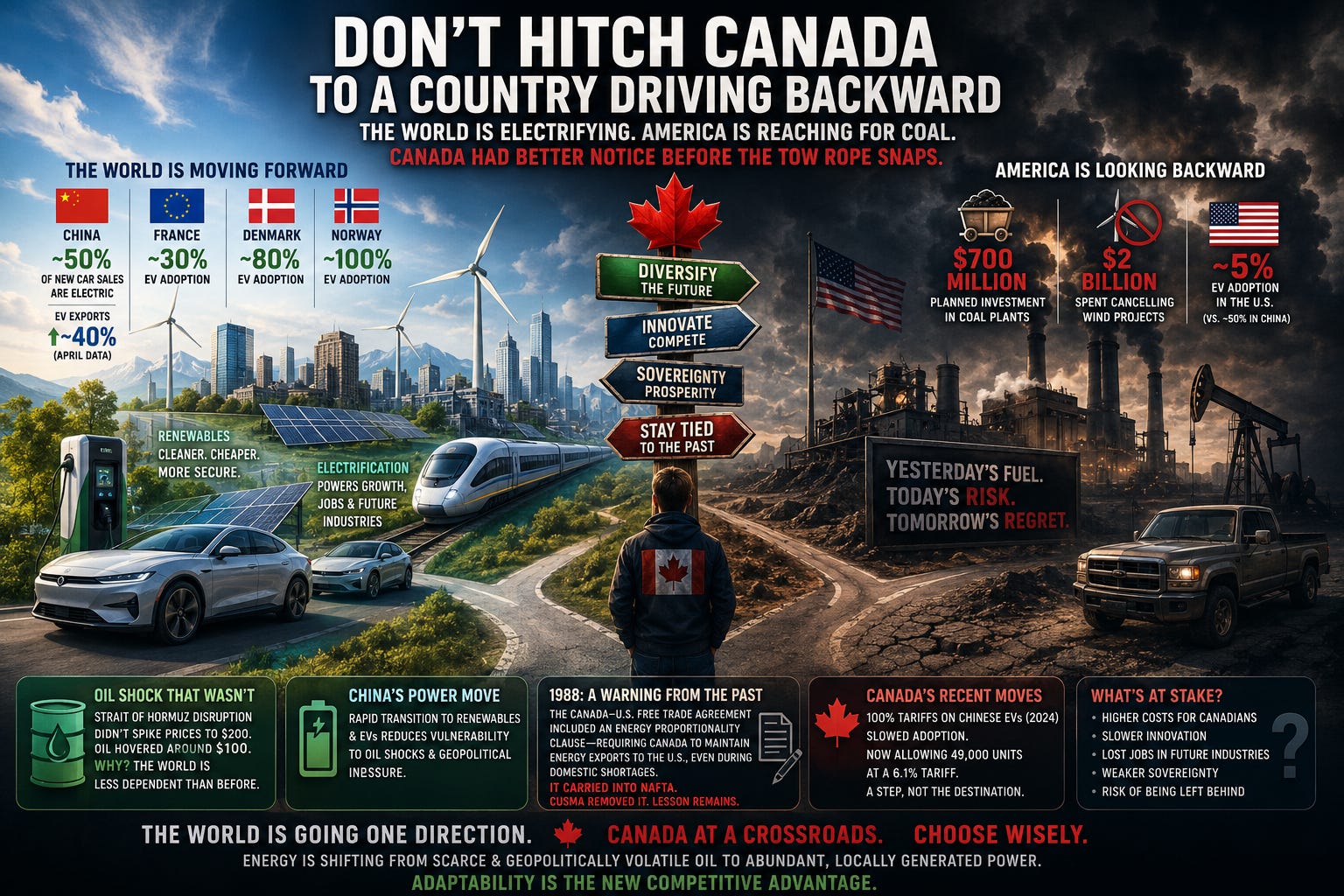
Back in 1988, during the Canada–U.S. Free Trade fight, John Turner warned Canadians that Brian Mulroney’s deal would bind Canada too tightly to American priorities.
One of the ugliest pieces was energy proportionality.
In plain English, if Canada restricted energy exports, we still had to keep supplying the United States in roughly the same proportion as before. Even if things got tight here.
That clause carried into NAFTA.
It is gone now under CUSMA. Good.
But the lesson remains.
When the economic levers go, political independence follows.
And that is the real issue now.
Canada spent generations building east-west infrastructure because we understood the danger of becoming a branch plant economy pointed south.
Then we turned around and built too much of our energy, auto, and trade thinking around one customer anyway.
Now that customer is wobbling.
Look at electric vehicles.
China is not dabbling.
It is charging ahead.
More than half of new cars sold in China are now electric. Chinese EV exports jumped sharply this year.
Europe is moving too.
Norway is practically at the finish line.
Denmark is racing. France is moving.
North America is dragging its feet like a teenager told to clean the garage.
Canada and the U.S. slapped 100% tariffs on Chinese-made EVs.
That may protect some factories in the short term, but it also protects consumers from cheaper cars, better competition, and a faster transition.
Brilliant, really.
Nothing says “future-ready economy” like making the future more expensive.
Canada has now cracked the door open slightly, allowing a limited number of Chinese-made EVs in at a lower tariff.
Predictably, the Americans are twitchy about it.
Of course they are.
Washington loves free trade right up until somebody else gets good at something.
Meanwhile, China is doing something even bigger than selling cars. It is reducing its vulnerability to oil shocks.
That matters.
For decades, oil was the choke chain of global power.
Control the supply.
Control the routes.
Control the price.
Control the panic.
But the Strait of Hormuz disruption did not send oil to $200 the way the old playbook might have predicted.
Prices rose, yes.
The system shook, yes.
But the world did not collapse into the same kind of oil panic we used to expect.
Why?
Because demand is changing.
Because China and others are electrifying transport.
Because renewables reduce the amount of national life held hostage by tankers, pipelines, and unstable regimes.
That is the part the fossil-fuel crowd does not want to admit.
Renewables are not just about emissions.
They are about leverage.
A country that can generate more of its own power, store more of it, and run more of its transportation on electricity is harder to squeeze.
It is less exposed to foreign oil shocks. It has more room to move.
That is sovereignty with a charging cable attached.
And then there is America.
While China builds EVs and solar at industrial scale, the U.S. is still fighting culture wars over windmills.
Coal gets dressed up like a comeback story.
Renewable projects get tangled in politics.
EVs get treated like some foreign conspiracy instead of an industrial race.
This is not just dumb.
It is strategically dumb.
The next great economy will not be built by the country that wins the argument about 1978.
It will be built by the country that owns batteries, grids, rare earth processing, low-cost EVs, clean steel, smart manufacturing, and cheap electricity.
Canada has choices to make.
We have critical minerals.
‘We have hydro.
We have engineering talent.
We have land.
We have ports.
We have a public that, when not being dragged into performative nonsense, understands practical adaptation.
But we cannot keep acting like our job is to sit politely beside America while it mistakes nostalgia for policy.
This does not mean Canada should run blindly into China’s arms either.
China plays hardball.
China protects its interests.
China is not running a charity for polite Canadians with maple leaf mugs.
But trade diversification is not romance.
It is risk management.
You do not marry every customer. You sell to more than one.
Canada’s real danger is inertia.
The lazy assumption that because the U.S. was the obvious partner yesterday, it must be the safest bet tomorrow.
That is how countries get stuck.
The world is not waiting for North America to finish its argument with itself.
China is building.
Europe is adapting.
Emerging markets are buying cheaper electric vehicles.
Energy power is shifting from scarce fuel controlled by geography to electricity that can be generated locally, stored, moved, and scaled.
That changes everything.
Oil will still matter. Fossil fuels will not vanish next Thursday after lunch. Workers in those industries deserve honesty, not fairy tales.
But pretending the old system will dominate forever is not a plan.
It is a lawn chair on railway tracks.
Canada needs to stop asking, “What will Washington allow?”
The better question is…
Where is the world going, and how does Canada make sure we are not chained to the wrong bumper?
Because if America wants to drive backward into coal smoke and tariff walls, that is its choice.
But Canada does not have to ride shotgun.
The Recap…
The world is electrifying while the U.S. keeps flirting with fossil-fuel nostalgia.
China is building EVs, batteries, and renewable power at industrial speed.
Europe is moving.
Canada is still too often looking south for permission.
That is not strategy.
That is habit wearing a business suit.
The Gut-Punch…
Canada’s future will not be saved by loyalty to yesterday’s customer.
It will be saved by knowing when the customer is driving the wrong way.
Source Credit:
Canada’s 100% Chinese EV surtax began in 2024; Canada has now allowed up to 49,000 Chinese-made EV imports at a reduced 6.1% tariff; IEA reports China reached close to 55% EV share in 2025 while the U.S. stalled around 10%; CUSMA removed NAFTA’s energy proportionality clause.
🔎 The GeezerWise Standard
This space is built on disciplined thinking.
Facts over spin.
Verification before amplification.
Good-faith discussion over tribal noise.
I use AI tools to help shape my spoken drafts into clear writing.
The judgment, conclusions, and final message are mine.
If you’re new here, this explains how I decide what’s worth sharing:
How I Decide What’s Worth Sharing → [link]
💌 Subscribe at GeezerWise.com to receive future letters:
www.geezerwise.com/subscribe
— Fred Ferguson
GeezerWise
#CanadaStrong
Fred, we live in the Midlands , early this year we had solar panels installed. Now it is June we are actually exporting electricity to the National Grid. We also have an electric car, a VW. It is brilliant! Our electricity bill has dive bombed, our car is fully charged and we are making money! My husband wants us to buy another battery by October to carry us through the winter. We have those who want to drill baby drill into the depleted stocks in the North Sea, you can guess why! Petrol companies really don’t want to lose. The sooner we transition to electric, the better.
IMO - Canada has been elbow deep in this fight (O&G vs sustainable) since OPEC funded Regan’s run for POTUS.
Regan proved to be a great investment he ripped up America’s first sustainable plan and the solar panels off the White House…
Regan also co-founded the Global IDU group.
Removed the fairness doctrine and opened up American airwaves to foreign companies..
Basically setting the stage for today. Projext 2025 is only the American chapter inside a global playbook….
Our focus on timelines needs to broaden…