

Most political controversies come and go.
This one matters.
Because it isn’t about a single policy.
It’s about direction.
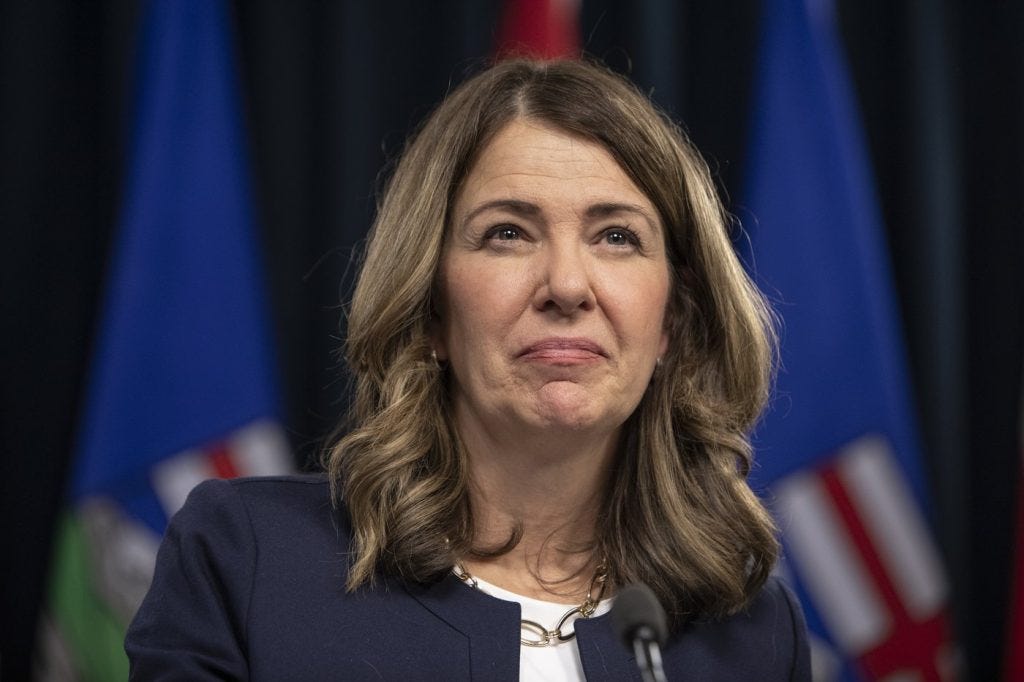
Over the past few years, Alberta Premier Danielle Smith has repeatedly pushed ideas that collide directly with federal authority…
Immigration control, pension withdrawal, sovereignty legislation, referendum rules.
Each issue on its own might look like routine provincial-federal friction.
But when you line them up?
A pattern appears.
The Immigration Referendum Question
Smith has proposed a provincial referendum asking whether Alberta should gain more control over immigration framed around…
Lowering numbers, prioritizing economic migrants, and protecting jobs for residents.
Immigration is primarily a federal responsibility in Canada, though provinces do have some nominee programs.
So the practical impact of such a referendum is limited.
The political impact, however, is not.
It feeds a narrative that Alberta’s problems come from Ottawa… and that independence could solve them.
That narrative matters more than the policy.
The Pension Plan Fight
The same pattern showed up earlier with the proposal that Alberta leave the Canada Pension Plan (CPP).
The Alberta government argued the province might be entitled to roughly 53% of CPP assets if it withdrew.
Experts across the country disputed that figure heavily.
And the basic structure of CPP complicates the claim anyway… contributions follow workers across provinces throughout their careers.
The money doesn’t belong to a province. It belongs to individuals.
But again, the politics were powerful.
The message wasn’t really about pensions.
It was about autonomy.
The Population Contradiction
Here’s where things get more revealing.
In 2022, Alberta launched a massive campaign… “Alberta Is Calling” … to attract workers from across Canada.
It worked.
Tens of thousands moved to the province, including 33,000 people in a single quarter.
Fast-forward to recent years.
Population growth increases pressure on housing, healthcare, and services… while lower oil prices squeeze revenue.
Now immigration is framed as a contributor to budget strain.
Same government. Opposite message.
That’s not policy evolution.
That’s political positioning.
Making Separation Easier
Smith’s government has also changed referendum rules… lowering the threshold required to trigger a provincial vote initiated by citizens.
On paper, that’s democratic reform.
In practice, it lowers the barrier for a future independence vote.
That matters because Alberta’s actual separatist parties have very limited support.
In recent by-elections…
NDP: 45.8%
United Conservative Party: 41.5%
Alberta separatist party: 9.2% (concentrated in one riding)
Province-wide, that support would likely be far smaller.
A direct “run on separation” campaign would almost certainly fail.
Which creates an obvious political incentive…
Don’t campaign on separation.
Shift public opinion slowly instead.
The Pipeline Reality Check
Separatist rhetoric often claims Ottawa blocks Alberta energy exports.
But the federal government spent roughly $30 billion building the Trans Mountain expansion pipeline…
one of the largest infrastructure projects in Canadian history… to move Alberta oil to the coast.
Exports surged after completion in 2024.
One of the largest buyers?
China.
That doesn’t fit the “Ottawa is landlocking Alberta” story.
But narratives don’t require accuracy to spread.
Two Possible Explanations
There are only two logical interpretations of Smith’s approach.
Option 1: Political strategy.
Keep separatist-leaning voters engaged without fully committing to independence.
Option 2: Long-game positioning.
Gradually normalize the idea of separation so a future referendum becomes plausible.
Either way, the effect is the same.
National unity becomes collateral damage.
Why This Matters Now
Canada has faced separatist pressures before… most notably in Quebec, including the 1980 and 1995 referendums.
Those moments were destabilizing but ultimately democratic.
The difference today is mandate.
Quebec leaders who held referendums campaigned openly on independence.
Smith did not.
That distinction is critical.
Because legitimacy in democratic systems comes from voter consent… not gradual policy drift.
The Bigger Risk
Even if separation never happens, the constant friction has consequences…
Investor uncertainty
Interprovincial tension
Reduced federal cooperation
International perception of instability
Markets dislike uncertainty more than they dislike bad news.
And political volatility is uncertainty.
Bottom Line
Danielle Smith may not intend to break Canada apart.
But she is undeniably testing the structural seams.
And when leaders start pulling at seams, they don’t always control what unravels.
The Recap…
There’s a pattern emerging in Alberta politics.
Immigration fights. Pension fights. Referendum changes. Ottawa blame.
Each issue alone looks ordinary.
Together, they point somewhere much bigger.
I broke it down.
The Gut Punch…
You don’t have to declare independence to weaken a country.
You just have to keep questioning whether it should exist.
Source Credit:
Source: Analysis based on public statements, election data, government policy announcements, and reporting from Canadian media outlets.
🔎 The GeezerWise Standard
This space is built on disciplined thinking.
Facts over spin.
Verification before amplification.
Good-faith discussion over tribal noise.
I use AI tools to help shape my spoken drafts into clear writing.
The judgment, conclusions, and final message are mine.
If you’re new here, this explains how I decide what’s worth sharing:
How I Decide What’s Worth Sharing → [link]
💌 Subscribe at GeezerWise.com to receive future letters:
www.geezerwise.com/subscribe
— Fred Ferguson
GeezerWise
#CanadaStrong
I don't understand. What does causing friction accomplish? Is this some ploy conceived by US oligarchs to destabilize Canada?
This is a bit scary to me, because I have to live with DonOld for the foreseeable future, and I'm depending on Canada to let me feel as if there's still some level of sanity in the world. Hang in there for those of us who need you to be strong, Canada!