

For years, businesses across North America operated under a simple assumption…
The rules of trade between Canada, the United States, and Mexico were relatively stable.
That assumption just took a hit.
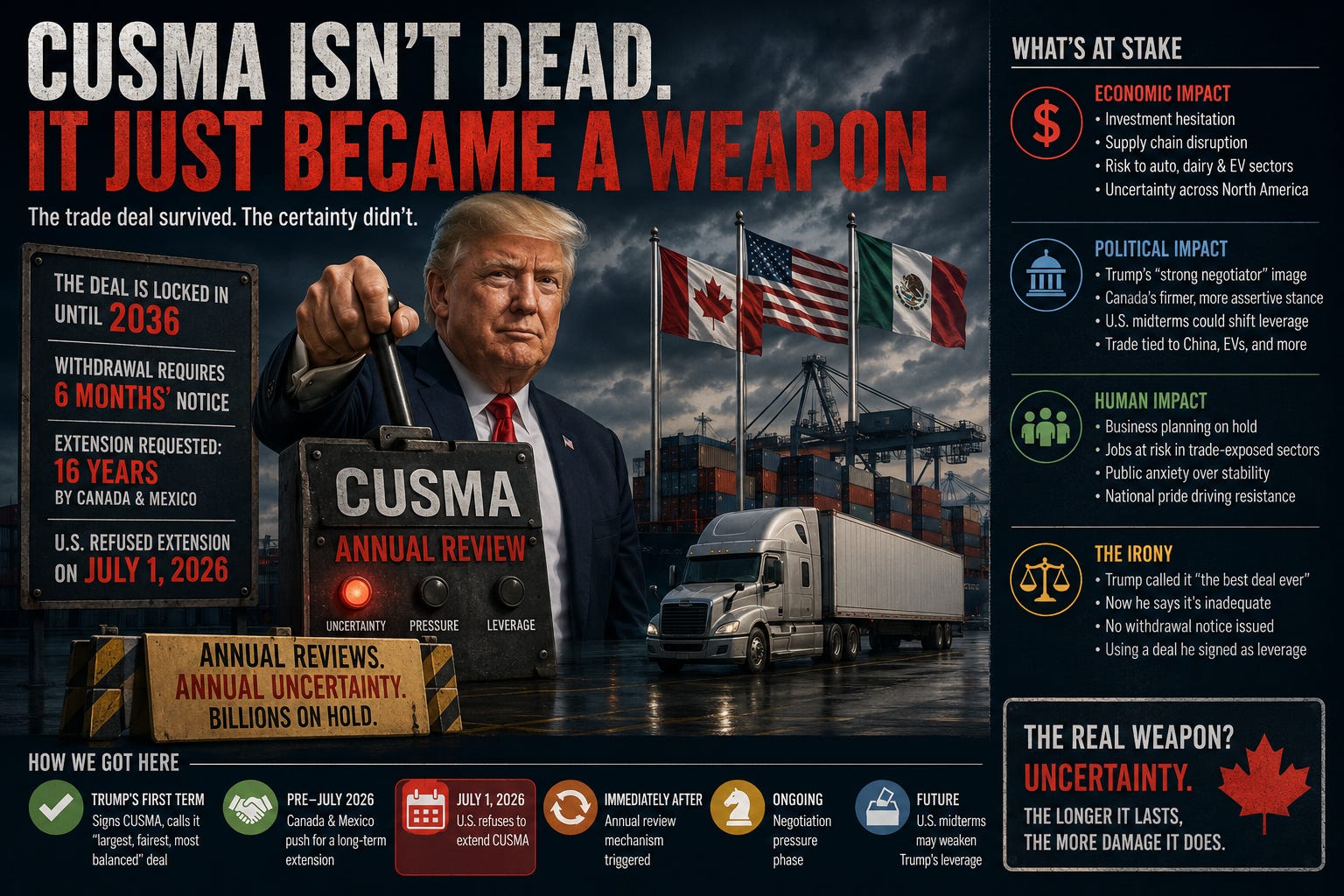
On July 1, the United States declined to extend CUSMA, the trade agreement that replaced NAFTA during Donald Trump’s first term.
The agreement itself remains in force until 2036. Nobody pulled the plug. Nobody issued a withdrawal notice.
But something important changed.
Instead of locking in another long stretch of predictability, Washington triggered a process that now opens the door to annual reviews and recurring trade battles.
The deal survived.
The peace of mind didn’t.
When CUSMA was signed, it was sold as a modernized agreement that would bring stability to North American trade.
Trump himself praised it as a major achievement.
Now the same agreement is suddenly being treated as something that needs fixing.
That should raise a few eyebrows.
If it was a historic success then, why is it inadequate now?
The answer may have less to do with trade and more to do with leverage.
Because you don’t need to cancel an agreement to create pressure.
You simply make everyone wonder what happens next.
This is where the real economic risk begins.
Large manufacturers don’t make billion-dollar decisions on a whim.
Auto plants, supply chains, distribution hubs, processing facilities, and export infrastructure all depend on long-term planning.
Investors like certainty.
Banks like certainty.
Employers like certainty.
When governments start reviewing trade rules every year, companies start hesitating.
Projects get delayed.
Expansion plans get reconsidered.
Capital waits on the sidelines.
The uncertainty becomes its own economic force.
And that’s exactly why it can be such an effective negotiating tool.
The United States is reportedly looking for changes in several areas, including automotive content requirements, dairy access, and restrictions connected to Chinese electric vehicles entering North American markets.
None of those issues are new.
What is new is the negotiating environment.
Instead of one large review years down the road, everyone now faces the possibility of recurring pressure campaigns.
A deal that was supposed to reduce uncertainty now risks creating it.
Canada and Mexico wanted a longer extension.
They didn’t get it.
But neither country appears eager to rush into concessions simply to make the problem disappear.
That’s a noticeable shift from earlier eras when many Canadians assumed our only option was to accommodate whatever Washington demanded.
The tone today feels different.
The message coming from Ottawa is that negotiations are welcome.
Capitulation is not.
Whether that position holds under sustained pressure remains to be seen.
But politically, it reflects a country that has become more aware of the risks of overdependence on a single trading partner.
There is another irony buried in all of this.
If Washington truly believed the agreement no longer served American interests, there is a mechanism to leave.
The deal requires six months’ notice for withdrawal.
That notice has not been issued.
Which suggests this isn’t really about ending CUSMA.
It’s about controlling the conversation around CUSMA.
The United States keeps the benefits of the agreement while increasing pressure on its partners.
From a negotiating standpoint, that’s a clever play.
From a business standpoint, it’s a headache.
For Canadian workers, manufacturers, exporters, and business owners, the biggest threat isn’t necessarily a trade war.
It’s the possibility of permanent uncertainty.
Markets can adapt to bad news.
They struggle much more with unpredictable rules.
When companies don’t know what the trade environment will look like next year, many simply stop making big bets.
And when investment freezes, growth usually follows.
The next chapter may depend as much on American politics as trade policy.
Future elections could strengthen Washington’s bargaining position.
They could also weaken it.
Until then, Canada, Mexico, and the United States appear headed into a long period of recurring negotiations where uncertainty itself becomes part of the strategy.
The deal remains alive.
But it now comes with an annual reminder that stability can be negotiated away.
The Recap…
CUSMA wasn’t cancelled.
It was turned into a pressure point.
The U.S. kept the deal, rejected the extension, and opened the door to annual trade fights.
For businesses, the danger isn’t withdrawal.
It’s never knowing what comes next.
The Gut-Punch…
A tariff can cost you money.
Uncertainty can stop you from investing altogether.
And in the long run, the second one usually does more damage.
Source Credit:
Based on reporting and public statements surrounding the July 1, 2026 CUSMA review decision, the agreement’s review provisions, withdrawal requirements, and ongoing trade discussions involving Canada, the United States, and Mexico.
If you enjoy thoughtful conversations, Canadian stories, and the occasional smart-ass observation about the world we’re living in, you’re in the right place.
Subscribe free and get new stories, insights, and observations delivered directly to your inbox.
No paywall.
No spam.
No nonsense.
Leave anytime with a single click.
I promise not to take it personally.
Fred, you said it in a nutshell when you write:
"If Washington truly believed the agreement no longer served American interests, there is a mechanism to leave.
The deal requires six months’ notice for withdrawal.
That notice has not been issued.
Which suggests this isn’t really about ending CUSMA.
It’s about controlling the conversation around CUSMA."
It's gangster tactics plain and simple, and all about control by bully-boying the negotiations. Negotiations can be co-operative or they can be oppositional, or a combination of the two. Clearly, USA is being oppositional.
However, it's not very smart long-term, as anyone who has ever dealt with such methods in any negotiations can tell you.
To deal with bully boy tactics in negotiation, Canada must remain stoic, keep calmly pointing out that we desire co-operation but we are wise to the oppositional maneuvers, and also just keep pointing out ad nauseum the objective facts of our trade arrangements in CUSMA.
Since gangster negotiations use intimidation, artificial urgency, and personal attacks to force hasty concessions, it will never serve us to react hastily, nor to respond with matching aggression. Similarly, compliance or cowering in submission will not work.
Patience. Patience. Patience. Even to the point of suggesting we are grateful for the Pause because it lets us get some other ducks— or geese if you prefer— lined up.
Also, as an extension of the Grateful Pause, Canada can do what is known as flipping the script: Ask USA for a timeline as to when they might be ready to reconsider and if they suggest "not sure" or say "never" then give them our terms, like three to six months (after their midterms) for our decision as to whether or not Canada might be withdrawing from CUSMA.
Finally, as the PM did before,we tell USA that the owners of Canada do not approve of the President's tactics, which keeps it objective and avoids making it personal which bullies love to do. We can state that in deference to the elected mandate, Canada's trade team are just doing its job. Sorry. (Not sorry.)
It's imperative that we present a strong front and push back against the obvious foreign interference, hoping as it does, to "divide and conquer".
Clearly, we are stronger together. That's why in negotiations it's called a "team".
PM Carney is wise. His experience and calm demeanour will be vital. As will his sense of humour.
We've got this!
❤️🇨🇦
It looks like we are in for a long hard ride.
We have a trading partner who uses every tactic to destroy us.
I wouldn't give them an inch.
Thank God we have PM Carney.