

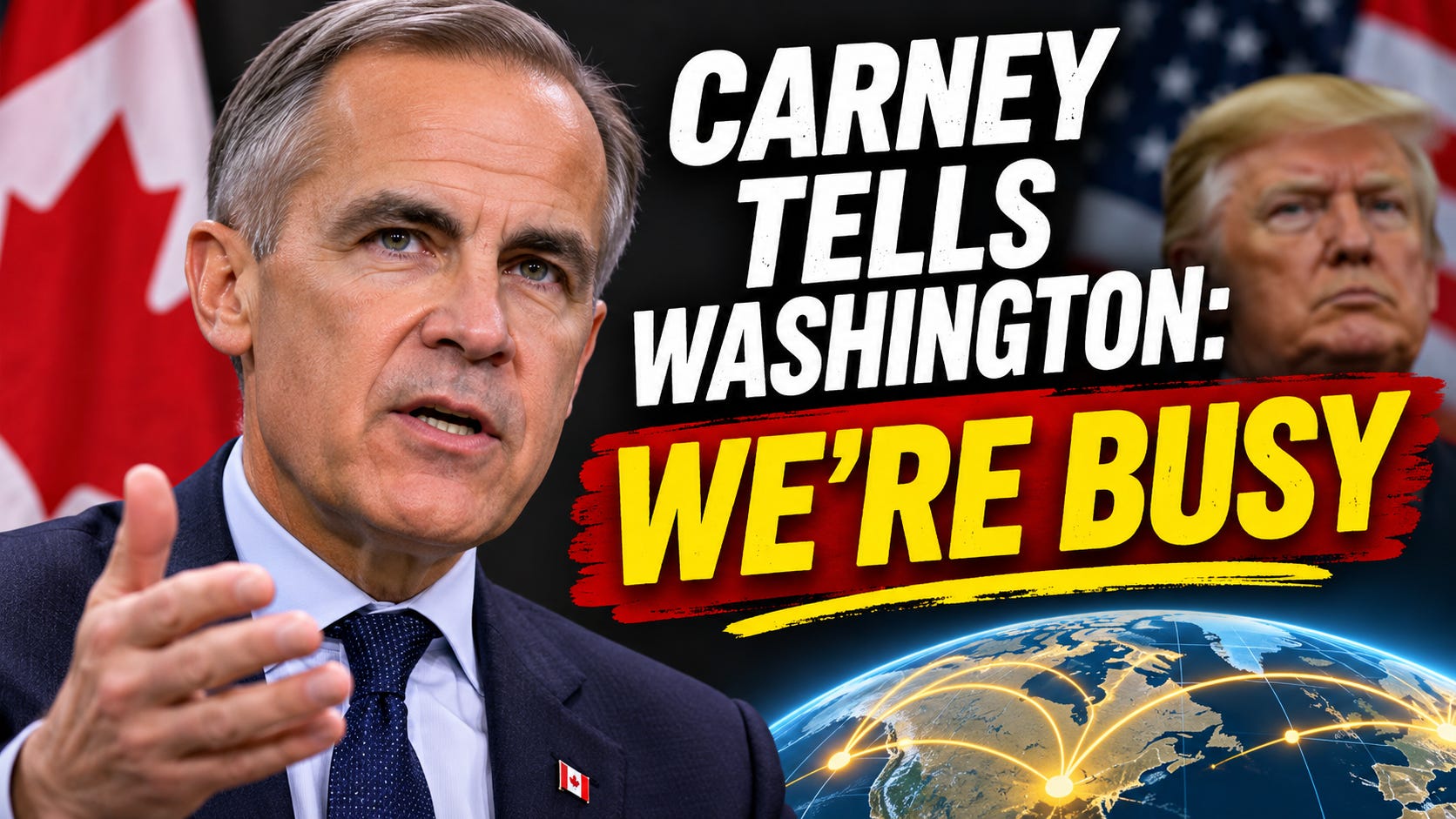
There’s a difference between wanting to make a deal and needing to make one.
Mark Carney just explained that difference to an American audience.
And he did it without raising his voice.
On November 18, Carney appeared remotely at the New York Times DealBook Summit, speaking with Andrew Ross Sorkin from China.
Sorkin wanted to know how Canada’s trade negotiations were going.
Carney said they were going exceptionally well. Tariffs had been reduced, and more than 90% of trade irritants had been addressed.
Then came the punchline.
He was talking about China.
With the United States, he explained, Canada still had a series of unresolved issues.
I suspect that wasn’t quite the answer the American audience expected.
But it got better.
Trump Has All the Cards. Apparently.
Sorkin reminded Carney that Donald Trump had recently claimed Canada was willing to give the United States anything it wanted.
Trump also claimed America held all the cards.
So Sorkin asked Carney what cards Canada had.
Carney’s first answer was worth remembering:
“Our cards are that everyone else in the world wants to deal with us.”
That’s quite a statement from the prime minister of a country that has spent decades depending heavily on one customer.
And it wasn’t just talk.
Carney pointed to Canada’s strong fiscal position, its energy resources, growing investment opportunities and expanding relationships with countries outside the United States.
He also acknowledged something important.
Moving away from decades of deep economic integration with America won’t be easy.
Nobody with a functioning calculator should pretend otherwise.
But difficult and impossible are two different things.
And continuing to depend on a trading partner that keeps changing the rules carries risks of its own.
The China Comparison Washington Won’t Enjoy
Carney wasn’t suggesting China had suddenly become Canada’s best friend.
In fact, he made a point of explaining the limits of the relationship.
Canada sells China agricultural products, energy and other commodities. We import manufactured goods.
But Carney emphasized that Canada does not share sensitive intelligence infrastructure with China.
That’s an important distinction.
Canada can trade with China without pretending that China is a trusted military or intelligence ally.
And Canada can remain a NATO ally of the United States without surrendering the right to develop other markets.
Those two things aren’t contradictory.
They’re what independent countries do.
Carney also made another observation that deserves attention.
Both China and the United States have used economic integration as a weapon.
Think about that.
For generations, Canadians were encouraged to believe that closer economic ties with America meant greater security and prosperity.
Much of the time, they did.
But when the country buying your products can suddenly threaten tariffs, disrupt supply chains or demand concessions, dependence becomes a vulnerability.
That’s the lesson Canada is learning.
And I would argue we’re learning it several decades later than we should have.
The Part About Insurance
One of the most revealing moments came when Carney discussed the cost of diversifying.
He didn’t pretend it was free.
Building alternative supply chains, developing new markets and reducing dependence on American technology all cost money.
Carney called it insurance.
That’s a pretty good description.
You don’t buy insurance because you’re certain your house will burn down.
You buy it because you understand what happens if it does.
Carney pointed to Greenland, the 51st-state rhetoric, Ukraine and Starlink as examples of why Canada can no longer assume that old relationships will always operate according to old rules.
He wasn’t saying Canada should abandon its American alliance.
He was saying Canada must stop treating that alliance as an unconditional guarantee.
There’s a difference.
And after everything Canadians have heard from Washington, it’s a distinction worth making.
Meanwhile, Canada Has Other Appointments
Carney reminded his American audience that Canada had recently concluded new trade agreements involving the Philippines and ASEAN.
He also spoke about plans to complete an agreement with India within three months.
That India agreement was still a goal, not a completed deal.
The distinction matters.
But so does the direction.
Carney said Canada already had free-trade access to markets representing roughly two billion consumers outside the United States, with plans to expand that reach.
Access doesn’t guarantee sales, of course. Canadian businesses still have to compete, establish customers and deliver products.
But at least they’re being offered more doors to walk through.
And that’s a considerable improvement over standing outside Washington waiting for someone to answer the bell.
Carney also made clear that Canada remains interested in an American trade agreement.
He believes a good arrangement is possible.
But Canada won’t sign something that doesn’t make sense simply because Washington wants a signature.
Then he delivered the line that, for me, summed up the entire interview.
“We’d like to do the deal. But if the U.S. doesn’t want to do the deal, we’re busy.”
There it is.
No threats.
No chest-thumping.
No announcement that Canada is walking away from America.
Just a prime minister explaining that Canada has a country to run and an economy to build.
And we’re not putting everything on hold while Donald Trump decides what he wants this week.
Here’s What I Think Has Changed
For years, Canadian governments approached American trade negotiations from a position of necessity.
We needed access to their market.
We needed certainty.
We needed Washington to understand how much our economies depended on each other.
And we still need a productive trading relationship. Geography hasn’t changed, and neither has the importance of American customers to Canadian businesses.
But something else has changed.
Canada is beginning to act like a country that understands the danger of having too much of its economic future controlled by somebody else.
Carney isn’t promising that diversification will happen overnight.
He isn’t pretending China is harmless.
And he isn’t claiming Canada can simply replace the American market.
What he’s doing is more practical.
He’s making sure Canada has alternatives.
Because when you have alternatives, you can negotiate.
When you have none, you’re at somebody else’s mercy.
Trump says America holds all the cards.
Maybe he should take another look at the table.
Canada hasn’t folded.
We’ve started playing a different game.
The Recap…
Mark Carney told an American audience that Canada’s trade negotiations are going exceptionally well.
He was talking about China.
Washington still has unresolved issues, while Canada keeps expanding its trading relationships elsewhere.
Carney’s message was simple: Canada wants a good American trade deal, but it has other business to conduct.
The Gut-Punch…
Trump thinks Canada is waiting for permission to build its future.
Carney just reminded him that we’re a country, not a customer standing in line.
Source Credit:
The New York Times — DealBook Summit, November 18, 2026. Andrew Ross Sorkin’s interview with Prime Minister Mark Carney.
The Canadian Press — November 18, 2026. Reporting on Carney’s U.S. trade negotiations and meeting with Trump in China.
Associated Press — November 18, 2026. Reporting on Canada’s expanding trade relationship with China.
CBC News — November 18, 2026. Reporting on Canada’s negotiations with Washington and diversification efforts.
If you enjoy thoughtful conversations, Canadian stories, and the occasional smart-ass observation about the world we’re living in, you’re in the right place.
Subscribe free and get new stories, insights, and observations delivered directly to your inbox.
No paywall.
No spam.
No nonsense.
Leave anytime with a single click.
I promise not to take it personally.
Hello to Fred’s readers. I read an article by a Canadian journalist named Dean Blundell yesterday. He is active on substack. I’m going to post the title of the article in here so that anyone who might be interested in reading about the latest “slap in the face” delivered from trump and his administration to Canada can find it. I really only read it to find out about Ottawa’s response.
Pete Hegseth Restricted Military Ties With Canada Because We Won’t Buy Their F-35’s And The Threat Is As “Useless As He Is.”
But difficult and impossible are two different things. I like this statement Fred. I can’t expound upon it so I’m going to leave it as it is.