

Something interesting is happening between Canada and the United States right now.
And no… it’s not just politics.
It’s money.
More specifically… where Canadians are choosing not to spend it.
For months, we heard stories about fewer Canadians crossing the border. Snowbirds staying home. Weekend shopping trips slowing down. Flights looking thinner.
At first, the numbers looked noticeable, but not catastrophic.
Then someone looked deeper.
Turns out, the slowdown wasn’t just a slowdown.
It may be a quiet economic rebellion.
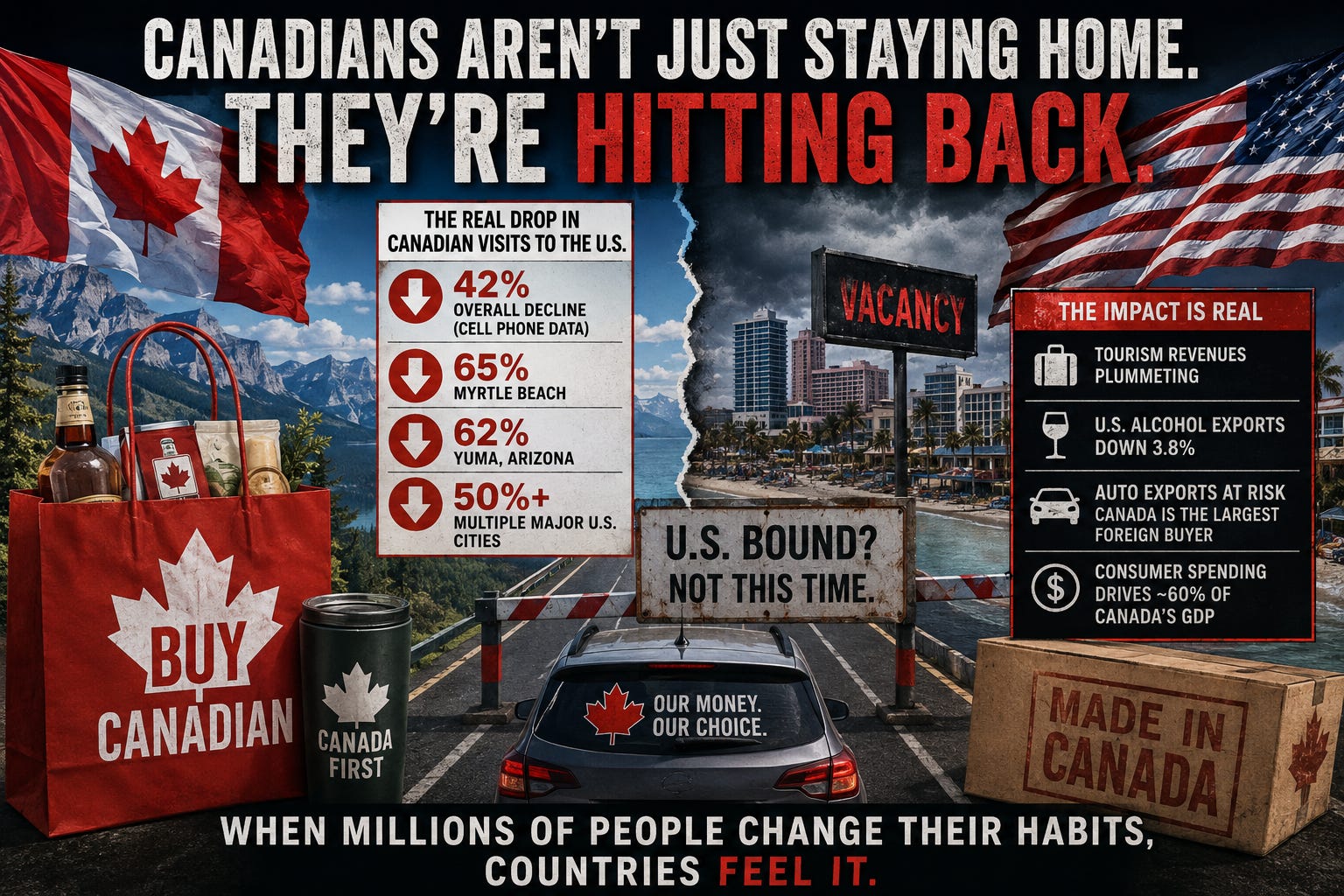
The 42% Number That Changes The Story
Early estimates suggested Canadian travel to the U.S. had dropped about 25%.
That got attention.
But newer behavioral data… using cellphone location tracking rather than traditional border counts… suggests the real decline may be closer to 42%.
That’s not a rounding error.
That’s a mood shift.
And it matters because border crossing numbers don’t tell the whole story.
Business travel still happens. Truckers still cross. Trade still moves.
But the family taking the Florida vacation?
The retired couple heading to Arizona for a month?
The spur-of-the-moment shopping trip?
That’s the stuff disappearing.
And when millions of people quietly stop doing something… the bill eventually lands on somebody’s desk.
America’s Tourism Industry Is Starting To Notice
Some U.S. cities are getting hit hard.
Canadian visits reportedly dropped…
65% in Myrtle Beach
62% in Yuma, Arizona
More than 50% in places like Miami, Palm Beach, San Francisco, and Panama City
Those aren’t tiny dips.
Those are the kinds of numbers that make hotel managers nervous and tourism boards start whispering into politicians’ ears.
And then came something almost funny… if it wasn’t so revealing.
Some U.S. officials started publicly pleading with Canadians.
The tone suddenly changed from…
“Take the tariffs.”
To…
“Please come back, we miss you.”
Funny how economics works.
The Booze Shelves Told The Story Before Politicians Did
One of the clearest signals happened quietly inside liquor stores.
Several Canadian provinces pulled U.S. alcohol products from shelves.
Suddenly, buying American whiskey or wine wasn’t automatic anymore.
The result?
U.S. alcohol exports reportedly dropped 3.8%, with Canadian pullback being part of the explanation.
When industry CEOs start saying things like “we are suffering”, that’s when you know this has moved beyond symbolism.
This Isn’t Just Patriotism. It’s Self-Defense.
Let’s be honest about what’s driving this.
A lot of Canadians feel insulted.
Tariffs on Canadian auto, steel, aluminum, and forestry industries landed like a slap.
You can only tell a country they’re a problem so many times before people start quietly saying:
“Fine. We’ll spend our money somewhere else.”
And that’s exactly what seems to be happening.
More Canadians are vacationing at home.
Buying Canadian products.
Keeping spending inside the country.
And considering that consumer spending makes up roughly 60% of Canada’s economy, this isn’t just symbolism.
Money moving domestically matters.
The Real Leverage Might Be Cars
Here’s where things get interesting.
Canada happens to be the largest foreign buyer of U.S.-made automobiles.
Read that again.
Largest.
Foreign.
Buyer.
If consumer anger ever spreads meaningfully into auto purchasing decisions?
That’s not a tourism story anymore.
That becomes an industrial story.
And industrial stories get political very fast.
The Bigger Story Nobody’s Talking About
Here’s what I think this really means:
Governments may no longer be fully driving trade disputes.
People are.
Every purchase is becoming a tiny vote.
Buy this.
Skip that.
Vacation here.
Avoid there.
No press conference.
No protest signs.
Just millions of quiet decisions adding up.
And frankly?
That may be far more powerful than politicians expected.
Because governments negotiate.
Consumers punish.
The Recap…
Something bigger may be happening than border numbers first showed.
New cellphone tracking suggests Canadian visits to the U.S. may be down 42% — far worse than early estimates.
Tourism cities are hurting. U.S. alcohol exports are slipping.
Turns out Canadians may be doing something governments can’t control:
Voting with their wallets.
The Gut-Punch…
Trade wars always sound like politicians arguing in expensive suits.
But eventually, ordinary people join the conversation.
Not with speeches.
With spending.
And when millions of people quietly change habits at the same time?
That’s when countries start paying attention.
Source credit:
Research compiled from reporting on Canadian travel behavior, mobile location data, tourism trends, trade impacts, and consumer spending patterns related to Canada–U.S. tariff tensions.
🔎 The GeezerWise Standard
This space is built on disciplined thinking.
Facts over spin.
Verification before amplification.
Good-faith discussion over tribal noise.
I use AI tools to help shape my spoken drafts into clear writing.
The judgment, conclusions, and final message are mine.
If you’re new here, this explains how I decide what’s worth sharing:
How I Decide What’s Worth Sharing → [link]
💌 Subscribe at GeezerWise.com to receive future letters:
www.geezerwise.com/subscribe
— Fred Ferguson
GeezerWise
#CanadaStrong
So proud of my fellow Canadians for voting with their wallets! We have learned to spend our money in a way that benefits our own country and our own citizens. Let’s keep it going for decades to come. Canada proud 🇨🇦
Good for you, Canada. I'm proud of our Northern neighbors for taking a stand against the stupidity of 70 million 'merkans. We don't deserve your friendship or your dollars untill we get our act together and prove to you we can, once again be good neighbors.