

There’s a number I think Donald Trump should have a good look at.
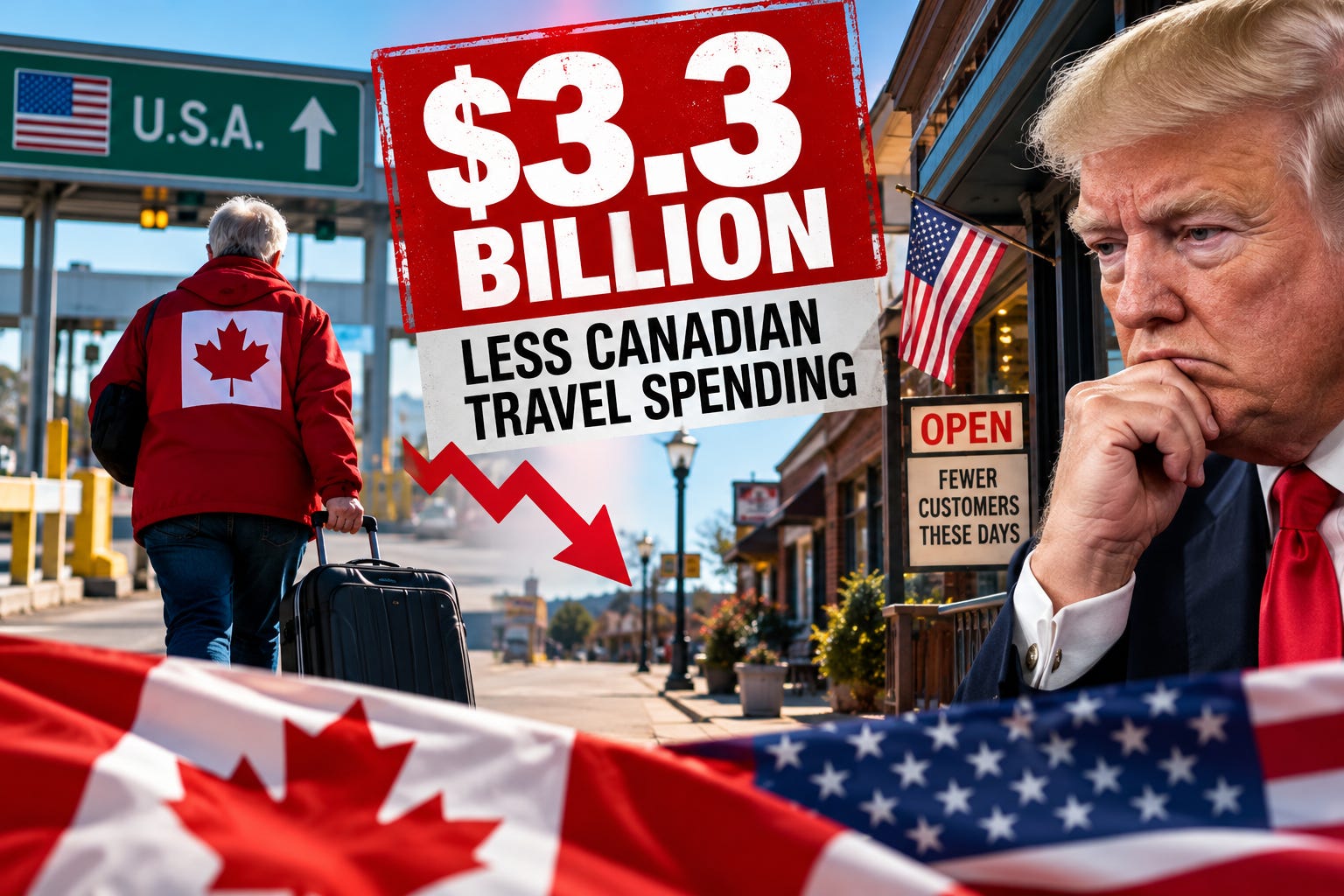
$3.3 billion.
That’s approximately how much Canadian spending on trips to the United States dropped in 2025 compared with 2024, measured in Canadian dollars.
Not tariffs collected by Ottawa.
Not some government retaliation program.
Money Canadians simply didn’t spend south of the border.
And now an American congressman is warning his colleagues that businesses along the northern border are suffering because Canadians are staying away.
Imagine that.
You spend months threatening your neighbour, insulting its leaders, talking about swallowing its country, and then act surprised when the neighbour stops dropping by with his wallet.
I ran across something interesting in a U.S. congressional proceeding (video blow) that I think Canadians should know about.
On September 16, Democratic Congressman Jamie Raskin of Maryland spoke during a House Judiciary Committee debate over legislation called the No Racketeers on Our Shores Act.
Raskin was opposing the bill.
But what caught my attention wasn’t the bill’s name, although that’s quite a mouthful.
It was what he told his American colleagues about Canada.
He said Canadians were boycotting the United States and that businesses in northern border communities were paying the price.
He pointed to Michigan, New York and Vermont, where Canadian visitors have long been part of the local economy.
Now, Raskin’s description of struggling businesses is his assessment. It isn’t a verified count of business closures caused by the boycott.
But the larger change in Canadian spending is very real.
And the numbers are worth examining.
Canadians didn’t just complain. They changed their behaviour.
According to Statistics Canada, Canadian visits to the United States fell 23.5% in 2025 compared with 2024.
Spending on those visits dropped approximately 15.1%, from $22.1 billion to $18.8 billion.
That’s the $3.3 billion difference.
To be clear, that figure represents the overall decline in Canadian travel spending in the United States. We can’t attribute every dollar to a political boycott.
Exchange rates, travel costs and other factors influence people’s decisions too.
But we don’t need to pretend the political relationship has nothing to do with it.
Trump spent months talking about Canada becoming America’s 51st state.
He threatened to use economic force.
He imposed tariffs on Canadian goods.
And Canadians started reconsidering where they wanted to spend their money.
Some cancelled American vacations.
Some stopped making cross-border shopping trips.
Others began looking more carefully at the products they were buying.
Nobody needed to organize a national referendum.
Nobody needed to pass a law.
Canadians just started making different choices.
And those choices added up.
During the first quarter of 2026, Canadian visits to the United States were still down 10.6% compared with the same period in 2025. Spending was down another 13.6%.
The monthly numbers have fluctuated since then, so this isn’t a story about travel declining every single month.
It’s about a relationship that has changed.
And apparently, American politicians are beginning to understand the consequences.
Here’s where the story gets even more interesting.
The legislation Raskin was speaking against would give the U.S. government additional immigration powers targeting certain foreign government officials accused of economic discrimination against American interests.
In plain English, Washington wants another way to punish foreign officials over economic disputes.
The bill isn’t specifically aimed at ordinary Canadian shoppers or tourists.
It also hasn’t become law.
But Raskin argued that giving the administration another broadly defined power could make America’s already strained relationships with its allies even worse.
And on September 16, the Republican-controlled House Judiciary Committee advanced the legislation by a 15–8 vote.
Think about the timing.
American businesses are losing Canadian customers.
American politicians are hearing complaints about the damage.
And rather than concentrating entirely on repairing the relationship, Congress is considering another tool for confrontation with foreign governments.
I have a question.
How exactly does threatening other countries persuade their citizens to come back and spend money in America?
Because I spent years in business, and I don’t remember that chapter in the customer service manual.
Trump forgot something about customers.
The United States has enormous economic power.
Nobody disputes that.
But economic relationships aren’t supposed to be one-way streets.
For generations, Canadians crossed the border to shop, vacation, attend sporting events, visit family and spend money.
American businesses welcomed us.
They advertised to us.
They built businesses around our visits.
And Canadians generally thought of the United States as a friendly neighbour.
Then along came a president who decided our country should become his 51st state.
Apparently, we’re supposed to smile politely, accept the insults and keep bringing our credit cards.
Well, some Canadians have a different idea.
We can spend our money in Canada.
We can visit other countries.
We can buy from businesses that don’t operate under a government constantly threatening our sovereignty.
That’s not hostility toward ordinary Americans.
Many of those people are suffering from decisions they never supported.
It’s simply Canadians deciding where their money goes.
And there’s an important difference between those two things.
We didn’t declare war on American small businesses.
We’re responding to a president who keeps treating our country like something he can acquire.
The part Washington may be underestimating.
Even if Trump stopped threatening Canada tomorrow, would Canadians immediately return to their old habits?
Some probably would.
Others might not.
Once somebody discovers they enjoy vacationing in Nova Scotia instead of Florida, that becomes another option.
Once a family starts buying more Canadian products, some of those purchasing habits may stick.
Once businesses develop new suppliers and customers, they don’t necessarily abandon those relationships because Washington suddenly decides to behave itself.
That’s the part of this story I find most interesting.
The damage to a trading relationship isn’t always limited to the period when tariffs are in place or politicians are fighting.
Sometimes the consequences outlast the argument.
Trust is difficult to build.
It’s remarkably easy to destroy.
And it doesn’t automatically return because somebody in Washington decides the fight is over.
Jamie Raskin understands that Canada isn’t some hostile foreign power.
We’re neighbours.
We’ve been allies through wars, economic crises and generations of shared history.
Our economies are deeply connected.
But being neighbours doesn’t mean Canadians have to accept being bullied.
And friendship doesn’t mean one country gets to threaten the other’s independence.
For months, Trump has been talking about the economic pressure America can put on Canada.
Now an American congressman is talking about the economic consequences of Canadians staying away.
There’s a lesson in there.
Whether Washington learns it is another question.
The Recap…
Canadian spending on trips to the United States dropped approximately $3.3 billion in 2025.
Now Democratic Congressman Jamie Raskin is warning that Canadian boycotts are hurting American businesses along the northern border.
Meanwhile, Republicans have advanced legislation that could create another source of conflict with foreign governments.
Canadians are discovering that they don’t need a tariff to make an economic decision.
Sometimes they just need to keep their wallets in their pockets.
The Gut-Punch…
Trump wanted to teach Canada a lesson about American economic power.
Now American businesses are learning what happens when Canadians decide to spend their money somewhere else.
Sources
Statistics Canada
International travel, 2025… Statistics Canada… Annual Canadian travel and spending figures.
National tourism indicators and international travel statistics… Statistics Canada… Quarterly and monthly travel data.
United States Congress
U.S. House Judiciary Committee, September 16, 2026… Legislative markup and remarks by Congressman Jamie Raskin opposing the bill.
If you enjoy thoughtful conversations, Canadian stories, and the occasional smart-ass observation about the world we’re living in, you’re in the right place.
Subscribe free and get new stories, insights, and observations delivered directly to your inbox.
No paywall.
No spam.
No nonsense.
Leave anytime with a single click.
I promise not to take it personally.
Hopefully Canadians spend that $3billion at home.
It just shows that Canadians have the intelligence that is missing in the disunited states!