

I keep hearing about the enormous economic decisions being made in boardrooms and government offices.
Tariffs. Trade agreements. Pipelines. Factories. Export markets.
All important.
But I stumbled across another number that reminded me there are about 41 million other economic decision-makers in this country.
They’re called Canadians.
And apparently we’ve been busy.
Canada had a record tourism summer in 2025.
Between May and August, tourism generated an estimated $59 billion in revenue.
Up 6% from the year before.
Here’s the part that caught my attention…
$44.4 billion of it came from Canadians travelling in Canada.
Not Americans.
Not Europeans.
Not some foreign investment fund arriving with briefcases full of money.
Us.
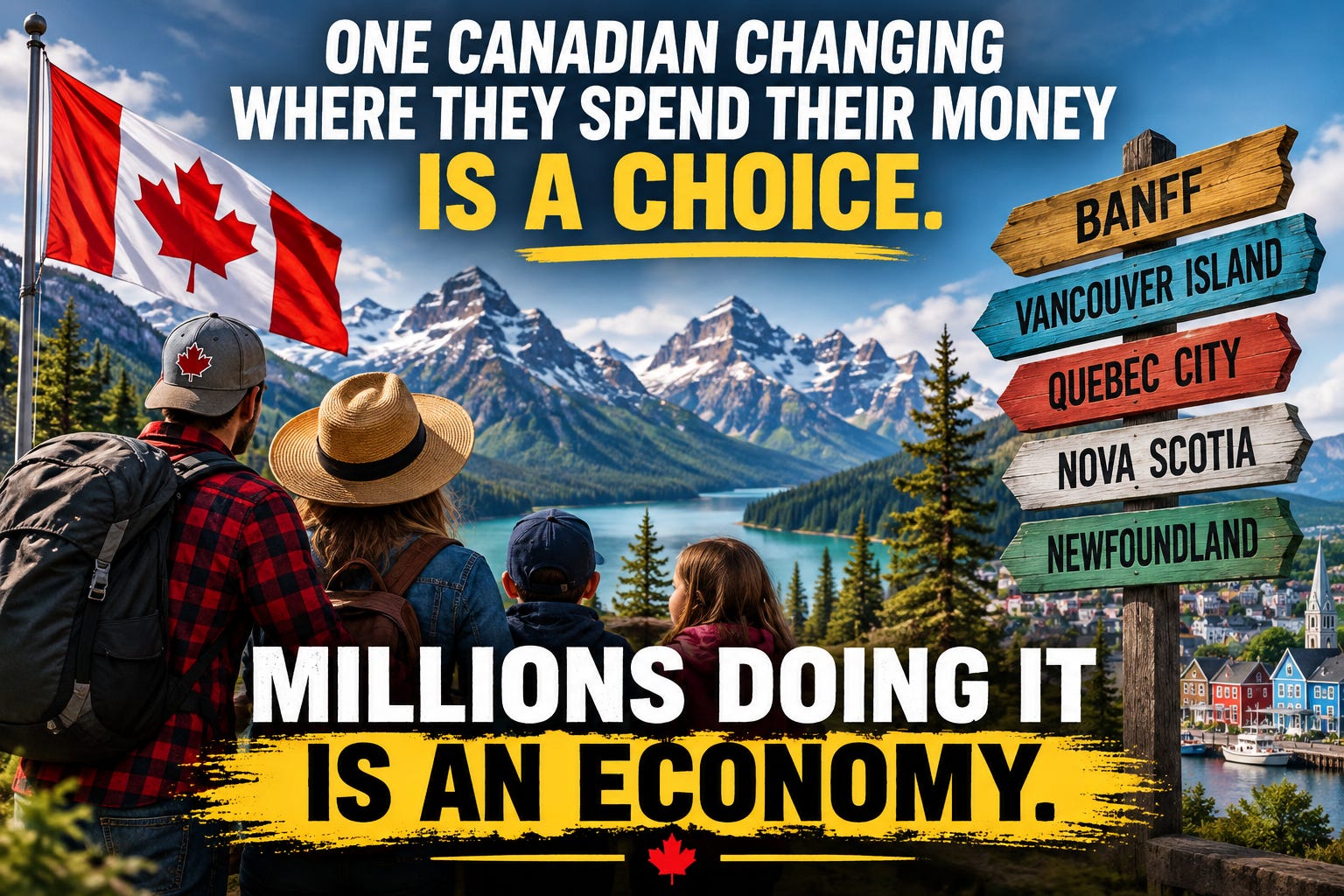
Canadians deciding that maybe Quebec City, Vancouver Island, Newfoundland, Banff or Halifax wasn’t such a bad place to spend the vacation money after all.
Destination Canada says domestic travellers were a major reason for the record summer.
Statistics Canada has since given us the full-year picture.
In 2025, Canadians made 342 million visits within Canada, up 1.5% from 2024.
Meanwhile, Canadian visits to the United States fell 23.5%.
That is not a rounding error.
Something changed.
And you can see it in the money.
Domestic tourism spending reached $81.3 billion in 2025, an increase of 8.7% from the previous year.
That’s what “buy Canadian” looks like when nobody is holding a flag
This is the part I find interesting.
Economic patriotism doesn’t necessarily require some grand sacrifice.
Sometimes it’s just changing the destination.
Instead of Arizona, maybe Alberta.
Instead of Maine, maybe Nova Scotia.
Instead of California, maybe Vancouver Island.
Nobody needs to stand on Parliament Hill singing O Canada while booking the hotel.
You simply make a different purchase.
And enough people apparently did.
Destination Canada estimates that Canadians redirecting travel spending back home added about $1.5 billion to the Canadian tourism economy in 2025 alone.
They’re projecting the effect could reach $4.4 billion between 2025 and 2027.
That’s real money.
And unlike some economic statistics that disappear into spreadsheets somewhere, tourism money lands all over the place.
Hotels.
Restaurants.
Airlines.
Gas stations.
Museums.
Fishing guides.
Coffee shops.
Campgrounds.
The little family restaurant where somebody’s grandmother still thinks a serving size means you shouldn’t be able to walk afterward.
Statistics Canada says tourism supported roughly 700,000 jobs in 2026, and the industry touches accommodation, transportation, restaurants, recreation and plenty of businesses that don’t necessarily have the word “tourism” hanging over the door.
And here’s another number I didn’t expect.
In 2025, tourism generated $34.6 billion in government revenue.
For every $100 Canadian tourists spent travelling inside Canada, governments collected an average of $24.54 in attributable revenue.
Turns out taking the grandkids to Niagara Falls is economic policy.
Who knew?
And then I noticed the cars
This is where the story gets even more interesting.
Canadians didn’t just change where they vacationed.
Something similar started happening with automobiles.
According to the Trump White House’s own figures, U.S. motor-vehicle exports to Canada fell from approximately $25.9 billion to $20.3 billion when comparing April 2025–March 2026 with the same period a year earlier.
That’s roughly a 22% drop.
At the same time, Canadian imports of vehicles from Mexico increased about 23.6%, while imports from Japan, Korea and Germany increased by roughly 10% to 14%.
Altogether, Canadian vehicle imports from countries other than the United States increased by about $2.85 billion over the comparison period cited by the White House.
Now, let’s not get carried away.
Those numbers don’t prove every Canadian walked into a dealership, saluted the maple leaf and deliberately rejected an American vehicle.
Tariffs changed prices. Manufacturers changed supply. Dealers changed inventories. Consumers had different choices.
Economies are messy things.
But money moved.
That’s the part we shouldn’t miss.
One Canadian can’t do much. Millions can.
I’ve written a lot lately about Canada’s attempt to diversify trade.
Find new customers.
Build new infrastructure.
Sell more to Europe and Asia.
Reduce our vulnerability to one enormous customer south of the border.
Those are government and business decisions.
But there is another side to economic diversification that doesn’t require anybody’s permission.
Consumer spending.
A Canadian family deciding to vacation in Canada isn’t going to alter the national economy.
Neither is somebody choosing one vehicle over another.
But multiply small decisions by millions of households and suddenly you’re not talking about symbolism anymore.
You’re talking about demand.
And businesses follow demand.
That’s Economics 101 without having to buy the textbook.
There’s one more reason I’m paying attention.
The story didn’t end with that record summer.
Statistics Canada released its newest tourism figures just four days ago.
Canadian tourism GDP continued growing in the second quarter of 2026. Tourism spending reached $28.5 billion for the quarter, while tourism-related employment increased again.
And Canadian domestic trips in the first quarter of 2026 were up 2.3% from a year earlier, with domestic travel spending up 5.1%.
So I’m not calling this a revolution.
I’m calling it something more useful.
Evidence.
Canadians changed some spending habits.
Billions of dollars changed direction.
Businesses noticed.
The statistics noticed.
And maybe that’s worth remembering the next time somebody tells you ordinary Canadians don’t have much influence over what happens to this economy.
Individually?
Not much.
Forty-one million of us?
That’s a different bloody spreadsheet.
The Recap…
Canada’s record tourism summer wasn’t just tourists discovering Canada.
Canadians rediscovered Canada.
Domestic travel surged while Canadian visits to the United States dropped sharply.
Billions of dollars changed direction because millions of ordinary people changed relatively ordinary decisions.
Sometimes economic power isn’t sitting in Ottawa.
Sometimes it’s sitting in your wallet.
The Gut-Punch…
One Canadian changing where they spend their money is a choice.
Millions doing it is an economy.
Source credit: Statistics Canada; Destination Canada; Government of Canada; White House trade data.
If you enjoy thoughtful conversations, Canadian stories, and the occasional smart-ass observation about the world we’re living in, you’re in the right place.
Subscribe free and get new stories, insights, and observations delivered directly to your inbox.
No paywall.
No spam.
No nonsense.
Leave anytime with a single click.
I promise not to take it personally.
I hope we in America have the same feelings for recovering our country !! 💙💚🩵💙🩵💚
🙌👏❤️🇨🇦