

I found a number the other day that grabbed my attention and made me stop.
$25.6 billion.
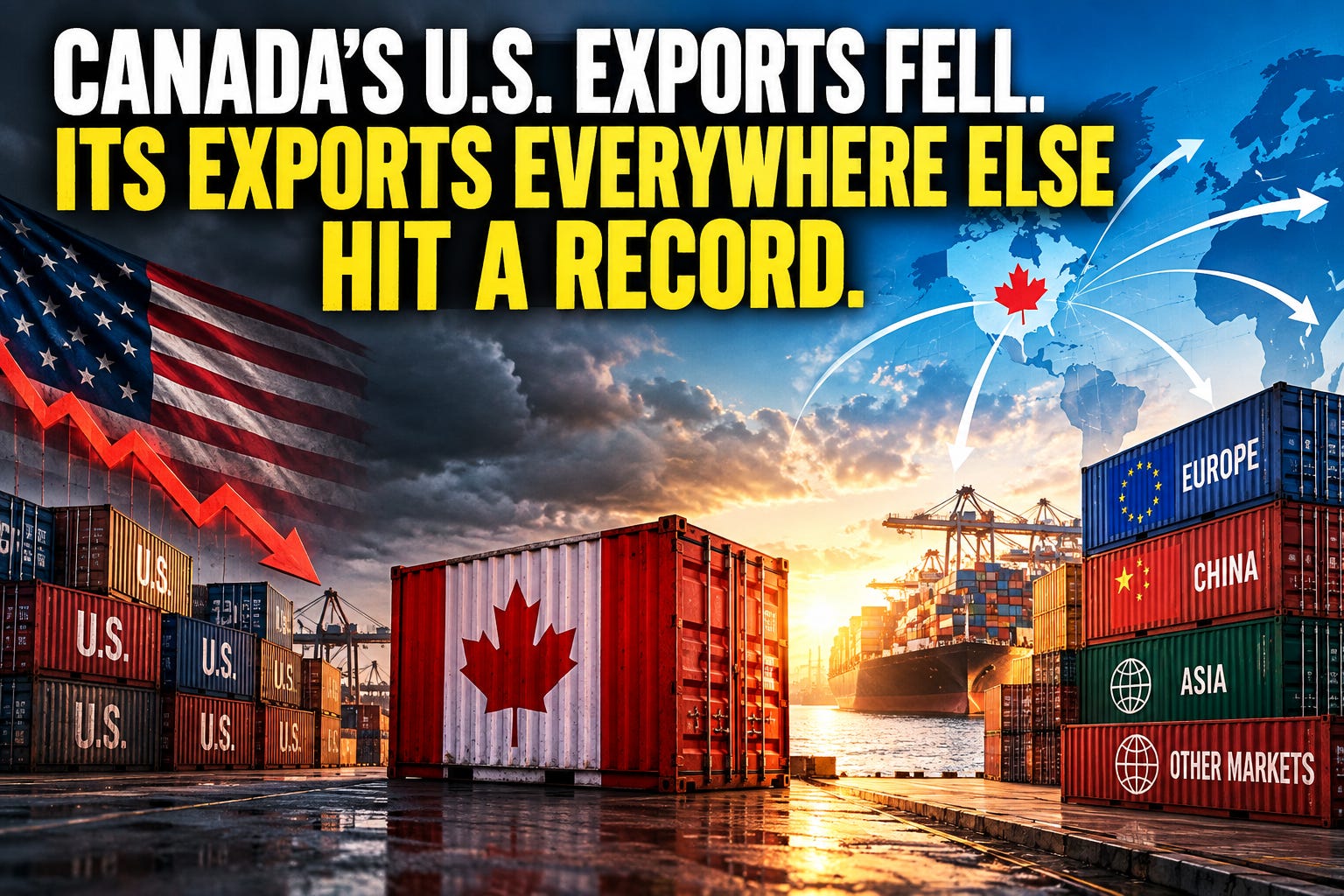
That is how much merchandise Canada exported to countries other than the United States in July.
Not in a year.
In one month.
And according to Statistics Canada, it was the highest monthly total ever recorded.
Now, before we start firing off the champagne corks, there’s another number we need to look at.
Canada’s total merchandise exports actually fell 2.3% in July.
Why?
Exports to the United States dropped 6.6%.
But exports everywhere else went the opposite direction.
They jumped 7.4% in a single month, reaching that record $25.6 billion.
That pushed the non-U.S. share of Canadian merchandise exports to 33.7%.
One-third.
That caught my attention.
Because for years we’ve been told some version of the same thing..
Canada needs the United States.
Of course we do.
The United States remains our biggest customer by a country mile, and pretending otherwise would be economic fairy dust.
But there is a very big difference between saying…
“The United States is our biggest customer.”
and…
“The United States has to be our only serious customer.”
Canada appears to be learning that difference rather quickly.
Look where the new business is going
Statistics Canada says July’s increase in non-U.S. exports included stronger shipments to the Netherlands, China and Germany.
Canadian canola exports were also up 43.2% in July, with increased shipments going to China, Pakistan and Japan. Through the first seven months of 2026, canola exports were up 32.2% compared with the same period in 2025.
That doesn’t mean Canada has somehow replaced the American market.
We haven’t.
What it means is that Canadian companies are finding customers somewhere else.
And that is exactly what diversification is supposed to look like.
Not a press conference.
Not a slogan.
A shipment leaving the country with somebody else’s address on the invoice.
Then I looked at the money coming IN
This is where things got even more interesting.
Foreign investors put $100.6 billion into Canadian securities during the second quarter of 2026.
That was unprecedented.
Foreign investment in Canadian debt securities reached $110.2 billion, also a record, including $80.8 billion in government bonds.
Foreign direct investment in Canada also increased, reaching $25.9 billion in the second quarter, up from $18.8 billion in the first.
By July, non-residents had accumulated a record $179 billion in Canadian securities during 2026.
Money doesn’t have feelings.
It doesn’t wave flags.
It doesn’t care what somebody yelled on social media this morning.
It goes where investors believe there is an opportunity worth taking.
That doesn’t mean Canada’s economy is suddenly bulletproof.
It isn’t.
The Bank of Canada is warning that new U.S. tariffs could hurt Canadian growth later this year.
But that’s what makes these other numbers important.
Canada is taking a hit from its largest trading partner while simultaneously building relationships elsewhere.
That isn’t immunity.
It’s insurance.
And now defence spending is becoming industrial policy too
Here is another piece of this puzzle.
On September 25, Canada announced a non-binding agreement setting the groundwork for negotiations to potentially buy six Saab GlobalEye surveillance aircraft.
The interesting part isn’t simply that Saab is Swedish.
It’s what Canada is asking to get along with the aircraft.
The federal government says Saab’s potential partnership with Bombardier could support domestic production, skilled Canadian jobs, Canadian suppliers, research and development, and even future exports of Canadian-built GlobalEye aircraft.
That’s a very different way of looking at defence procurement.
Instead of…
Here’s several billion dollars. Please send us airplanes.
The idea is closer to…
If we’re spending billions anyway, how much of the work can we build here?
That is a question Canada probably should have been asking more often for the last forty years.
Meanwhile, Canadian buying decisions are being noticed south of the border
This one really jumped out at me.
McManis Family Vineyards in California has put 3,500 acres, ten vineyards and its winery operation up for sale.
The Los Angeles Times reported that its exports to Canada collapsed.
Canada once accounted for about 40% of the company’s export sales.
Now?
About 5%.
The Canadian boycott isn’t the only problem facing California wine. The industry is also dealing with falling wine consumption, oversupply and other financial pressures.
But in this particular case, losing Canadian customers clearly mattered.
And that should tell Canadians something.
Our individual shopping decisions may feel insignificant.
One bottle of Ontario wine instead of California wine isn’t going to shake Wall Street.
But multiply that decision by millions of Canadians?
Companies notice.
Industries notice.
Eventually accountants notice.
This is the part I don’t want us to forget
None of these numbers proves Canada has “won” a trade war.
Trade wars aren’t hockey games.
There isn’t a horn at the end followed by somebody skating around with a trophy.
Canadian businesses are being hurt too. Some sectors remain heavily dependent on the American market, and replacing decades-old supply chains isn’t something you accomplish between breakfast and lunch.
But something important is happening underneath all the political noise.
Canada is discovering other customers.
Foreign investors are buying Canadian assets.
Defence procurement is increasingly being tied to Canadian industrial capacity.
And Canadians themselves are learning that where they spend their money matters.
Maybe the biggest mistake Canada made wasn’t becoming close economic partners with the United States.
That partnership made both countries enormously prosperous.
The mistake was allowing ourselves to believe there could never be a reason to need a Plan B.
We have one now.
It isn’t replacing America.
It’s making sure America isn’t our only option.
The Recap…
Canada’s exports to the U.S. fell sharply in July.
But exports everywhere else jumped 7.4% to a record $25.6 billion.
Foreign money is flowing into Canadian securities at record levels too.
Canada isn’t replacing the American market.
We’re building alternatives to depending on it.
The Gut-Punch…
A good neighbour is valuable.
Needing that neighbour for everything is vulnerability.
Canada is finally learning the difference.
Source credit:
Statistics Canada… Canadian International Merchandise Trade, July 2026; Canada’s Balance of International Payments, Q2 2026.
Government of Canada… Defence Investment Agency, GlobalEye negotiations, September 25, 2026.
Los Angeles Times… reporting on McManis Family Vineyards and the effect of Canada’s U.S. wine boycott.
Financial Post/Posthaste… foreign investment in Canadian securities.
If you enjoy thoughtful conversations, Canadian stories, and the occasional smart-ass observation about the world we’re living in, you’re in the right place.
Subscribe free and get new stories, insights, and observations delivered directly to your inbox.
No paywall.
No spam.
No nonsense.
Leave anytime with a single click.
I promise not to take it personally.
Interesting info Fred, Carney's done a great job in getting our economy diversified, and I think that those percentages of sales to non-USA countries will only continue to grow. Thanks for bringing us good news about Canada's prospects.
I'd be interested in a stratification. Remove the oil that goes in pipelines to the US and the power that pops over on the integrated grid. Now, what do the figures look like? I reckon that might be eye catching.