

For years, Canada treated pipelines like family dinners after too much wine.
Everybody yelled. Nobody solved anything.
Industry blamed government. Government blamed politics. Provinces blamed Ottawa. Ottawa blamed the market. Meanwhile, Canada kept selling the bulk of its oil to one customer — the United States — while pretending diversification was just around the corner.
It never came.
Now something quietly bigger may be happening.
And if it plays out, it could change how Canada thinks about energy, infrastructure, and who gets to profit from national wealth.
Here’s the part nobody likes to admit:
Big infrastructure in Canada doesn’t magically appear because executives suddenly feel patriotic.
Especially not across the Rocky Mountains.
Those mountains are beautiful when you’re taking pictures.
They are a financial migraine when you’re trying to build a pipeline.
Massive terrain. Enormous engineering costs. Political risk stacked on top of legal risk stacked on top of environmental battles.
That’s why the private sector hasn’t exactly been stampeding to build giant pipelines westward.
In fact, Canada hasn’t seen a major privately built pipeline crossing the Rockies in decades.
Which brings us to the uncomfortable truth hiding underneath all the political shouting:
The “free market will handle it” argument sounds great on television.
Reality has been a lot messier.
The countries Canada competes against… whether it’s the United States, the Middle East, or China… don’t sit around hoping billion-dollar infrastructure projects happen out of pure market magic.
They subsidize.
They invest.
They backstop.
Sometimes they outright own the damn thing.
And now Ottawa appears to be moving in that direction too.
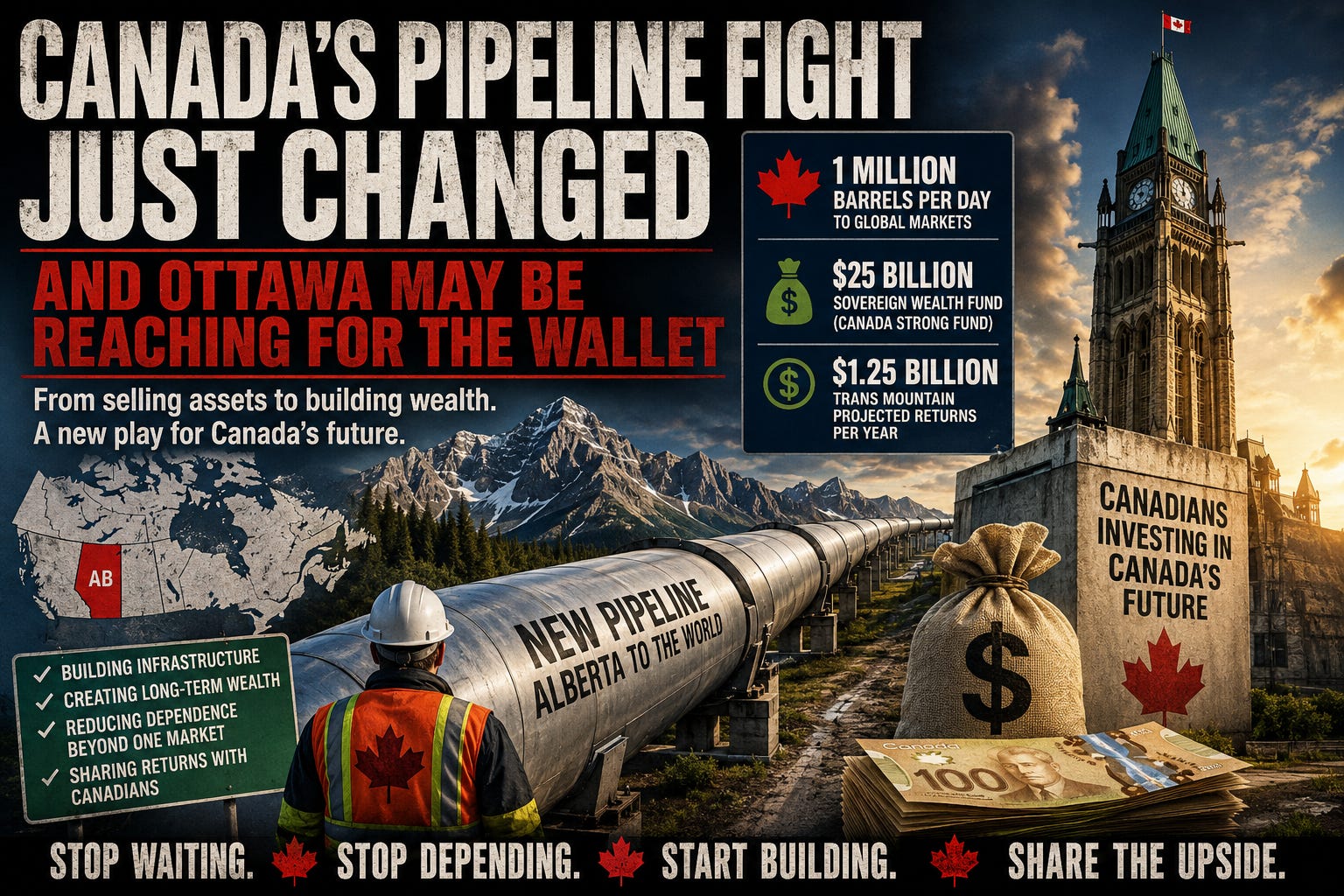
The talk coming out of government circles points toward a potential new pipeline capable of moving roughly 1 million barrels of oil per day to markets outside the United States. The bigger goal?
Stop acting like Canada only has one customer.
Because depending too heavily on one buyer is fine…
Right up until that buyer decides to change the rules.
Or starts acting like your economy is a bargaining chip.
Canada’s answer may be a new $25-billion sovereign wealth fund… what some are calling the Canada Strong Fund… aimed at helping finance major national infrastructure.
And that’s where this story gets interesting.
Because this isn’t just about oil.
It’s about philosophy.
For decades, governments sold public assets because somebody convinced us “government should run things like a business.”
Funny thing though…
Businesses usually keep profitable assets.
Take the Trans Mountain pipeline.
Ottawa owns it.
And projected revenues are estimated around $1.25 billion annually, generated through tolling fees that move oil to export markets.
Not exactly pocket lint.
So the thinking now appears to be shifting:
What if Canada stopped selling strategic assets…
And started treating them like long-term wealth engines?
That’s a very different mindset.
Less: sell the family farm.
More: keep the farm and collect rent forever.
There’s also talk of opening investment access so ordinary Canadians… pensions, retirement funds, even retail investors… could potentially own pieces of national infrastructure through ETF-style investment structures.
And frankly?
That part makes sense.
Because here’s the tension nobody talks about enough…
GDP can rise.
Corporate profits can rise.
The country can technically become “wealthier.”
And regular people can still feel broke.
We’ve seen that movie already.
If taxpayers help build national assets, then maybe taxpayers should actually share in the upside.
Wild idea, I know.
Of course, none of this is simple.
Pipelines of this scale don’t cost lunch money.
We’re talking roughly $20–30 billion and years of political trench warfare before a single drop moves.
There are environmental concerns.
Provincial tensions.
Carbon pricing negotiations.
Questions about who benefits most.
And a fair criticism remains…
If public money builds the roads, why do private companies collect most of the rewards?
That debate isn’t going away.
But here’s what is changing:
Canada appears to be moving away from the fantasy that mega-projects happen without public involvement.
Because the last 40 years offered a pretty clear lesson:
When government steps back entirely…
Nothing gets built.
And countries that stop building eventually start falling behind.
The bigger story here may not be pipelines.
It may be Canada quietly deciding to think bigger again.
The Recap…
Canada may be done waiting for the “free market” to magically build nation-sized projects.
A new pipeline.
A $25-billion sovereign wealth fund.
And a very different way of thinking about who owns Canada’s future.
This isn’t just an oil story.
It’s a power story.
The Gut-Punch…
A country that refuses to build eventually becomes a customer in somebody else’s economy.
The real question isn’t whether Canada can afford to think bigger.
It’s whether we can afford not to.
Source credit:
Sources/Research: Public reporting, policy discussion, infrastructure data, and energy market analysis compiled from current reporting and research notes. Research transcript treated as source material only; article rewritten and independently structured in GeezerWise voice.
🔎 The GeezerWise Standard
This space is built on disciplined thinking.
Facts over spin.
Verification before amplification.
Good-faith discussion over tribal noise.
I use AI tools to help shape my spoken drafts into clear writing.
The judgment, conclusions, and final message are mine.
If you’re new here, this explains how I decide what’s worth sharing:
How I Decide What’s Worth Sharing → [link]
💌 Subscribe at GeezerWise.com to receive future letters:
www.geezerwise.com/subscribe
— Fred Ferguson
GeezerWise
#CanadaStrong
Good commentary. I think the political climate (pun intended) is right for the Carny government to extract some concessions from the oil and gas industry on its carbon capture policy in order to finally get an new oil pipeline to the west coast built. I know a lot of people are against any more oil and gas development in Canada given global warming and climate issues, however the ill-advised war in Iran and the economic fallout from the resultant higher energy prices highlights that the world economy still needs oil and gas for the foreseeable future. So a new oil pipeline to the west coast will make Alberta happy (and put to rest the potential separatist movement) and the Government will secure the carbon capture concessions that should appease the climate activists. Seems to me that more, but cleaner, oil and gas production would be a win-win for Canada. After all, more people working and paying taxes, plus oil and gas companies also paying more tax is good for Canada.
Love your refusing to build quote - describes NZ perfectly.