

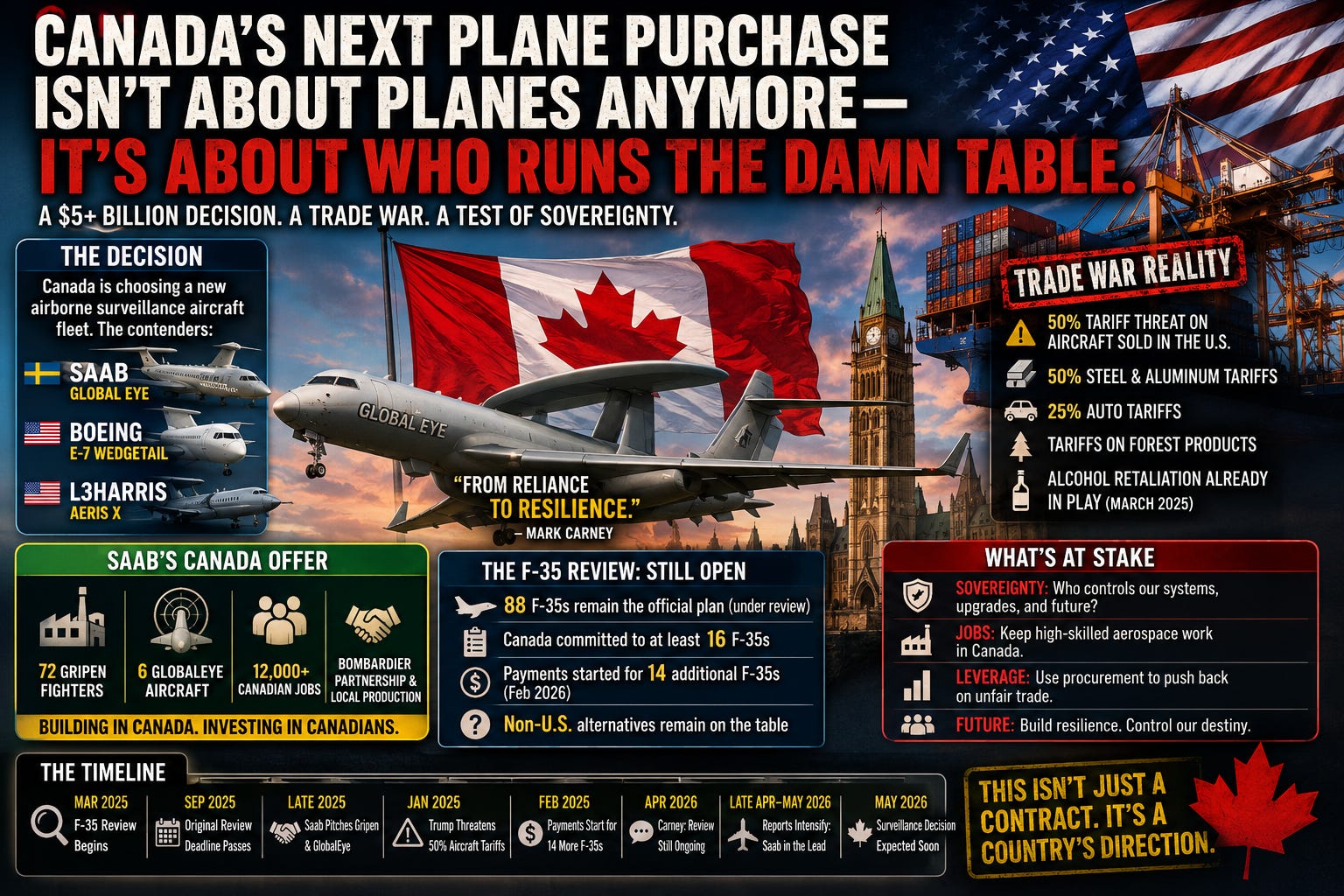
For years, Canada treated military procurement like a Costco run with a Pentagon loyalty card.
Need fighter jets? Buy American.
Need surveillance systems? Buy American.
Need software updates, parts, permissions, and political approval? Yup. American.
Simple. Predictable. Comfortable.
Until the relationship stopped feeling comfortable.
Now Ottawa is staring at a decision worth more than $5 billion… and suddenly the conversation isn’t really about aircraft performance anymore.
It’s about leverage. Jobs. Sovereignty. And whether Canada is finally getting tired of being economically shoved around every time Washington has a political mood swing.
The immediate decision involves airborne surveillance aircraft…
flying radar systems used to monitor airspace, coordinate defense operations, and keep tabs on Arctic activity.
The contenders are Saab’s GlobalEye from Sweden and two American options: Boeing’s E-7 Wedgetail and L3Harris’s Aeris X.
On paper, this sounds like a military procurement story.
It’s not.
It’s a trade-war chess move wearing a pilot’s helmet.
Because Saab didn’t just show up with airplanes. They showed up with jobs, production promises, Bombardier partnerships, and something Canada hasn’t heard enough of lately:
“We’ll build with you.”
That changes the emotional math fast.
Saab’s broader pitch reportedly includes 72 Gripen fighters, six GlobalEye aircraft, and thousands of Canadian aerospace jobs tied to localized production.
Estimates float around 12,000+ jobs.
Now compare that to the current mood between Canada and the United States.
Steel tariffs.
Auto tariffs.
Forest product fights.
Aircraft tariff threats reportedly reaching 50%.
Alcohol retaliation already spilling across provincial shelves.
At some point, even polite Canadians start looking at the menu differently.
And here’s where this gets interesting.
Mark Carney appears to be running a two-track strategy at the same time…
diversify away from dangerous overdependence on the U.S.
while still keeping North American integration alive where it benefits Canada
That’s not contradiction. That’s leverage management.
You don’t slam the door shut.
You keep the other guy guessing how badly you need him.
The real pressure point here may not even be the surveillance planes themselves.
It’s the F-35 fighter jet deal sitting behind them like a loaded briefcase nobody wants to open too fast.
Canada officially plans to buy 88 F-35s. The review is still ongoing. Ottawa is already committed to at least 16 aircraft, and payments reportedly started for additional units. But the government has also kept non-U.S. alternatives alive.
That ambiguity matters.
Because if Canada picks Saab’s GlobalEye for surveillance, the signal won’t stay confined to radar aircraft.
Washington will read it as…
“Canada is willing to look elsewhere.”
And suddenly the F-35 file becomes negotiation leverage instead of destiny.
That’s why this story matters far beyond defense nerds and aviation circles.
This is about whether procurement spending becomes a national strategy instead of a glorified online checkout cart.
For decades, countries like Canada often bought foreign military equipment first and worried about domestic industrial value later.
But in a world where supply chains are weaponized, tariffs arrive by tweet, and allies increasingly pressure each other economically, that old model starts looking dangerously naïve.
People aren’t just asking…
“What plane is best?”
They’re asking…
“Who controls the future maintenance?”
“Who owns the software?”
“Who controls the upgrades?”
“Who gets the jobs?”
“And who can politically squeeze us later?”
That’s a very different conversation.
Especially in Canada right now.
A lot of Canadians are simply exhausted by the unpredictability coming out of Washington. And emotionally, the Saab option scratches a deeper itch…
Stop rewarding people who keep threatening you.
That feeling is real whether politicians say it out loud or not.
Meanwhile, Bombardier quietly sits in the middle of this entire thing like the hidden jackpot nobody’s talking about enough.
If Canadian aerospace manufacturing becomes deeply tied into the deal, this shifts from a military expense into industrial policy with long-term economic consequences.
That’s the real battlefield here.
Not the sky.
The factory floor.
Because the country that builds things controls more than jobs. It controls resilience.
And Carney keeps using that exact language…
moving from “reliance to resilience.”
That may end up being the defining phrase of this whole era.
The old model was dependency dressed up as efficiency.
The new model might be strategic diversification disguised as procurement.
Big difference.
And if Canada chooses Saab?
It won’t mean Canada is abandoning the United States.
But it will mean Ottawa is finally learning how to negotiate with one hand on the steering wheel instead of both hands tied behind its back.
The Recap…
Canada’s new surveillance aircraft decision isn’t really about planes anymore.
It’s become a live test of whether Ottawa wants deeper industrial independence… or continued reliance on U.S. defense systems.
Saab showed up offering more than hardware.
They offered jobs, Bombardier partnerships, and leverage.
And suddenly the entire F-35 conversation got a lot more interesting.
The Gut-Punch…
The real fight isn’t over who patrols Canadian skies.
It’s over who controls Canada’s future when the next trade war hits.
Source credit:
CBC reporting, defense procurement reporting, Saab proposals, federal statements, and trade-policy developments summarized from research notes provided by the user.
🔎 The GeezerWise Standard
This space is built on disciplined thinking.
Facts over spin.
Verification before amplification.
Good-faith discussion over tribal noise.
I use AI tools to help shape my spoken drafts into clear writing.
The judgment, conclusions, and final message are mine.
If you’re new here, this explains how I decide what’s worth sharing:
How I Decide What’s Worth Sharing → [link]
💌 Subscribe at GeezerWise.com to receive future letters:
www.geezerwise.com/subscribe
— Fred Ferguson
GeezerWise
#CanadaStrong
The real elephant in the room that we are all ignoring is that the only country that could feasibly attack us, to the point where we were using war planes, is the U.S. In that case it doesn't matter what we fly. In that scenario if we fly planes designed and controlled by the enemy we have even less opportunity to defend ourselves.
At least if we choose a plan that provides jobs, control and aircraft then we are in charge of our own destiny, as far as that's possible. The F-35 contract serves as leverage in trade talks and we should keep it on the table as long as possible. The Global Eye aircraft already use a Bombardier-built plane and are an obvious choice for surveillance, to maintain jobs and reputation.
The Gripen provides Canadian manufacturing and provides an aircraft that will ensure our readiness to maintain our NATO obligations and patrol our Northern frontier. It's not if, it's when. In my mind it comes after the CUSMA decisions are made. Let's be a country again; Canada strong.
Perfectly stated and understandable.