

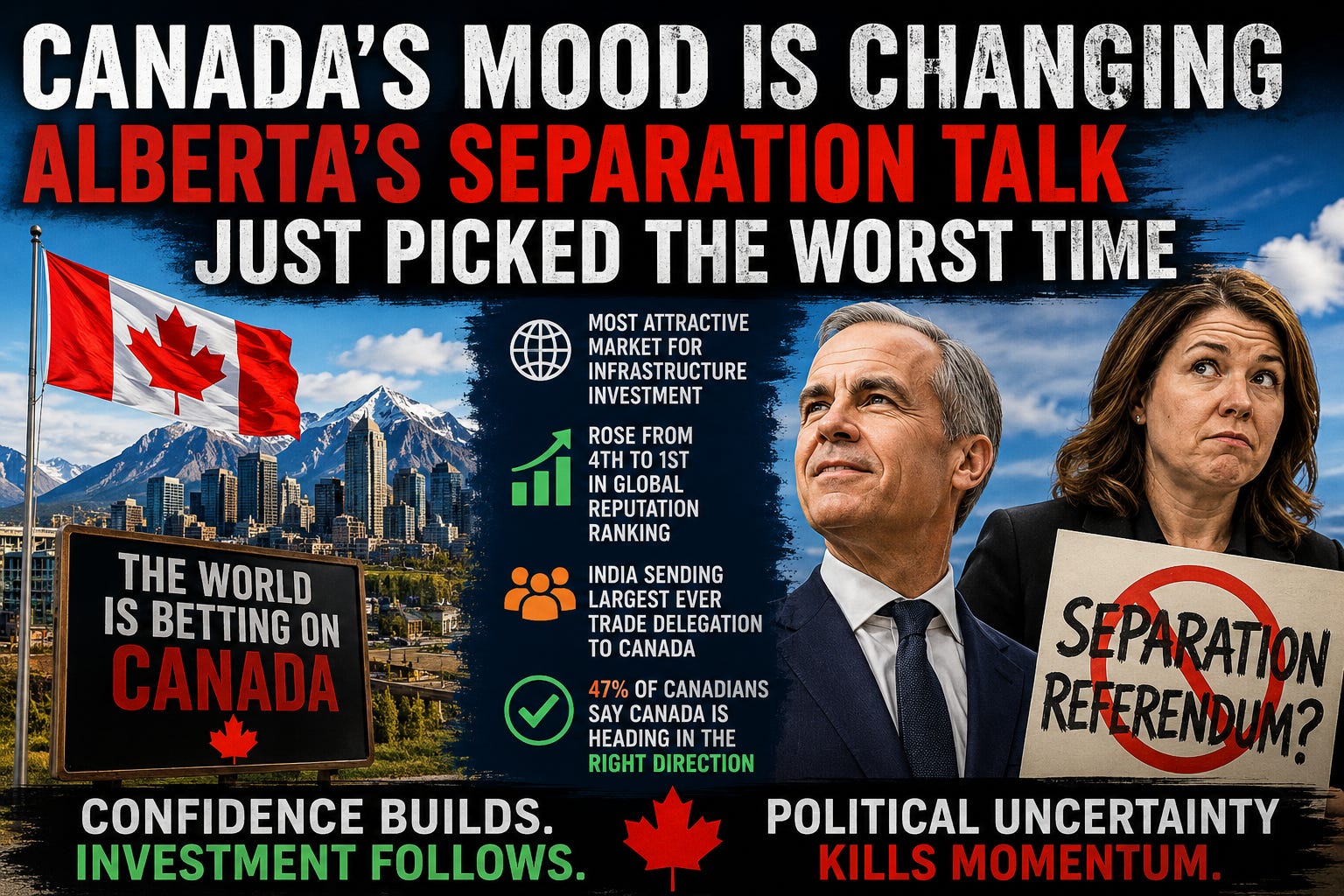
For the better part of a decade, Canadians have sounded tired.
Tired of inflation.
Tired of division.
Tired of feeling like everything costs more while somehow feeling smaller at the same time.
But something interesting has started happening lately.
The mood is shifting.
Not everywhere. Not all at once. But enough to notice.
And just as Canada seems to be regaining a bit of swagger, Alberta’s separation talk is back on the table like the political version of somebody flipping the Monopoly board because they don’t like how the game is going.
Here’s what caught my attention.
While Canadians spend half their lives arguing online about whether the country is broken, the rest of the world seems to be quietly looking at Canada and saying…
“Actually… this looks pretty stable.”
That matters.
Because money follows confidence.
And confidence follows stability.
In recent weeks, Canada has started showing up near the top of some important global rankings.
Infrastructure investors reportedly now see Canada as one of the most attractive places to put money… even ahead of the United States.
That is not nothing. We’re talking about the people who decide where billions of dollars get parked.
At the same time, India is reportedly sending one of its biggest trade delegations ever to Canada, with senior leaders tied to industries like mining, energy, aerospace, and automotive.
Translation?
The adults in the global room are paying attention.
Not because Canada suddenly became perfect.
But because in a world that increasingly feels chaotic, stable starts looking sexy.
Meanwhile, polling suggests Canadians are feeling oddly different about themselves than they do about the rest of the planet.
One recent survey showed far more Canadians believing Canada is moving in the right direction than those saying the same about the United States or the world generally.
That gap matters.
Because national confidence is economic fuel.
People invest when they feel hopeful.
Businesses expand when they believe tomorrow might actually be better than today.
Countries negotiate from strength when they stop talking like permanent victims.
Which brings me to Alberta.
Because just as Canada appears to be rebuilding momentum…
Premier Danielle Smith has decided this might be the perfect time to reopen the national divorce conversation.
Bad timing doesn’t even begin to cover it.
Think about this for a second.
Canada is heading into sensitive trade discussions with the Americans.
Global investors are paying closer attention.
Businesses are weighing long-term bets.
And now we’re floating referendum chatter?
Political uncertainty is kryptonite for investment.
Always has been.
You don’t have to guess how this movie goes either.
Canada already lived a version of it during Quebec separation battles.
Major businesses moved operations.
People relocated.
Investment hesitated.
Markets hate uncertainty almost as much as Canadians hate telecom bills.
And if you want an international example?
Look at Brexit.
Britain was promised leverage.
Strength.
Control.
A better negotiating position.
Instead, years later, they’re still untangling economic headaches nobody fully understood when people were casting emotional votes.
That’s the dirty little secret about separation politics.
People often vote for feelings.
But economies respond to math.
And math has no patience for political theatre.
Now here’s where things get politically awkward.
Pierre Poilievre finds himself walking a very uncomfortable tightrope.
He says Conservatives will support Canada staying together.
Fair enough.
But some of the loudest voices still backing him come from parts of the political coalition most sympathetic to separatist anger.
That creates a problem.
Because when you spend years telling people the country is broken beyond repair, eventually some folks start asking…
“Okay then… why stay?”
Words matter.
Especially repeated ones.
And politics has a funny habit of eventually collecting on the emotional debt it creates.
Meanwhile, Mark Carney appears to be trying a different approach.
Less yelling.
More negotiation.
More “let’s figure this out” than “everything is on fire.”
Whether people agree with him or not, his argument is fairly straightforward…
Canada works better together than apart.
Not just economically.
Socially too.
That matters more than people realize.
Because being Canadian has never really been about chest-thumping nationalism.
We’re not Americans waving giant flags every third Tuesday.
Canada works because most of us quietly believe in the idea that when somebody’s struggling, we don’t just shrug and say…
“Good luck, buddy.”
We pitch in.
Messy sometimes.
Imperfect always.
But together.
And that’s the thing about national confidence.
It spreads.
Negativity spreads too, sure.
But optimism tends to build things.
Investment.
Trade.
Momentum.
Trust.
You can actually feel it when a country starts believing in itself again.
The danger is not disagreement.
Healthy disagreement is democracy.
The danger is convincing people the house is so broken it deserves to burn down.
Because once you light that match, you don’t always control where the fire goes.
And history has a nasty habit of reminding people that emotional decisions can turn into expensive regrets.
The Recap…
Something interesting is happening in Canada…
While many people still think the country is broken, the rest of the world seems to be quietly betting on us.
Investors are paying attention. Trade partners are showing up.
Which makes Alberta separation talk feel a little like arguing about divorce while the family business finally starts making money again.
Full story below 👇
The Gut-Punch…
Countries don’t fall apart all at once.
First, people stop believing in them.
Then politicians start feeding that doubt.
And before long, somebody mistakes frustration for a plan.
Canada isn’t perfect.
Never was.
But this may be one of those moments where we decide whether we’re building something stronger… or picking a fight with the foundation.
Source credit:
Research based on polling discussion, public commentary, economic reporting, and transcript material.
🔎 The GeezerWise Standard
This space is built on disciplined thinking.
Facts over spin.
Verification before amplification.
Good-faith discussion over tribal noise.
I use AI tools to help shape my spoken drafts into clear writing.
The judgment, conclusions, and final message are mine.
If you’re new here, this explains how I decide what’s worth sharing:
How I Decide What’s Worth Sharing → [link]
💌 Subscribe at GeezerWise.com to receive future letters:
www.geezerwise.com/subscribe
— Fred Ferguson
GeezerWise
#CanadaStrong
Treaty Rights
The Duty to Consult
Anything else is posturing
The First Peoples will keep Canada as it is.
Costs are up globally. People need to get outside of the bubble they live in and see what's happening elsewhere. There is no short-term fix for an economy to turn itself around in a few weeks or months. The state of the current economy did not happen overnight. It takes leadership with a realistic vision that can take the necessary steps to help implement lasting policies that can facilitate changes. Transformation is underway in Canada and outsiders see it. It's sad that there are Canadians who are short sided or as you say may be unduly influenced by outside parties with a very different agenda for Canada. Frankly, having a financial guru such as PM Carney who has the background to manage Canadian assets, forge new alliances and treaties is just the beginning for a better Canada.