

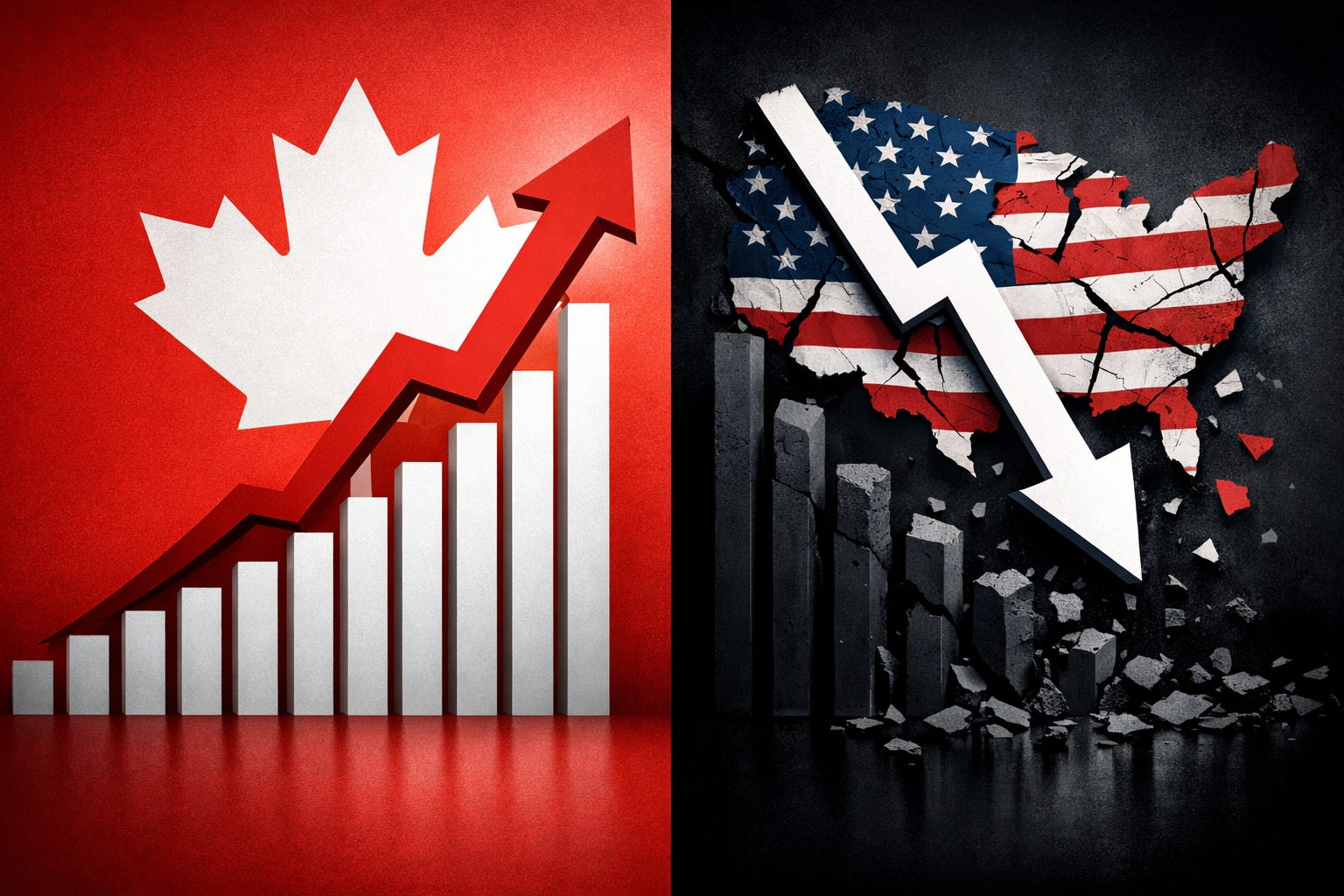
There’s a simple rule in economics…
Money goes where confidence lives.
Right now, confidence is moving.
And a surprising amount of it is moving toward Canada.
For the past year, the dominant narrative… especially online… has been that Canada is weak, collapsing, or about to get crushed by U.S. policy pressure.
The numbers say the opposite.
Let’s start with markets.
According to global performance data cited by major financial institutions, U.S. equities have had one of their weakest starts relative to the rest of the world since the mid-1990s.
While American markets slipped roughly 1% early in the year, international markets gained around 8%.
Over a longer window, the gap is even clearer… non-U.S. markets rose roughly three times more than U.S. markets over the past year.
Among the world’s ten largest stock markets by capitalization, the United States ranked near the bottom for performance in 2025.
Canada ranked at the top.
That doesn’t happen by accident.
Stock markets are forward-looking. Investors don’t buy based on nostalgia… they buy based on expected future conditions. Rising prices signal belief that a country’s economic trajectory is stable or improving.
In other words, investors are voting.
And lately, they’ve been voting with Canadian dollars.
The Trade Story Nobody Expected
Here’s the part that really matters.
Canada entered the recent trade conflict in a vulnerable position. Our economy is more tied to U.S. exports than almost any other country on Earth.
Many analysts predicted severe damage… even economic capitulation.
Instead, something else happened.
Canada diversified.
For the first time since the trade tensions began, Canada recorded a trade surplus… exporting more than it imported… as exports rebounded and imports fell.
Economists pointed to two key trends…
Stabilizing trade flows with the United States
Increasing diversification away from U.S. dependence
That second point is the big one.
Canada isn’t alone.
Around the world, countries are adjusting.
Europe is reducing reliance on U.S. defense suppliers.
European governments are replacing American tech platforms with domestic or open-source alternatives.
Asian trade patterns are shifting as tariffs reshape supply chains.
China’s global trade surplus reached record levels despite reduced direct exports to the U.S.
Mexico’s trade surplus with the United States hit historic highs.
Multiple Southeast Asian countries expanded surpluses with the U.S. dramatically.
Meanwhile, the U.S. trade deficit with Asia grew significantly.
These aren’t political opinions.
They’re structural changes.
Reliability Is Currency
The deeper issue isn’t tariffs.
It’s trust.
When countries begin to question whether agreements will hold, they start building alternatives.
Trade partners want predictability.
Defense partners want stability.
Investors want policy clarity.
When those signals weaken, capital moves.
And that movement doesn’t require headlines or speeches… it happens quietly through contracts, supply chains, and investment flows.
Canada’s Position Is Stronger Than Expected
What makes Canada’s performance notable is context.
We were supposed to struggle the most.
Instead…
Our market outperformed major global peers
Our trade position improved
Investors signaled confidence in long-term prospects
Even voices from across the political spectrum… including former Prime Minister Stephen Harper… have emphasized the need for Canada to reduce dependence on the United States.
That’s not ideology.
That’s strategy.
The Bigger Picture
The world economy is reorganizing.
Not collapsing.
Rebalancing.
Countries are spreading risk, diversifying partnerships, and building redundancy into supply chains.
Canada is benefiting from that shift… partly because of resources, partly because of geography, and partly because we’re seen as a stable partner in an unstable moment.
Markets notice stability.
Capital rewards it.
The Recap…
For months, we’ve been told Canada was in trouble.
The data says the opposite.
Our market is outperforming.
Our trade position is improving.
And investors are quietly betting on Canada’s future.
Sometimes reality is very different from the noise.
The Gut Punch…
Markets don’t follow politics.
They follow confidence.
And right now, confidence is shifting north.
Source Credit:
Source references include Reuters, Global News, Yahoo Finance, Goldman Sachs analysis, and international trade reporting.
🔎 The GeezerWise Standard
This space is built on disciplined thinking.
Facts over spin.
Verification before amplification.
Good-faith discussion over tribal noise.
I use AI tools to help shape my spoken drafts into clear writing.
The judgment, conclusions, and final message are mine.
If you’re new here, this explains how I decide what’s worth sharing:
How I Decide What’s Worth Sharing → [link]
💌 Subscribe at GeezerWise.com to receive future letters:
www.geezerwise.com/subscribe
— Fred Ferguson
GeezerWise
#CanadaStrong
Canada is diversifying trade even further. Mark Carney is on his way to India with the expectation of initiating free trade discussions with PM Modi, and then on to Australia and Japan.
I was checking StatsCan records for a Hansard Files update. The numbers completely back you up. For decades, Ottawa obsessed over the American market. Now, the percentage of our exports going to the US just dropped to 71% in 2025. Meanwhile, non-US exports surged by 17%. The political noise during Question Period (the daily debate where MPs grill the government) ignores this reality. Real trade contracts tell a smarter story of survival.