

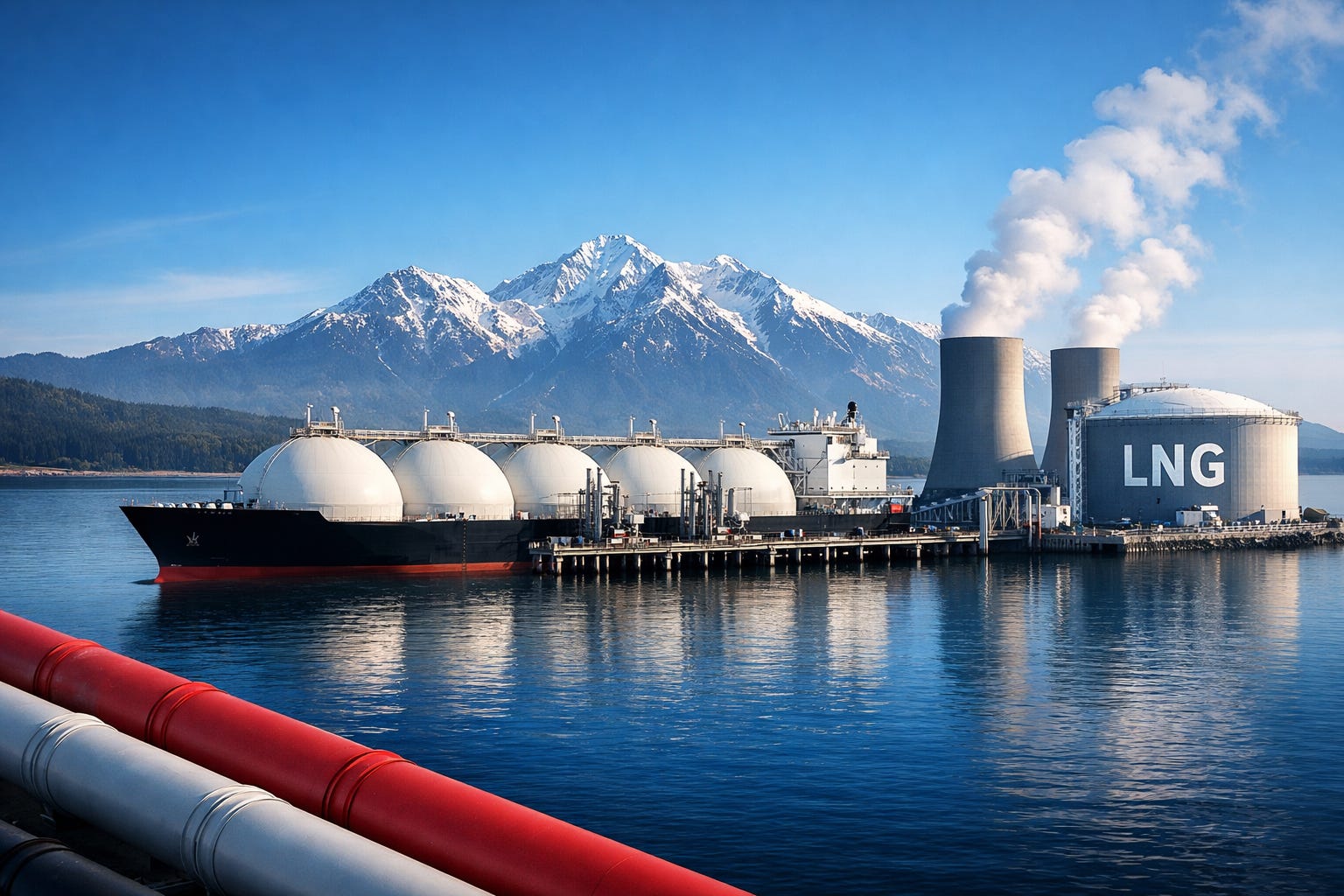
Most Canadians have no idea this is happening.
While we argue about politics and doom-scroll global chaos, one of the biggest economic shifts in decades is unfolding on the West Coast.
Canada is building the infrastructure to become a major global exporter of liquefied natural gas (LNG).
And the timing couldn’t be better.
The Demand Is Real… And It’s Huge
India… one of the fastest-growing energy markets on Earth… is actively looking for long-term suppliers of oil, gas, and uranium.
Officials have openly stated they’re willing to buy whatever Canada can provide.
That matters, because India and Japan are expected to remain among the world’s largest LNG importers for decades.
Energy demand in Asia isn’t slowing down. It’s accelerating.
Canada is stepping into that gap.
The Profit Math Is Obvious
Natural gas prices in North America recently hovered around $2.86 per MMBtu.
Meanwhile, LNG import prices in India were around $11 per MMBtu.
Same resource. Completely different market value.
That price spread is why companies are pouring billions into Canadian LNG infrastructure.
Not government spending.
Private capital.
One major expansion project alone is expected to attract roughly $33 billion in investment and could make the facility one of the largest LNG export terminals in the world.
When investors smell margins like that, they don’t wait for permission.
They move.
The Infrastructure Is Already Happening
Western Canada has a major advantage… existing gas reserves and pipeline networks across Alberta and British Columbia.
Projects like the Coastal GasLink pipeline connect inland gas fields to export terminals on the Pacific coast, where gas is cooled into liquid form and shipped overseas.
Once that export capacity scales, Canada could ship up to 100 million tonnes of LNG per year.
That would place the country among the top global suppliers.
Why LNG… Not Oil… Is Driving This
Oil trades on a global market with relatively uniform pricing.
Heavy Canadian crude recently fell from about $80 per barrel in 2022 to below $50 in early 2026, with only modest recovery afterward.
There’s no premium market waiting to pay triple for oil.
But LNG is different.
Natural gas markets are regional because transportation is complex and expensive.
Countries without pipelines must import LNG by ship… and they’ll pay significantly more to secure reliable supply.
That creates opportunity.
Canada has it.
Global Investors Are Noticing
Canadian equities performed strongly in 2025 and continued into 2026, with energy companies representing a significant portion of the market.
At the same time, valuation momentum outside the United States has been strengthening relative to U.S. markets.
Capital flows follow opportunity.
Right now, Canada’s energy sector is attracting attention.
The Geographic Advantage
Canada’s Pacific coast offers a shorter shipping route to Asia than many competing exporters.
The United States exports most LNG from the Gulf Coast, which is optimized for Atlantic markets.
To compete in Asia, the U.S. is considering a massive LNG project in Alaska… estimated between $44 billion and $60 billion.
But that project faces major obstacles…
Over 1,000 km of pipeline required
Arctic construction challenges
High material costs
Long timelines
Potential government financing support needed
Canada, by contrast, already has operational exports and connected infrastructure corridors.
In energy economics, being first matters.
The Bigger Picture
Trade discussions with India aren’t just diplomacy.
They’re market positioning.
Long-term contracts with large buyers create stability, investment confidence, and decades of revenue potential.
And unlike many public megaprojects, much of this build-out is being funded by private industry responding to global demand signals.
That’s how sustainable growth usually happens.
The Quiet Opportunity
Good economic news rarely feels dramatic.
It’s incremental. Technical. Easy to miss.
Pipelines get built quietly.
Terminals expand quietly.
Contracts get signed quietly.
Then one day you realize an entire industry has shifted.
Canada may be standing at that moment now.
Not because of ideology.
Not because of slogans.
Because supply, demand, geography, and timing are lining up at the same time.
That combination doesn’t happen often.
The Recap…
Most Canadians don’t realize this, but a massive economic shift is underway on the West Coast.
Canada is positioning itself to become a global LNG powerhouse… with billions in private investment and major buyers already waiting.
This could reshape our economy for decades.
The Gut-Punch…
“Energy markets don’t care about politics. They care about who can deliver.”
Source Credit:
Source: Canadian energy project data, commodity pricing reports, and international market analysis referenced from public reporting and industry coverage.
🔎 The GeezerWise Standard
This space is built on disciplined thinking.
Facts over spin.
Verification before amplification.
Good-faith discussion over tribal noise.
I use AI tools to help shape my spoken drafts into clear writing.
The judgment, conclusions, and final message are mine.
If you’re new here, this explains how I decide what’s worth sharing:
How I Decide What’s Worth Sharing → [link]
💌 Subscribe at GeezerWise.com to receive future letters:
www.geezerwise.com/subscribe
— Fred Ferguson
GeezerWise
#CanadaStrong
LNG ships look so strange, as if they’re carrying spacecraft to a secret launching site.
I do wonder if the LNG tanker from Australia to Halifax was more of a symbolic gesture then a need. Was it a little back hand to the US, saying us middle powers can do things without you? There is a lot of gas on the East Coast with existing pipelinnes to Central Canada in place, it just needs extracion.