

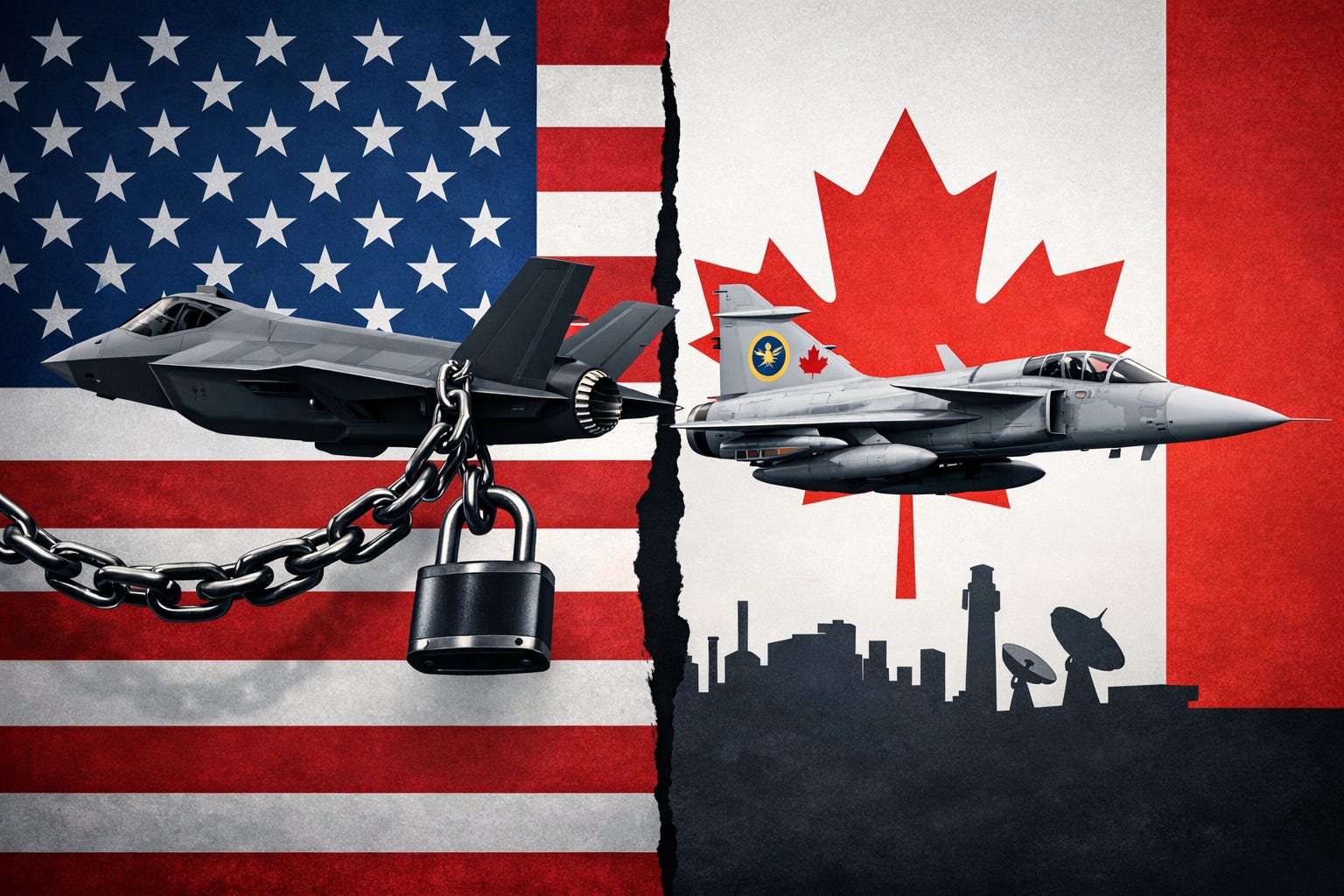
A billion dollars doesn’t just “appear” in a budget for fun.
When Ottawa quietly drops nearly $900 million into domestic defence innovation… and ties it directly to Canadian-built aircraft… that’s not routine spending.
That’s a signal.
And the message is simple…
Canada is starting to rethink who controls its military… and how much of it stays at home.
This Was Supposed to Be Simple
For years, the plan looked locked in.
Buy 88 F-35 fighter jets.
Plug into the American system.
Call it a day.
But that plan came with a catch nobody could ignore forever…
Control.
The F-35 isn’t just a plane… it’s a fully integrated American system. Maintenance, software, parts, upgrades… all run through the U.S.
And when your entire air force depends on another country’s permission to function, that’s not independence.
That’s a leash.
Now Look What Just Happened
Ottawa just did three things that don’t line up with a full F-35 commitment…
Dropped $900 million into Canadian defence innovation
Invested in drone and aerospace development at home
Bought a Bombardier Global 6500 platform… a key piece in Sweden’s Saab proposal
That last one matters.
Because Saab’s pitch to Canada isn’t just “buy our jets.”
It’s…
Build them here.
Create jobs here.
Keep control here.
We’re talking about 12,600 potential jobs tied to domestic production.
That’s not procurement.
That’s industrial strategy.
The Mixed Fleet Idea Isn’t Crazy… It’s Math
Here’s where things get brutally practical.
Operating costs per hour…
F-35: $35,000–$50,000
Gripen (Sweden): $8,000–$12,000
Every hour. Forever.
So now the question isn’t “which jet is better?”
It’s…
Do you want a Ferrari… or a fleet you can actually afford to drive?
Even analysts are starting to admit something quietly…
Around 40 F-35s could handle NORAD obligations
The rest? Could be cheaper, flexible aircraft for NATO and Arctic patrol
That’s where the Gripen fits.
Not as a replacement.
As a balance.
And Then Denmark Spoke Out Loud What Others Are Thinking
Denmark… already locked into the F-35… basically said the quiet part out loud:
If the U.S. controls the parts… they control your air force.
Planes grounded for repairs.
Supply chains controlled externally.
Political leverage baked into your defence system.
That’s not a conspiracy theory.
That’s logistics.
Washington’s Reaction Tells You Everything
The U.S. didn’t shrug this off.
They warned that pulling back from the F-35 could affect NORAD arrangements.
Translation?
“Stay in the system… or we’ll need to rethink how this works.”
That’s pressure.
And pressure only shows up when something matters.
So What’s Actually Happening Here?
Canada isn’t ditching the F-35.
It’s doing something smarter…
Keep enough to satisfy NORAD
Reduce dependency on a single supplier
Build domestic capability
Spread risk across systems
In plain English…
Stop putting your entire air force in one foreign basket.
This Is Bigger Than Jets
This is about control.
About whether Canada…
Builds capability at home
Or rents it from someone else
Because once your defence system depends on another country’s approval…
You don’t fully own it anymore.
The Real Question Isn’t “Which Jet?”
It’s this…
How much independence are we willing to pay for?
Because the cheapest decision today…
Can become the most expensive one later.
The Recap…
Canada just made a quiet move that could reshape its entire military strategy.
This isn’t about fighter jets anymore.
It’s about control… cost… and who holds the keys.
Most people missed what just happened. 👇
The Gut-Punch…
If another country can ground your air force… it’s not really your air force.
Source Credit:
Source: Claus Kellerman POV analysis (CTV, Globe and Mail, National Post, Walrus reporting summarized)
🔎 The GeezerWise Standard
This space is built on disciplined thinking.
Facts over spin.
Verification before amplification.
Good-faith discussion over tribal noise.
I use AI tools to help shape my spoken drafts into clear writing.
The judgment, conclusions, and final message are mine.
If you’re new here, this explains how I decide what’s worth sharing:
How I Decide What’s Worth Sharing → [link]
💌 Subscribe at GeezerWise.com to receive future letters:
www.geezerwise.com/subscribe
— Fred Ferguson
GeezerWise
#CanadaStrong
I've been preaching this perspective for months now. Buy enough F35s to meet our obligation re NORAD. Because it's a joint project with the U.S. it's in their best interest to keep the things flying. Buy the planes that our Nordic neighbors have, because we are a Northern nation with similar goals. The fact that they are willing to share the technology and let Canada build them says an awful lot about the difference in world view from the U.S. Most of us have had a different perspective on life than our southern neighbors, and that's becoming larger and more apparent. We need to plant the flag in our own country!
🇨🇦💙 Add in China imposing strict export controls and licensing requirements, blocking rare earths for foreign military use like in U.S. F-35s but allowing case by case approvals. 🤔 One F35 contains 418 Kg or rare earth, One Arleigh Burke DDG -51 destroyer contains 2600 Kg of rare earth, One Virginia Class submarine contains 4600 Kg of rare earth. Recently, the pentagon issued a tender for $500 million in alloy-grade cobalt. Not one country made a bid. The tender was retracted.