

Here’s the situation in plain English.
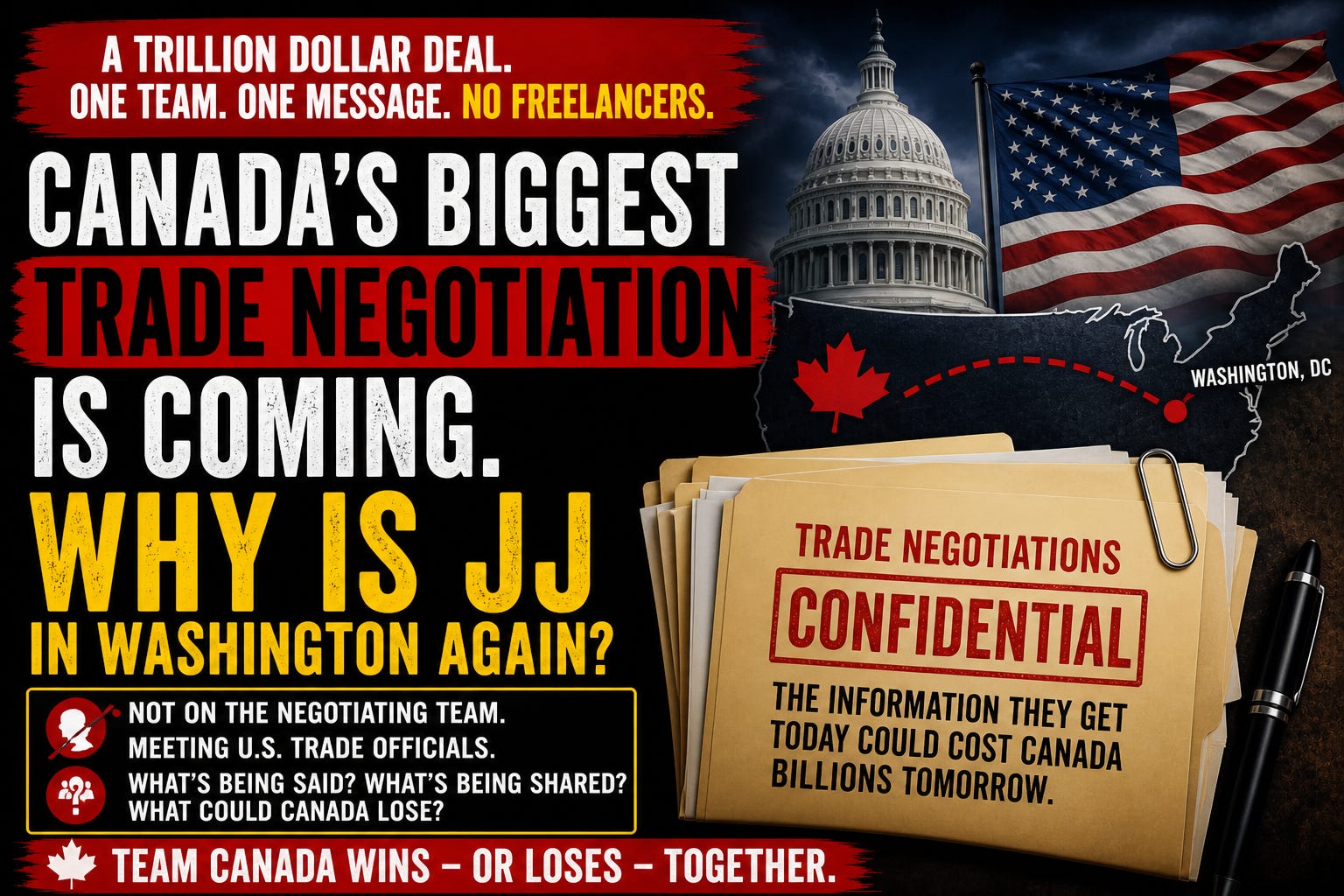
Canada is heading into one of the biggest economic negotiations it’s faced in years… the 2026 review of the CUSMA trade agreement.
That’s the deal that governs how Canada, the U.S., and Mexico do business with each other.
We’re not talking pocket change here.
We’re talking about a trade relationship worth over a trillion dollars.
So what does Canada do?
It builds a proper negotiating team.
The Prime Minister appoints a lead negotiator, pulls in advisors from business and labour, and… smart move… includes voices from different political backgrounds.
Even a few Conservatives are in the mix.
That’s what you call a “Team Canada” approach.
One voice. One strategy. No freelancing.
And here’s the kicker…
Canada’s actually walking into these negotiations from a position of strength.
Recent U.S. data shows their trade deficit is growing… not shrinking… even after tariffs were supposed to fix that.
Imports are rising. Inflation pressure is building. Their policies are starting to backfire.
Which means?
They need what Canada sells more than they’re willing to admit.
Oil. Resources. Materials.
All the stuff that keeps their machine running.
You can tell things aren’t going to plan down there when they quietly greenlight new pipeline capacity after saying they didn’t need anything from Canada.
That’s not strategy.
That’s scrambling.
So far, so good for Canada.
Now here’s where things start to wobble.
A backbench MP… not part of the negotiating team… decides to head down to Washington and meet with U.S. trade officials.
Not once.
Twice.
Let me translate why that matters.
In high-stakes negotiations, information is leverage.
Every comment, every hint, every “off-the-record” opinion gets collected, analyzed, and used.
Especially by experienced negotiators… and the Americans didn’t get where they are by playing nice.
So when someone outside the official team starts chatting?
They’re not “helping.”
They’re giving away pieces of the playbook.
Even casually.
Even unintentionally.
Think of it like this…
You’re negotiating to buy a car. You’re playing it cool, pointing out flaws, pushing for a better price.
Then someone on your side walks in and says…
“Oh yeah, we love this car. We’ll probably pay whatever it takes.”
Game over.
That’s exactly what this looks like on a national scale.
And it’s not just one issue.
There are already cracks forming inside Canada’s position.
Some provinces backed off retaliatory measures… like restrictions on U.S. alcohol… while others held the line.
That inconsistency?
It’s gold for the other side.
Now U.S. negotiators can point to those divisions and say…
“Get your house in order first… then we’ll talk.”
That’s how leverage works.
You don’t need to win outright.
You just need to find the weak spots and press on them.
And when those weak spots are self-inflicted?
That’s even better… if you’re sitting on the other side of the table.
Look… there’s nothing wrong with MPs promoting their regions, attracting business, or building relationships internationally.
That’s part of the job.
But there’s a line.
And that line is this…
If you’re not part of the negotiating team for a trillion-dollar agreement…
You don’t get to freelance the message.
Because at that level, even a small comment can ripple into a big concession later.
This isn’t about politics.
It’s about discipline.
And right now?
Canada needs everyone rowing in the same direction — not paddling off doing their own thing.
The Recap…
Canada’s heading into a trillion-dollar trade negotiation… from a position of strength.
But strength doesn’t matter if the message gets sloppy.
Side conversations. Mixed signals. Cracks between provinces.
That’s how leverage gets handed away… for free.
The Gut-Punch…
You don’t lose big negotiations in the room.
You lose them beforehand… when your own side can’t stop talking.
Source Credit:
Adapted from transcript-based research and commentary on Canada–U.S. trade positioning and pre-negotiation dynamics.
🔎 The GeezerWise Standard
This space is built on disciplined thinking.
Facts over spin.
Verification before amplification.
Good-faith discussion over tribal noise.
I use AI tools to help shape my spoken drafts into clear writing.
The judgment, conclusions, and final message are mine.
If you’re new here, this explains how I decide what’s worth sharing:
How I Decide What’s Worth Sharing → [link]
💌 Subscribe at GeezerWise.com to receive future letters:
www.geezerwise.com/subscribe
— Fred Ferguson
GeezerWise
#CanadaStrong
I’m pretty sure Jivani is nowhere near source material. He is a traitorous tRunt
We need to either revamp our legal definition of Traitor, or put in place laws that require governmental approval of any opposition MP wanting to travel to any other country to “meet with their leaders”. NO ONE is supposed to be doing g any of this except elected representatives of the sitting government!
This IS going to cause trouble and I truly believe this iteration of the Conservative Party are actively working FOR THE USA and against Canada!