

For years, Canada has had the same business problem as a small-town store
with only one major customer.
The customer knows it.
The customer uses it.
And the customer expects a discount.
That has been Canada’s relationship with oil exports for decades.
When most of your product goes south, the buyer holds the cards.
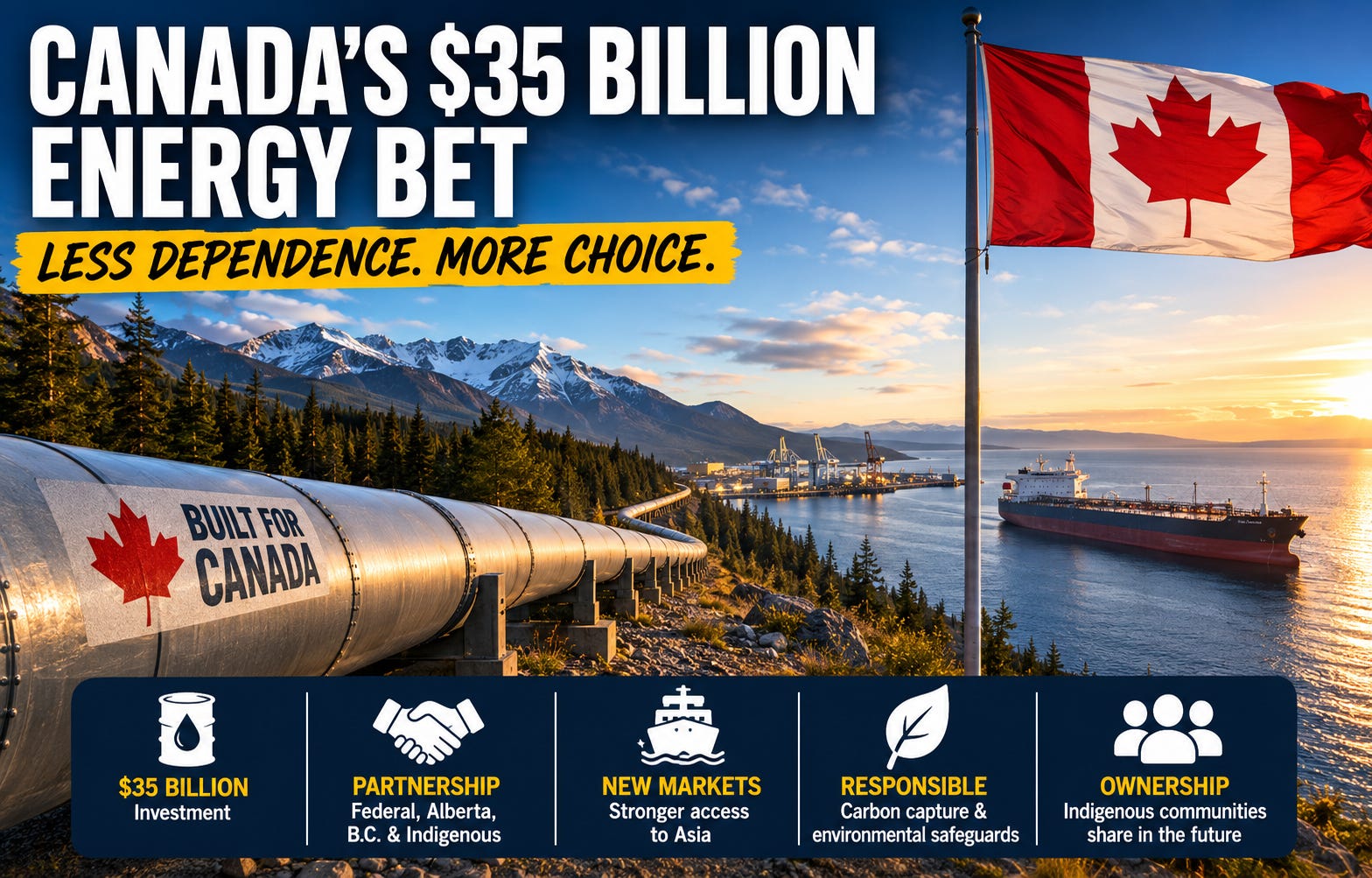
That is why the proposed $35 billion pipeline matters.
Yes, it moves oil.
But the real story is where that oil goes.
Instead of feeding almost exclusively into the American market, this project is designed to strengthen access to Asia and other international buyers.
The goal isn’t simply exporting more barrels. The goal is creating more options.
And options create bargaining power.
What makes this proposal different from the pipeline fights Canadians have watched for years is the political math behind it.
The usual script has been predictable.
Alberta wants a pipeline.
British Columbia objects.
Indigenous communities go to court.
Environmental groups mobilize.
Ottawa gets dragged into the middle.
Years disappear.
Nothing gets built.
This time the strategy appears to be the opposite.
Get the major players aligned first.
The proposed route largely follows an existing corridor connected to the Trans Mountain system, avoiding many of the battles that have stalled previous projects.
The controversial northern coastal route remains off the table, and the tanker ban on northern B.C.’s coast stays in place.
Those weren’t accidental decisions.
They were concessions designed to remove obstacles before construction even begins.
British Columbia reportedly receives environmental protections and infrastructure commitments.
Alberta gets a path to new export markets.
The federal government gets a nation-building project.
Indigenous communities receive an ownership stake rather than being treated as spectators watching others profit.
That last point may end up being the most important.
For decades, Indigenous consultation often happened after decisions were already made.
Equity ownership changes the conversation. When communities become partners instead of bystanders, incentives change dramatically.
No, it won’t eliminate every disagreement.
But it does create a different foundation.
Another condition tied to the project is advancement of major carbon capture investments in Alberta.
Some will see that as a necessary environmental safeguard.
Others will call it political horse-trading.
The reality is simpler.
Large infrastructure projects in Canada rarely happen without compromise.
Everybody gives something up.
Everybody gets something back.
That’s how deals get done.
The timing is also hard to ignore.
Recent American political rhetoric has repeatedly suggested the United States doesn’t need Canada as much as Canadians think.
Yet at the same time, American energy infrastructure continues to benefit from Canadian production.
The contradiction is obvious.
If Canada’s resources are so unimportant, nobody would be investing billions to move them.
Canada appears to have drawn its own conclusion.
Relying on one customer is risky.
Relying on one customer who changes the rules every few years is even riskier.
Diversification isn’t anti-American.
It’s basic business.
The loudest debate around this proposal may end up focusing on route choices, shipping times, environmental trade-offs, or ownership structures.
Those are important discussions.
But they aren’t the main story.
The main story is that several groups that normally spend years fighting each other seem to have found enough common ground to move forward.
That may be the rarest resource in Canada today.
Not oil.
Agreement.
Because history has shown that pipelines don’t fail because of steel.
They fail because nobody can agree where to put it.
This project appears to be an attempt to solve that problem before the first shovel hits the ground.
And if it works, the biggest export might not be oil at all.
It might be a lesson in how Canada finally learned to build things again.
The Recap…
Canada’s proposed $35 billion pipeline isn’t really an oil story.
It’s a leverage story.
For the first time in years, Ottawa, Alberta, B.C., and Indigenous partners appear to be pulling in the same direction.
The real breakthrough may not be the pipeline itself.
It may be the fact that everyone stopped fighting long enough to build it.
The Gut-Punch…
For years, Canada acted like a country sitting on a fortune while asking permission to use it.
This project suggests a different approach.
Find more customers.
Make more allies.
Depend less on any one buyer.
Because sovereignty isn’t something you announce.
It’s something you build.
Source Credit:
Research compiled from publicly discussed reports, stakeholder statements, infrastructure proposals, energy policy announcements, and background information provided in the research notes above.
If you enjoy thoughtful conversations, Canadian stories, and the occasional smart-ass observation about the world we’re living in, you’re in the right place.
Subscribe free and get new stories, insights, and observations delivered directly to your inbox.
No paywall.
No spam.
No nonsense.
Leave anytime with a single click.
I promise not to take it personally.
As despicable, untrustworthy, and corrupt as Trump is, he has done one positive thing for Canada. He's brought us together like nobody else could....to resist him and to develop our resources to be ready to sell to the rest of the world. I won't see it in my lifetime, but I look forward to the day when the bulk of our trade goes east / west instead of south.
Another great newsletter Fred! We are moving forward at least! Canada Strong!!!