

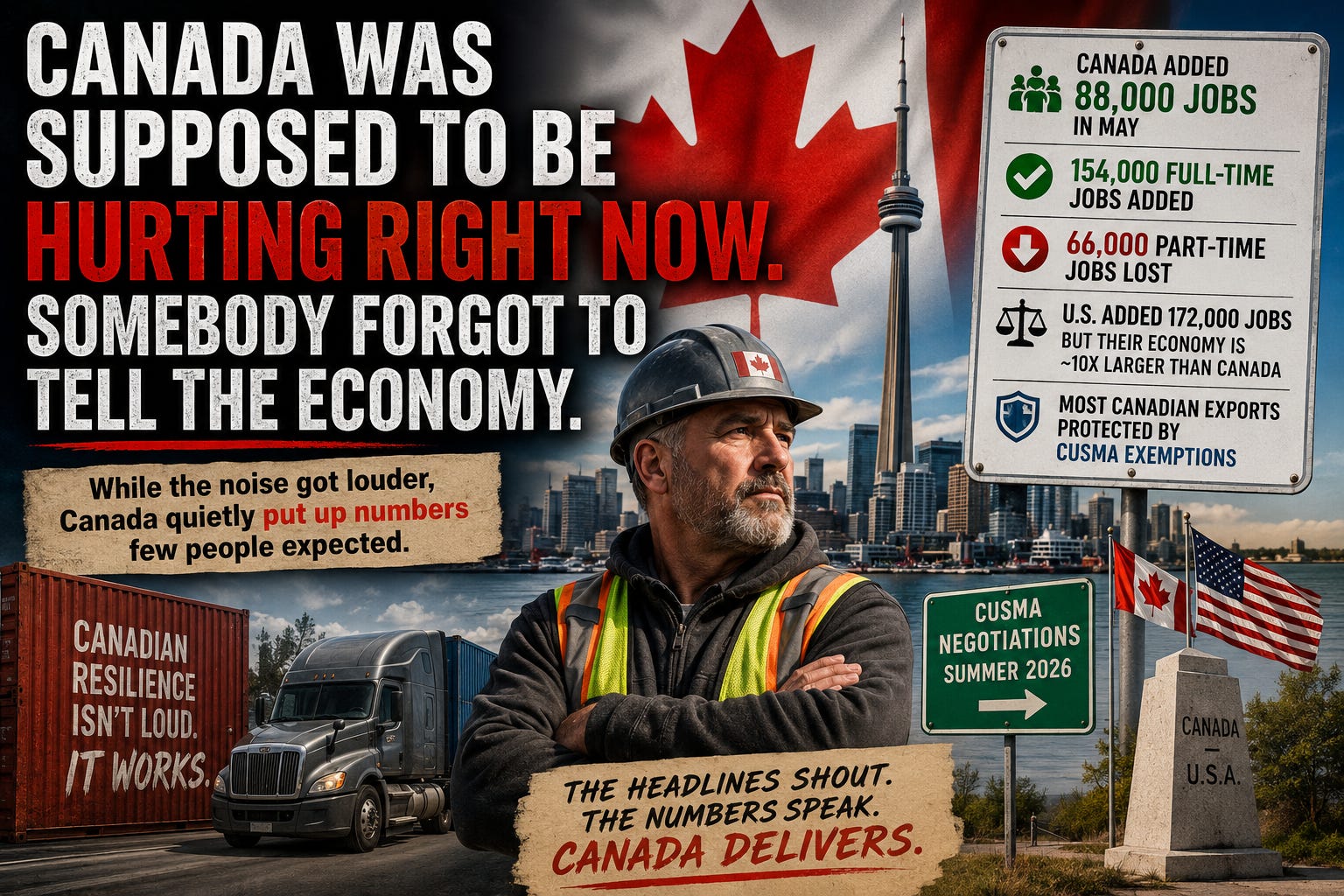
For months, we’ve been told Canada was heading for rough water.
Tariffs. Trade threats. Economic pressure from the United States. Warnings that jobs would disappear. Predictions that Canada would get squeezed because we rely too heavily on one giant customer south of the border.
Fair enough.
When your biggest trading partner starts throwing elbows, you pay attention.
But something interesting just happened.
Canada’s economy didn’t flinch the way many expected.
In May alone, Canada added 88,000 jobs.
That matters.
But here’s the part almost nobody talks about: these weren’t mostly side gigs, temp jobs, or “three-part-time-jobs-to-pay-the-rent” jobs.
Canada added roughly 154,000 full-time positions while part-time work dropped by 66,000.
In plain English?
A lot of people didn’t lose work.
They upgraded.
That’s a very different story than the doom headlines we were promised.
And before someone says, “Yeah, but America added more jobs,” let’s put that into perspective.
The United States added about 172,000 jobs.
Sounds huge… until you remember their economy is roughly ten times bigger than ours.
That’s like comparing a hockey team with a small town tournament and pretending the scoreboard means the same thing.
Scale matters.
So does quality.
And right now, Canada’s job numbers look stronger than expected at exactly the moment many people assumed trade pressure would start leaving bruises.
The Quiet Trade War Nobody Wants to Admit Is Happening
Here’s where things get interesting.
Publicly, it still sounds tense.
Washington keeps talking tough.
New tariffs appeared again… including a broad 10% import tariff tied to forced labour claims.
On paper, that sounds ugly.
But most Canadian exports? Still largely protected through CUSMA exemptions.
That little detail matters.
Because while the shouting gets headlines, the fine print often tells the real story.
And quietly… very quietly… some of the pressure is already easing.
The U.S. recently lowered some metal tariffs from 25% down to 15%.
Why?
Simple.
Because tariffs don’t just punish the other guy.
Sometimes they punch your own economy in the face.
American industries were feeling the pain too.
Funny how principles become negotiable when factories start complaining.
Canada Seems To Be Playing The Long Game
Now here’s the part I think many Canadians are missing.
This doesn’t look like panic.
It looks like positioning.
Canada recently backed away from plans to force American streaming companies to spend more money on Canadian content.
Some people saw that as weakness.
I don’t.
I see chess.
Because major CUSMA negotiations start this summer, and both countries are already moving pieces around the board.
Nobody wants to walk into a negotiation carrying unnecessary baggage.
You give a little here.
You hold firm there.
You buy leverage where it counts.
That’s not surrender.
That’s strategy.
Especially when you’re dealing with a neighbour known for changing the rules halfway through the game.
The UK Already Learned This Lesson The Hard Way
If Canada needs a warning sign, Britain already gave us one.
The U.K. rushed into trade arrangements hoping certainty would follow.
Then tariffs still showed up anyway.
Turns out a handshake doesn’t mean much if policy changes every few months.
Sometimes the paper isn’t worth what the printer charged for the ink.
That’s why patience matters.
A smaller country doesn’t win by rushing.
It wins by keeping options open and refusing to negotiate scared.
The Real Story Isn’t About Tariffs
Not yet.
The real story is resilience.
Canada was expected to wobble.
Instead, we added jobs.
Good jobs.
Full-time jobs.
At the exact moment trade pressure was supposed to be biting hardest.
Could things change?
Absolutely.
Trade negotiations can turn ugly fast.
Politics changes.
Policies shift.
One headline can undo six months of calm.
That risk is real.
But so far?
Canada looks steadier than many people expected.
And maybe… just maybe… we’re learning something important…
Depending on America doesn’t mean folding every time America sneezes.
The Recap…
Canada just added 88,000 jobs… and most weren’t part-time scraps.
While trade tensions with the U.S. keep making headlines, Canada’s economy quietly posted stronger-than-expected numbers.
Meanwhile, Washington is already softening some tariffs behind the scenes.
Funny how economic “wars” suddenly calm down when both sides feel the pain.
The Gut-Punch…
For months we were told Canada would crack under pressure.
Instead, the country quietly got back to work.
Turns out resilience doesn’t usually arrive waving a flag.
Sometimes it just shows up Monday morning with a lunch pail.
Source credit:
Research compiled from public reporting on Canadian and U.S. employment data, trade policy updates, tariff announcements, and upcoming CUSMA negotiations.
🔎 The GeezerWise Standard
This space is built on disciplined thinking.
Facts over spin.
Verification before amplification.
Good-faith discussion over tribal noise.
I use AI tools to help shape my spoken drafts into clear writing.
The judgment, conclusions, and final message are mine.
If you’re new here, this explains how I decide what’s worth sharing:
How I Decide What’s Worth Sharing → [link]
💌 Subscribe at GeezerWise.com to receive future letters:
www.geezerwise.com/subscribe
— Fred Ferguson
GeezerWise
#CanadaStrong
I reiterate every time someone calls this thing with the USA a “trade” war. It is not. What do you cal, the deliberate attempt to crush another country using economic tools? To bring an end to that country. I calk it an outright declaration of war. Strip away the BS niceties of diplomatic and misdirection talk. It’s is plain war.
When I shop, I aim for pure compliance with buying Canadian. When I dine, I tip based on a Canadian server and prep staff, and that is I tip well. Obviously the economy has some measure of resilience based on like minded people, realizing that paying into our economy, at any scale, is not just reasonable, it's wise.