

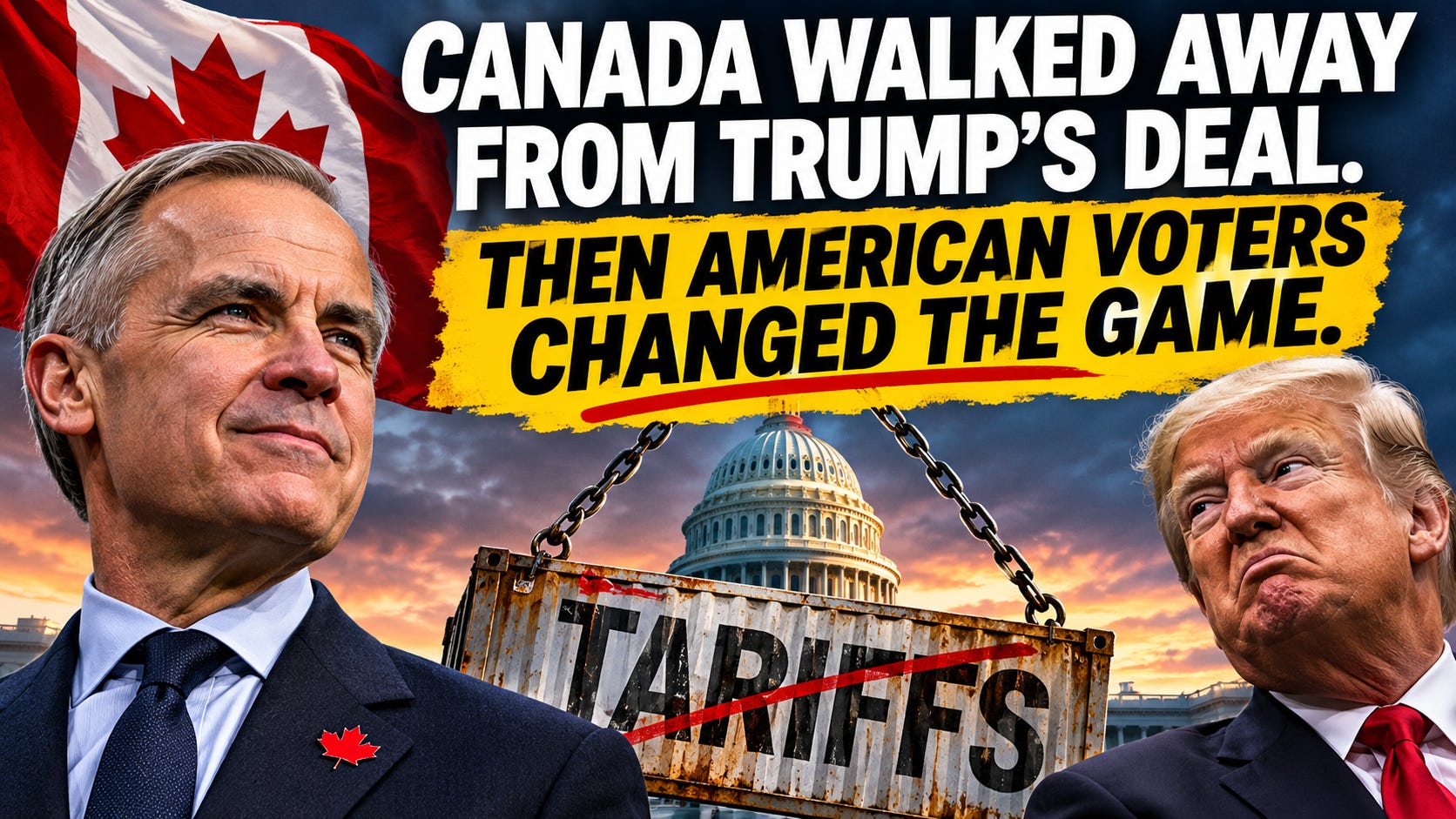
I’ve been watching Mark Carney handle Donald Trump for months now, and something has become pretty clear to me.
The man isn’t in a hurry.
And I’m beginning to think that’s one of his greatest advantages.
Remember August 22?
Canada and the United States were supposedly on the verge of another trade agreement. Negotiators had been working away in Washington. Trump wanted a deal. The deadline was approaching.
And with roughly two hours left, Carney told Canada’s negotiators to walk away.
No agreement.
No handshake.
No smiling photograph of two leaders congratulating themselves on a wonderful deal.
Just Canada saying no.
Trump responded with 50% tariffs on billions of dollars in Canadian goods.
At the time, plenty of people wondered whether Carney had made a terrible mistake.
Well, here we are in November.
The Democrats have just won control of both houses of Congress.
Trump’s tariffs have become a political headache in his own country.
And Canada is still at the negotiating table without having accepted the deal Washington wanted in August.
Funny how things change when you don’t panic.
Ottawa Was Watching More Than the Trade Negotiations
A November 8 investigation by Politico caught my attention.
The report described how Canadian officials studied the American electoral map while developing their response to Trump’s trade war.
Not just which products to tariff.
Which American states and congressional districts would feel the consequences.
Think about that for a minute.
Canada wasn’t simply throwing tariffs at American products and hoping somebody in Washington noticed.
According to Politico, officials were examining where economic pressure might encourage Republican politicians to reconsider their support for Trump’s trade policies.
That’s a very different approach.
And it wasn’t invented yesterday.
Back in 2018, when Trump imposed tariffs on Canadian steel and aluminum, Justin Trudeau’s government responded with carefully selected counter-tariffs.
The idea was straightforward.
If Washington wanted to make Canadian businesses suffer, American businesses and politicians needed to understand there would be consequences on their side of the border too.
The strategy didn’t require Canada to be bigger than the United States.
It required Canada to understand where its leverage existed.
And in 2026, that leverage included something Trump couldn’t negotiate away.
American voters.
Trump’s Tariffs Became His Own Political Problem
Here’s where the story gets interesting.
By October, Reuters was reporting that Trump’s tariffs on Canadian products had become a political liability for Republicans, particularly in border states.
That’s hardly surprising.
American businesses don’t operate in some imaginary economy where tariffs hurt foreigners and everybody at home gets richer.
American importers pay those tariffs.
Businesses absorb some of the costs, pass others along, or change their purchasing decisions.
And ordinary Americans eventually discover that making imports more expensive doesn’t magically make life cheaper.
Meanwhile, the war with Iran was putting additional pressure on energy prices and household budgets.
By the time Americans went to the polls on November 3, affordability had become a major political issue.
The Democrats won both the House and Senate.
Now, I wouldn’t insult your intelligence by claiming Canada single-handedly caused that result.
It didn’t.
Americans had plenty of reasons to be unhappy with their government.
But Canada’s trade dispute had become part of the argument over Trump’s economic policies.
And that matters.
Because suddenly the president who had been using tariffs to pressure Canada was facing political pressure at home over those very same tariffs.
There’s a certain satisfaction in watching that happen.
Carney Didn’t Need to Win an American Election
I want to be careful about something here.
There’s a difference between understanding the American political calendar and deliberately interfering in an American election.
Canada had every right to defend its economic interests.
It had every right to impose lawful retaliatory measures in response to American trade restrictions.
And it had every right to consider how those measures might influence the politicians responsible for American trade policy.
That’s international trade strategy.
Not proof of election interference.
In fact, when American officials accused Canada of interfering in the midterms, Carney rejected the accusation.
What the reporting does suggest is that Ottawa understood something important.
Trump’s negotiating position wasn’t necessarily going to improve with time.
His tariffs were creating costs for Americans.
An election was approaching.
And Republicans would eventually have to answer to voters who were paying those costs.
Carney could see the calendar just as clearly as Trump could.
The difference was that Canada didn’t have to face those American voters.
Trump’s party did.
Now the Democrats Want the Tariffs Gone
And look what’s happened since the election.
Democratic Senator Ron Wyden, expected to chair the Senate Finance Committee when the new Congress takes office in January, is already discussing legislation to repeal Trump’s tariffs on Canada.
Other Democrats are making similar arguments.
Carney has welcomed those efforts, pointing out that restoring freer trade would help American families and workers.
But here’s the catch.
Trump is still president.
He still has substantial authority over trade policy.
And he can veto legislation Congress sends him.
So anyone expecting the Democrats to arrive in January, wave a magic wand and make Canada’s trade problems disappear is going to be disappointed.
The political landscape has changed.
The trade war hasn’t ended.
And that’s why I think Carney’s patience matters.
Canada Still Has a Decision to Make
There are two ways to look at what happens next.
Canada could accept a partial agreement that reduces some tariffs while leaving others in place.
That might provide immediate relief to industries that desperately need it.
And let’s not forget those industries.
Canadian steelworkers, autoworkers, forestry workers and their families have been paying a real price for this dispute.
This isn’t a chess game where the pieces are disposable.
Those are Canadian jobs.
Or Canada could continue negotiating while waiting to see whether political pressure in Washington produces better terms.
Neither option comes without costs.
But there’s one thing I don’t want Canada doing.
Signing away important economic or sovereign rights just because Donald Trump has announced another deadline.
We’ve already seen what happened in August when Washington pushed demands Canada considered unacceptable.
Carney walked.
And by late October, he was reporting that the Americans had moved away from some of those demands.
That’s not a completed victory.
But it certainly doesn’t look like surrender.
Trump has threatened to raise tariffs on Canadian vehicles and steel to 50% beginning January 1, 2027.
That’s a serious threat, particularly for industries already under pressure.
But it’s a threatened escalation affecting particular sectors, not a blanket 50% tariff on everything Canada sells to the United States.
And threats aren’t the same as final decisions.
We’ve seen enough of those from Washington to know the difference.
The Part I Keep Coming Back To
For decades, Canadians have been told that our prosperity depends on maintaining a good relationship with the United States.
And there’s truth in that.
Our economies are deeply connected.
But somewhere along the way, maintaining a good relationship started sounding suspiciously like keeping Washington happy at almost any cost.
That’s not a relationship between equals.
That’s dependency.
What I find encouraging about Canada’s approach is that we’re finally beginning to act like a country with choices.
We can negotiate.
We can retaliate when necessary.
We can develop other markets.
We can strengthen our own industries.
And we can refuse agreements that would leave us worse off.
None of that requires us to hate Americans.
It requires us to stop confusing American political demands with Canadian national interests.
Carney hasn’t won the trade war.
He hasn’t eliminated Trump’s tariffs.
And the Democrats taking control of Congress won’t automatically solve our problems.
But Canada has demonstrated something worth remembering.
We don’t have to accept a bad deal simply because the bigger country demands an answer by Friday.
Sometimes the smartest move is to leave the table.
And let the other fellow discover that time isn’t always on his side.
The Recap…
Canada walked away from Trump’s trade deal in August.
Now Democrats have won Congress, and Trump’s tariffs are facing growing opposition in Washington.
Politico reports that Canadian officials studied exactly where economic pressure would matter politically.
Carney hasn’t won the trade war. But he hasn’t surrendered Canada’s bargaining power either.
The Gut-Punch…
Trump thought Canada’s greatest weakness was needing America.
He may be discovering that his own greatest weakness is needing American voters.
Source Credit:
Reporting and factual background: Politico, How Canada Inflicted Maximum Midterms Pain on Trump (November 8, 2026); Reuters reporting on Canada–U.S. trade negotiations (October 26 and November 4, 2026); Associated Press reporting on congressional tariff challenges (November 6 and 10, 2026); Global News reporting on Canada’s August negotiating red lines (October 26, 2026).
Politico investigation, excerpted by Political Wire… November 8
Reuters… Trade negotiations and political pressure, October 26
Associated Press… Democrats challenge Trump’s tariffs, November 6
Associated Press… Carney’s latest trade position, November 10
Original commentary and analysis: GeezerWise.
If you enjoy thoughtful conversations, Canadian stories, and the occasional smart-ass observation about the world we’re living in, you’re in the right place.
Subscribe free and get new stories, insights, and observations delivered directly to your inbox.
No paywall.
No spam.
No nonsense.
Leave anytime with a single click.
I promise not to take it personally.
Interesting discussion Fred. I'm of the opinion that making any side deals with Trump is not in Canada's best interest. I think the better approach would be to get CUSMA nailed down. It will take longer, but will be better in the long run.
Good article Fred. Like my gramma always said “everything comes out in the wash”. Does this apply here? I don’t know, but like you I do appreciate Carney’s pace.