

Let’s start with results…
While half the internet argues about vibes, Canada just signed $5.5 billion…
worth of agreements with India.
That includes five new memorandums of understanding covering…
Energy and critical minerals
Technology and AI
Talent mobility
Culture
Defence cooperation
And the headline item?
A $2.6 billion uranium supply deal between India and Saskatoon-based Cameco to deliver nearly 22 million pounds of uranium from 2027 to 2035.
That’s Saskatchewan’s high-grade uranium heading into India’s nuclear energy system for the better part of a decade.
That’s not symbolism. That’s supply chains.
This Is What Diversification Looks Like
Here’s what matters.
Canada is moving fast to reduce dependence on a single customer… the United States… because the ground rules south of the border have changed.
In the last year…
China dropped tariffs on Canadian canola and certain agricultural exports after negotiations.
India signs multi-billion-dollar agreements days after high-level meetings.
Canada continues talks across the Indo-Pacific, Europe, and other partners.
This isn’t accidental. It’s strategic.
If one buyer gets unpredictable, you build more buyers.
Simple.
Cooperation vs. Posturing
One thing worth noting… Saskatchewan Premier Scott Moe… a Conservative… has been directly involved in trade missions to both China and India.
You can disagree on ideology and still show up to negotiate.
That’s called governing.
Meanwhile, the federal Conservative leader has spent much of the year criticizing international travel — only to begin traveling abroad himself when polling numbers shifted.
Recent Nanos polling…
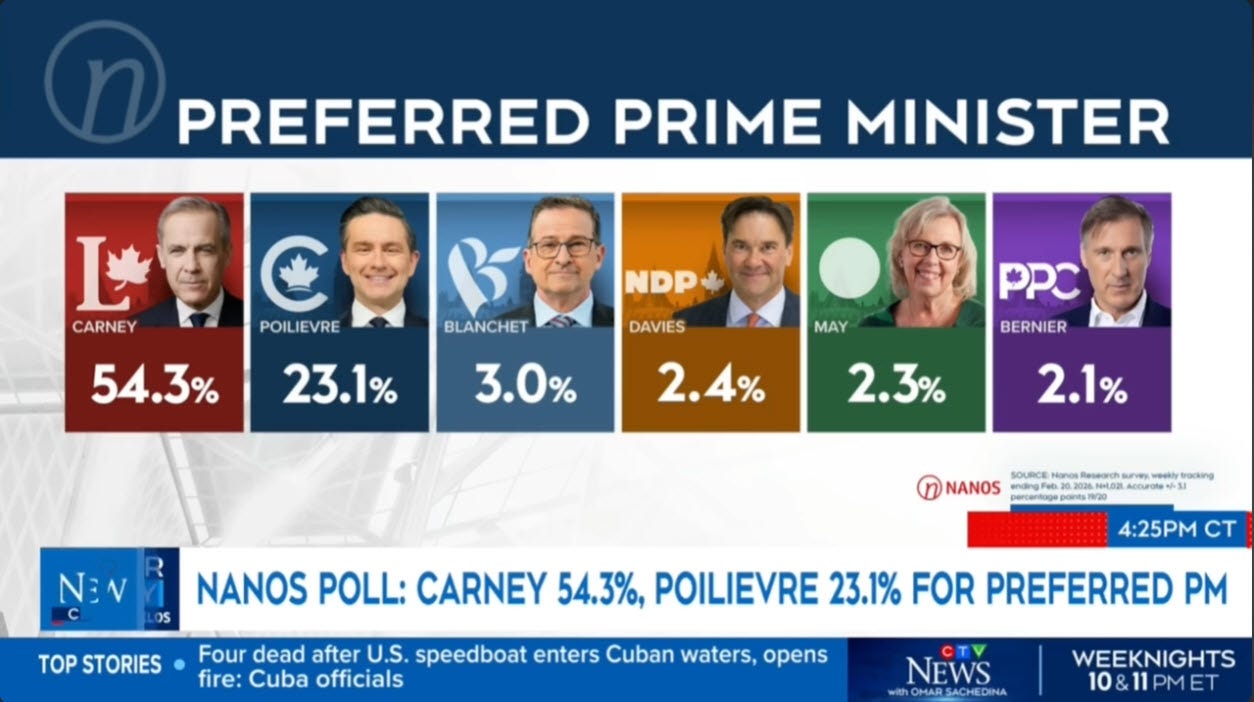
Preferred Prime Minister…
Mark Carney: 54.3%
Pierre Poilievre: 23.1%
Federal vote intention…
Liberals: 41.3%
Conservatives: 33.7%
Politics aside, one side is signing contracts. The other is waiting for something to fail.
The Real Issue… The U.S. Is Playing a Different Game
Now here’s the part Canadians need to understand clearly.
Senior U.S. officials have openly stated that American foreign policy prioritizes…
Control of natural resources in its “neighbourhood.”
Energy dominance for Americans.
Demonstrating military and economic leverage.
They’ve explicitly said… “In our neighbourhood, we call the shots.”
Let that sink in.
Venezuela holds the world’s largest crude oil reserves.
Saudi Arabia? Strategic alignment.
Iraq? Two wars.
Iran? Ongoing pressure.
This isn’t conspiracy. It’s stated doctrine.
Now look north.
Canada holds…
Massive oil reserves
Critical minerals
Freshwater
Uranium
Hydroelectric power
We are in the same “neighbourhood.”
So when trade talks under CUSMA (USMCA) come up, and tariffs are floated as leverage, understand the context.
This isn’t a friendly backyard barbecue.
It’s negotiation through pressure.
The CUSMA Reality
Here’s the strategic fork in the road…
If the U.S. insists tariffs must remain part of any agreement, Canada rejects that precedent.
If Canada rejects tariffs, talks stall.
If talks stall, opposition politicians say, “See? No deal.”
That’s the trap.
Which is why Ottawa is accelerating diversification.
Because if your biggest customer starts negotiating like a monopoly, you build alternative markets before you’re cornered.
History Matters
The last time the U.S. tried to absorb Canada by force was the War of 1812.
That didn’t go as planned.
Today the pressure isn’t military. It’s economic.
But the underlying logic is familiar… secure resources, control leverage, dominate the region.
So no… ideological alignment doesn’t guarantee favourable treatment.
Nations negotiate for themselves.
Always.
The Bottom Line
Canada signing a $5.5 billion package with India is not “nice diplomacy.”
It’s insurance.
It’s leverage.
It’s long-term positioning in a world where the rules are tightening and the swords are out.
And if we’re smart, we keep building more deals like that.
Fast.
The Recap…
Canada just signed $5.5B in deals with India… including a $2.6B uranium agreement.
Meanwhile, U.S. officials openly say they “call the shots” in their neighbourhood.
This isn’t about politics. It’s about leverage.
Diversify… or get cornered.
The Gut-Punch…
If your biggest customer carries a sword, you’d better find more customers.
Source: Public reporting on Canada–India agreements, Nanos polling data, and statements from senior U.S. officials regarding regional foreign policy strategy.
🔎 The GeezerWise Standard
This space is built on disciplined thinking.
Facts over spin.
Verification before amplification.
Good-faith discussion over tribal noise.
I use AI tools to help shape my spoken drafts into clear writing.
The judgment, conclusions, and final message are mine.
If you’re new here, this explains how I decide what’s worth sharing:
How I Decide What’s Worth Sharing → [link]
💌 Subscribe at GeezerWise.com to receive future letters:
www.geezerwise.com/subscribe
— Fred Ferguson
GeezerWise
#CanadaStrong
For people that didn't understand, that's why all the trips and MOUs that have resulted. The clock is ticking. There's a few things on Canada's side, such as the Sec. 122 tariffs which could die on July 24th. Also the House is drafting a pro-CUSMA bill which seems to have wide support from both sides of the aisle. Northern state governors have been very actively promoting this bill.
No matter how many trips, it would be a long time before we could replace all U.S. trade and I'm sure that's not the goal. However we do want to be in a position of relative strength when we get to the table. Tick-tock but not trick talk.
Talk is cheap, real cheap from Mr T.