

Let’s start with numbers, not slogans.
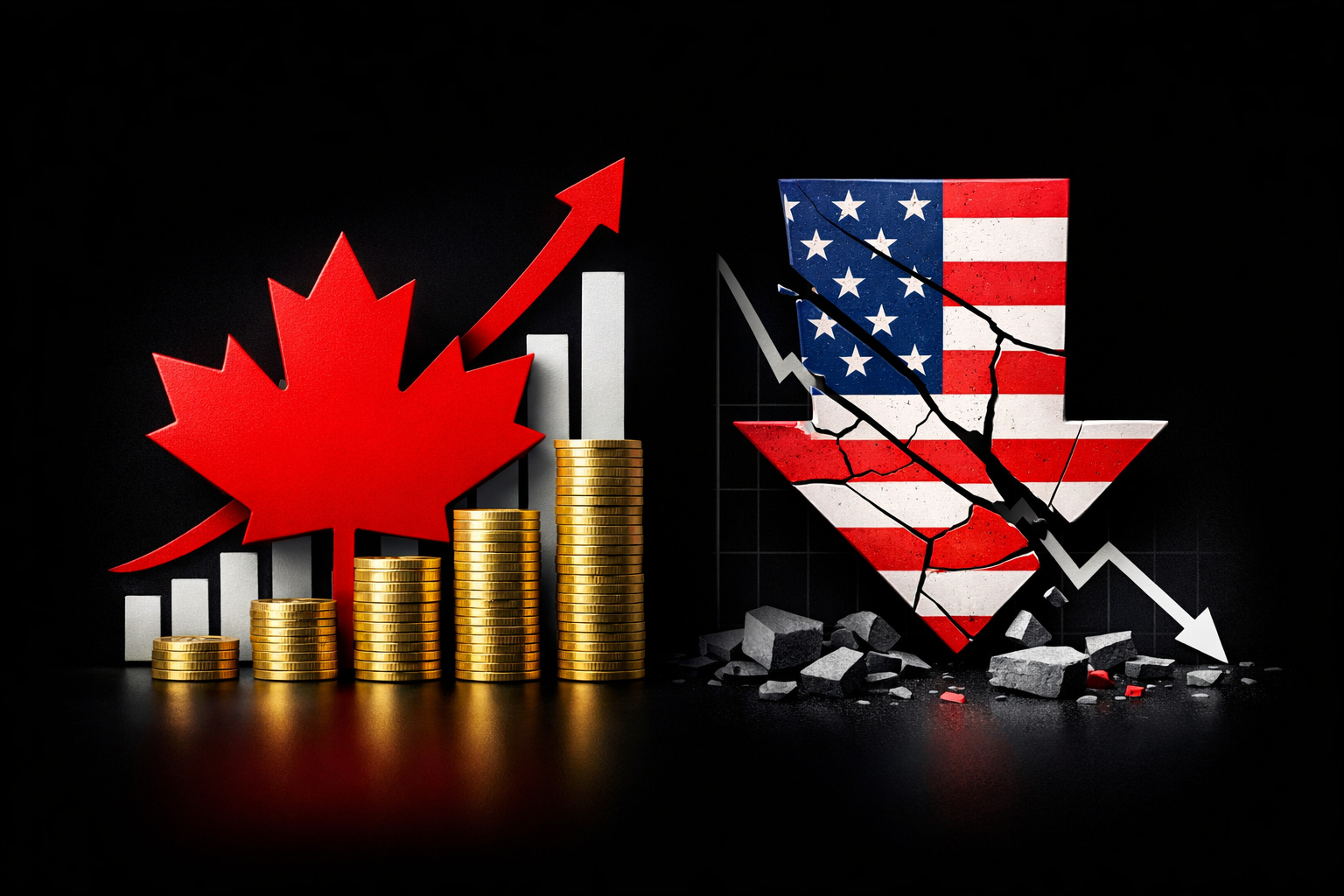
In 2025, Canada’s main stock index… the S&P/TSX Composite Index… returned 31.7%.
The United States? About 12.4% across major benchmarks.
Among the ten largest stock markets on the planet, the U.S. ranked eighth for performance last year.
Canada ranked first.
That’s not chest-thumping. That’s math.
The “Dow 50,000” Victory Lap
Yes, the Dow Jones Industrial Average briefly pushed past 50,000.
Cue fireworks. Cue political speeches. Cue self-congratulations.
But here’s the part the cheerleaders leave out…
Over the past year, the Dow rose roughly 11%.
During that same stretch, the U.S. dollar fell about 11% against a basket of global currencies.
In plain English?
Measured in global purchasing power, that stock market gain largely cancels out.
It’s like bragging your house price went up… while your currency shrank at the same speed. The sticker looks bigger. The substance doesn’t.
Meanwhile in Canada…
The TSX climbed from roughly 25,600 to over 32,700.
That’s about a 27%+ gain.
The Canadian dollar strengthened from about 69 cents U.S. to roughly 73.5 cents … about 7% higher.
So not only did Canadian equities rise more than double the U.S. pace, the currency tailwind added extra lift.
That’s called compounding advantage.
Why the Gap?
Structure matters.
Canada’s market is heavily weighted toward…
Financials
Energy
Mining
Those sectors surged.
Investors are betting on resource development, nation-building projects, energy demand, and a financial sector positioned to benefit from growth.
The U.S. surge?
Driven heavily by large-cap tech and AI names.
Tech stocks can soar… and many have… but their gains don’t necessarily spill into the broader economy the way commodity expansion and domestic infrastructure projects do.
A handful of AI giants can lift an index.
That doesn’t automatically lift the grocery bill off someone’s kitchen table.
Stock markets measure investor expectations… not whether regular people feel prosperous.
That’s true on both sides of the border.
The Stock Market Is Not the Economy
Let’s clear something up.
A stock market is a forward-looking betting board. Prices reflect what investors believe the future might look like.
It does not directly measure…
Wage growth
Affordability
Housing pressure
Grocery prices
When someone asks, “How’s your economy doing?” and points to the Dow, they’re confusing a scoreboard with the entire game.
It’s one data point. Not the whole story.
The Political Messaging Machine
There’s another layer here.
You’ve likely heard this line repeated…
“The Dow is at 50,000. The S&P is smashing records. Retirement accounts are booming.”
Repetition is powerful.
Stick to one message. Repeat it regardless of the question. Anchor everything back to the headline number.
We recently saw that tactic in a congressional hearing when Pam Bondi pivoted from questions about Jeffrey Epstein investigations straight into a speech about record stock indexes and 401(k)s.
Different topic. Same talking point.
When the Dow later dipped back below 50,000, the victory lap went quiet.
Markets move. Messaging just keeps looping.
A Canadian Reality Check
Now let’s not get smug.
A 31.7% stock return does not magically make rent cheaper in Toronto.
It doesn’t fix food inflation.
It doesn’t eliminate economic stress.
What it does signal is that global investors see momentum in Canada’s financial, energy, and resource sectors.
That’s forward-looking confidence.
And in 2025, that confidence ranked #1 in the world.
Bottom Line
If someone sneers, “How’s your economy doing?” while waving the Dow like a trophy…
You can calmly reply…
Canada outperformed the world last year.
And that’s not a slogan. It’s data.
The Recap…
You’ve heard the bragging about “Dow 50,000.”
Here’s what didn’t make the speeches…
Canada’s stock market ranked #1 in the world in 2025… more than double U.S. returns.
Let’s talk about numbers, not noise.
The Gut Punch…
Headlines brag. Currency-adjusted returns don’t lie.
Source: Connor, Clark & Lunn Financial Group 2025 market review; Trading Economics data.
🔎 The GeezerWise Standard
This space is built on disciplined thinking.
Facts over spin.
Verification before amplification.
Good-faith discussion over tribal noise.
I use AI tools to help shape my spoken drafts into clear writing.
The judgment, conclusions, and final message are mine.
If you’re new here, this explains how I decide what’s worth sharing:
How I Decide What’s Worth Sharing → [link]
💌 Subscribe at GeezerWise.com to receive future letters:
www.geezerwise.com/subscribe
— Fred Ferguson
GeezerWise
#CanadaStrong
Your explanations of complex financial topics are logical and easy to understand.
I thought when I first subscribed to you that you might be Canadian. I appreciate your information. I lived in the Detroit area for 27 years. At 76 (I’m now 78), I thought it was time to return to California where my two children & spouses are along with 5 granddaughters (1, 3, 5, 14 & 28) & a great granddaughter - 2 1/2. I have to say there’s been a number of times I’ve regretted not walking across the Ambassador Bridge & into Canada, especially since all my family are Trumpers. 😥 Go figure.