

Here’s a number worth paying attention to.
$12.73 billion.
That’s how much Canada exported to China in just three months, from July through September 2026.
A record quarter. Up 56.4% from the same period last year.
And while Canadians were busy arguing about Donald Trump, Mark Carney and whether we could survive another round of American tariffs, something rather important was happening.
We were selling more of our stuff somewhere else.
Imagine that.
For years, Canadians have been told how dependent we are on the United States. And we are. Nobody with a functioning calculator is going to argue otherwise.
But dependence isn’t a law of nature.
It’s something you can change.
And we’re beginning to see what that change looks like.
China Is Buying. Canada Is Selling.
On November 4, International Trade Minister Maninder Sidhu announced that Canada and China had extended a trade arrangement through the end of 2028.
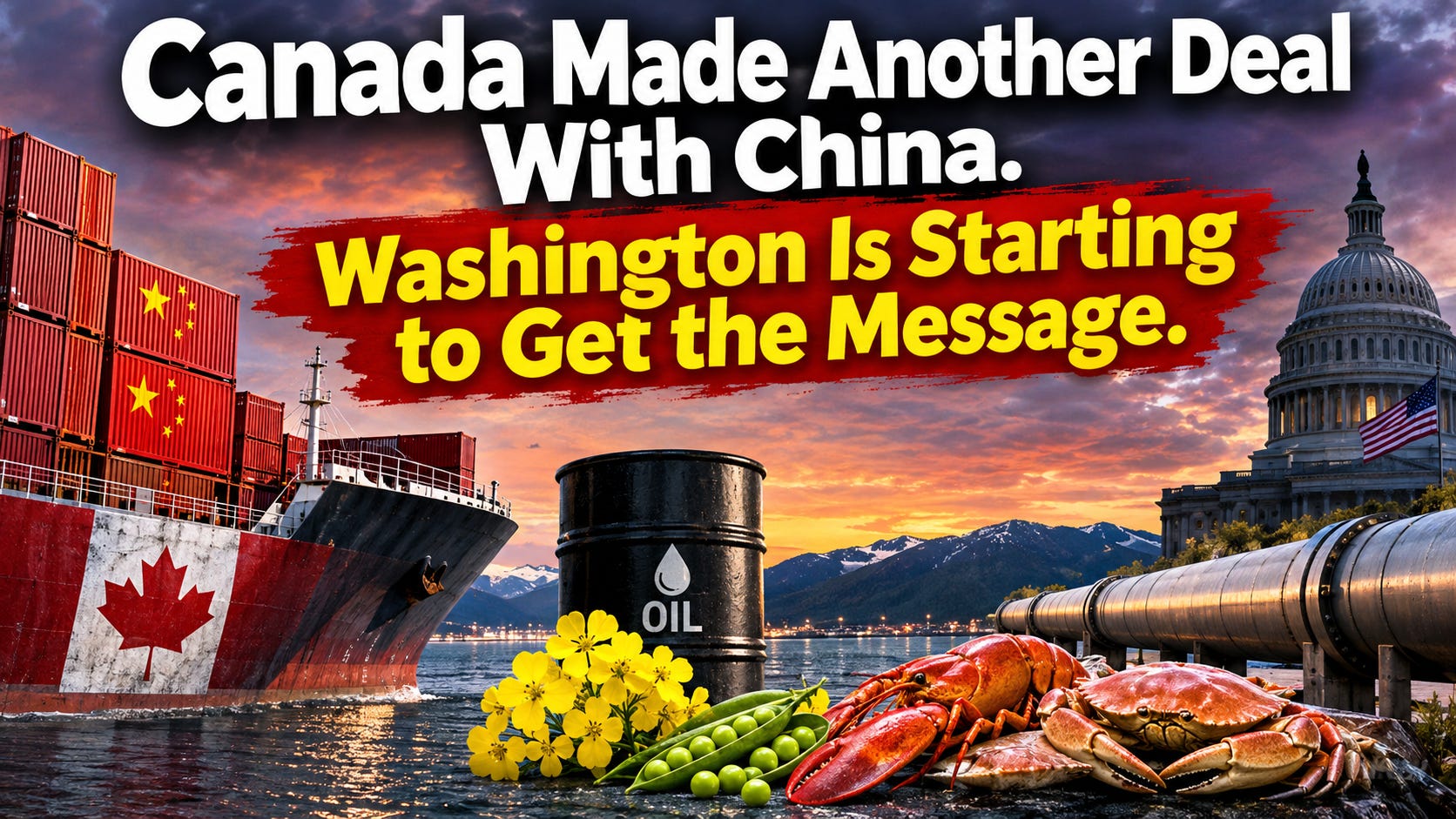
The agreement keeps favourable Chinese market access in place for Canadian canola meal, peas, lobster and crab.
In return, Canada continues providing tariff relief for certain Chinese steel and aluminum products that aren’t manufactured here.
That’s called negotiating.
Both sides want something. Both sides give something.
Nobody needs to threaten to annex anybody.
The arrangement builds on the agreement Carney reached during his January visit to Beijing.
And the results are showing up in actual exports.
According to the Canada China Business Council, Canadian exports to China rose 56.4% in the third quarter compared with a year earlier.
Alberta and Saskatchewan were among the biggest contributors.
Energy was a major driver, with crude petroleum accounting for roughly half the increase in export value.
That’s an important detail.
Because while some Canadian politicians are still arguing that Ottawa has been strangling Alberta’s ability to sell oil, Alberta’s exports to China have been growing dramatically.
And there’s a piece of Canadian infrastructure helping make that possible.
The Trans Mountain pipeline expansion.
The federally owned project expanded Canada’s ability to move Alberta crude to the Pacific coast, where it can reach buyers across the ocean.
We can argue about what that pipeline cost. We can argue about government ownership.
But we shouldn’t ignore what the additional export capacity makes possible.
Canada now has more ability to sell its oil somewhere other than the United States.
That’s worth something.
Especially these days.
Meanwhile, Washington Has Been Reconsidering a Few Things.
Remember when Canada walked away from trade negotiations in August?
Carney said the Americans were asking too much and offering too little.
Among the problems were American demands that threatened Canada’s independence, including its ability to make trade arrangements with other countries.
Think about that for a moment.
The United States wanted a say in who Canada could do business with.
We’re talking about a sovereign country, not a branch office.
Canada refused.
And on November 3, Carney reported that American negotiators had backed away from some of those demands.
The ability to negotiate our own trade agreements was among the issues where progress had been made.
Now, don’t misunderstand me.
That doesn’t mean Trump has surrendered.
It doesn’t mean the tariffs are gone.
And it certainly doesn’t mean we’ve got a finished trade agreement.
But it does mean Washington’s position has changed.
Canada refused to surrender its independence, continued looking for other customers, and the Americans started asking for less.
I wouldn’t claim one caused the other without evidence.
But I wouldn’t ignore the significance of those developments happening together, either.
We Don’t Have to Fall in Love With China.
There’s something else Canadians should understand.
Doing business with China doesn’t mean we have to approve of the Chinese government.
We can have serious disagreements about human rights, security, foreign interference and how Beijing conducts itself internationally.
Those concerns don’t disappear because somebody buys Canadian canola.
And we shouldn’t trade one dangerous dependency for another.
That’s the whole point.
Diversification means having more choices.
China. Europe. Asia. Other markets willing to buy what Canadians produce.
It means farmers having more customers, seafood harvesters having more markets, and energy producers having more places to send their products.
It means a country with options.
And a country with options is a lot harder to push around.
Here’s What I Find Interesting.
The United States remains Canada’s biggest trading partner. That isn’t going to change overnight.
Nor should we pretend that replacing American customers will be easy.
But the numbers coming out of China tell us something.
This isn’t just another government announcement about a future opportunity.
Canadian companies are already exporting more.
A trade arrangement has been extended.
And Washington has begun retreating from demands that Canada considered unacceptable.
That’s actual movement.
For too long, we’ve treated access to the American market as though it were something Canada had to protect at almost any cost.
Trump has reminded us how risky that thinking can be.
A market can be enormous and still be unreliable.
A neighbour can be wealthy and still be unreasonable.
And a trading relationship can be valuable without giving the other country the right to run yours.
Canada doesn’t need to stop trading with America.
We need to stop acting as though America is our only choice.
And for the first time in a long time, we’re seeing some impressive numbers to back that up.
The Recap…
Canadian exports to China reached a record $12.73 billion in the third quarter, up 56.4% from a year earlier.
Canada and China have extended a trade arrangement through 2028.
Meanwhile, Washington has backed away from some demands involving Canada’s right to make its own trade agreements.
We’re not independent of the American market.
But we’re working on becoming less dependent.
The Gut-Punch…
The best way to defend Canada’s right to choose its trading partners is to make sure we actually have some choices.
Source Credit
Global Affairs Canada — Trade Arrangement Extension, November 4, 2026
The Canadian Press via Global News — Canada-U.S. Trade Negotiations, November 3, 2026
Prime Minister of Canada — August 22 Trade Negotiations Statement
If you enjoy thoughtful conversations, Canadian stories, and the occasional smart-ass observation about the world we’re living in, you’re in the right place.
Subscribe free and get new stories, insights, and observations delivered directly to your inbox.
No paywall.
No spam.
No nonsense.
Leave anytime with a single click.
I promise not to take it personally.