

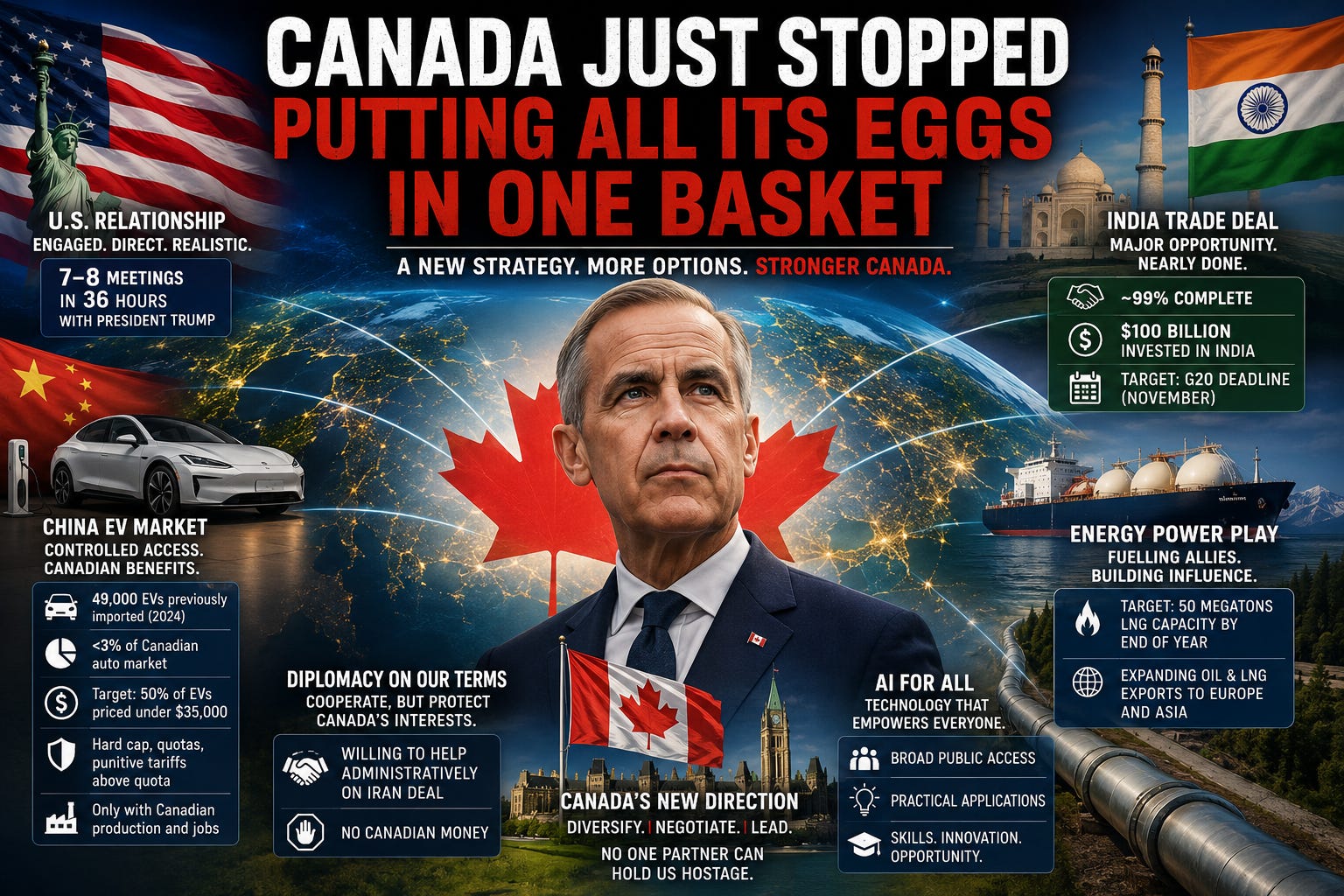
Mark Carney’s government is quietly building a strategy that spreads Canada’s bets across the United States, Europe, India, Asia, energy, technology, and manufacturing… all at the same time.
The biggest shift in Canadian policy isn’t happening in Parliament.
It’s happening on the world stage.
While most headlines focus on tariffs, trade disputes, and the latest political drama from Washington…
Canada appears to be pursuing something much larger… reducing its dependence on any single country.
That became clear during the recent G7 meetings, where Prime Minister Mark Carney reportedly spent nearly 36 hours in intensive diplomacy, including seven or eight separate discussions with Donald Trump.
The subjects went far beyond trade.
They included artificial intelligence, Ukraine, Iran, economic cooperation, and the future relationship between Canada and the United States.
That’s not the behaviour of a country looking to pick a fight with its largest trading partner.
It’s the behaviour of a country trying to maintain an important relationship while making sure it has alternatives.
And alternatives are exactly what Canada is building.
One of the most surprising developments is the cautious reopening of the door to Chinese electric vehicles.
Only a few years ago, Canada effectively slammed that door shut.
Now the approach appears very different. Instead of a blanket ban, Ottawa is exploring a tightly controlled system with quotas, pricing requirements, and penalties for exceeding limits.
The interesting part isn’t the cars.
It’s the conditions.
Canada’s message appears straightforward… if foreign companies want access to Canadian consumers, they should also be willing to create Canadian jobs and build things here.
That turns market access into leverage.
Chinese EV imports currently represent less than three percent of the Canadian vehicle market.
In other words, this is not an industry-changing flood of imports. It’s a test of whether Canada can attract investment while maintaining control of the rules.
At the same time, another piece of the puzzle is taking shape on the other side of the world.
India.
Canada already has roughly $100 billion invested there, and negotiations toward a major trade agreement are reportedly approaching the finish line.
If completed, the deal would give Canadian businesses deeper access to one of the fastest-growing major economies on the planet.
The timing matters.
For years, Canadian trade policy was dominated by managing the relationship with the United States.
Today, policymakers appear increasingly focused on creating multiple pathways for growth.
India represents one of them.
Europe represents another.
Energy may be the biggest opportunity of all.
Global instability has exposed a hard truth. Countries that control reliable energy supplies suddenly have more influence than countries that merely talk about influence.
Canada possesses enormous oil and natural gas resources, and Ottawa appears increasingly willing to use those resources as a strategic advantage.
The target of reaching roughly 50 megatons of LNG export capacity by year’s end is not just an economic objective.
It’s a geopolitical one.
European allies are searching for dependable suppliers. Asian economies continue to need massive amounts of energy.
Canada has what many of them need.
For decades, Canadians often treated energy as something we sold.
Now it is increasingly being viewed as something that gives us leverage.
The same logic appears in Canada’s approach to international diplomacy.
When discussions surfaced about a possible U.S.-Iran arrangement, Canada reportedly signaled willingness to assist administratively while refusing to contribute financially.
That is a subtle but important distinction.
Canada is saying yes to participation, but no to writing blank cheques.
Again, the pattern is clear.
Cooperate where it makes sense.
Protect Canadian interests first.
The final piece of the strategy may be artificial intelligence.
Unlike approaches that focus primarily on corporate dominance, Canada’s emerging AI vision emphasizes broad public access and practical adoption.
The goal appears less about creating a handful of tech giants and more about making sure ordinary Canadians, businesses, workers, and entrepreneurs can actually use the technology.
That matters because economic power increasingly belongs to countries that help their citizens adapt quickly.
Put all of this together and a larger picture emerges.
Canada is not choosing between the United States, China, Europe, or India.
Canada is trying to avoid choosing at all.
The old model was dependence.
The new model is diversification.
Trade diversification.
Energy diversification.
Diplomatic diversification.
Technology diversification.
The strategy carries risks. Every balancing act does.
Some Canadians will worry about China.
Others will worry about relations with Washington.
Some will question energy expansion.
Others will question AI policy.
But the direction is becoming increasingly clear.
Canada no longer wants its future tied to the decisions of any single foreign capital.
Not Washington.
Not Beijing.
Not Brussels.
Not New Delhi.
The goal is simple…
Build enough relationships that no one relationship can hold the country hostage.
That’s not isolation.
That’s independence.
The Recap…
Canada is quietly changing its playbook.
More trade with India. More energy exports to allies. Controlled engagement with China. Constant dialogue with Washington.
The goal isn’t to pick sides.
It’s to make sure Canada has options.
The Gut-Punch…
For most of our modern history, Canada’s strategy was simple… stay close to the United States and hope for the best.
The world has changed.
The countries that thrive in the next decade won’t be the ones with the biggest friends.
They’ll be the ones with the most choices.
Source credit:
Based on research notes provided, including G7 diplomacy, Canada-China EV negotiations, India trade discussions, LNG export strategy, AI policy direction, and Canada’s evolving trade diversification efforts.
🔎 The GeezerWise Standard
This space is built on disciplined thinking.
Facts over spin.
Verification before amplification.
Good-faith discussion over tribal noise.
I use AI tools to help shape my spoken drafts into clear writing.
The judgment, conclusions, and final message are mine.
If you’re new here, this explains how I decide what’s worth sharing:
How I Decide What’s Worth Sharing → [link]
💌 Subscribe at GeezerWise.com to receive future letters:
www.geezerwise.com/subscribe
— Fred Ferguson
GeezerWise
#CanadaStrong
I like the sentiments and won't quibble with any of the individual facts. It's correct in substance and form and yes, given the new King of America's approach to foreign policy, a wise one indeed.
Thank you so much for your reports and keeping us in the loop.