

I think we’re reaching the point where Canadians need to stop looking at every announcement individually.
One data centre here.
A pension fund there.
Another bank financing package.
Another port proposal.
Another European meeting.
Taken separately, they’re interesting.
Put them together and something much bigger is happening.
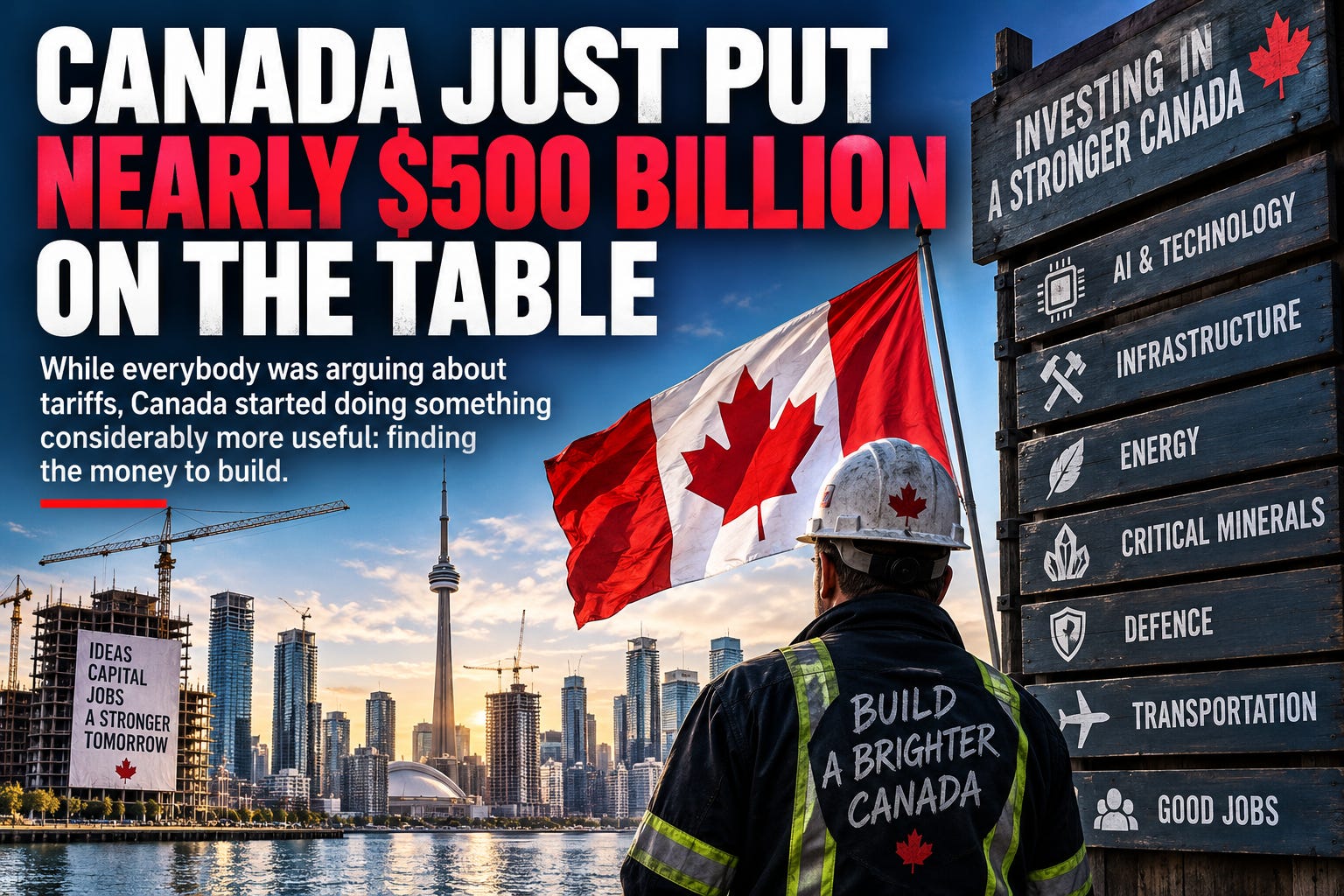
Canada held its first Canada Investment Summit in Toronto this week.
Investors from nearly 30 countries showed up.
Together, they manage more than $100 trillion in assets.
And by the time the summit wrapped up, the federal government said nearly $500 billion in investment and financing commitments had been announced or accelerated.
Half a trillion dollars.
Now before anybody starts firing up the confetti cannon, let’s get something straight.
That does not mean somebody deposited $500 billion into Canada’s bank account Tuesday afternoon.
Some of these are investment commitments. Some are financing commitments. Some will unfold over years. Some projects will undoubtedly change along the way.
That’s how big investment works.
But the scale matters.
And so does where the money is going.
Start with the Canadians investing in Canada
Some of Canada’s biggest pension funds, insurers and institutional investors committed nearly $100 billion in new capital to Canadian assets.
CPP Investments and Brookfield Asset Management announced a $50-billion Maple Fund aimed at Canadian infrastructure and strategic industries.
PSP Investments plans to increase its Canadian investments by roughly $25 billion, bringing its total Canadian holdings toward $100 billion.
Ontario Teachers’ Pension Plan committed another $10 billion by the end of 2027.
Sun Life added $5 billion over five years for infrastructure including energy, transportation and digital technology.
That part interests me.
For years we’ve heard the same complaint…
Canada has plenty of money.
We just don’t invest enough of it in Canada.
Well, somebody apparently found the Canadian cheque book.
Then the banks showed up
Canada’s major banks announced nearly $325 billion in financing for Canadian businesses and infrastructure.
TD: $150 billion.
Scotiabank: more than $100 billion.
BMO: $70 billion.
CIBC added $2 billion specifically aimed at smaller defence and dual-use businesses.
This isn’t government spending.
It’s financing capacity intended to help companies build projects in areas including energy, critical minerals, defence, aerospace, AI and infrastructure.
And those are exactly the sectors Canada keeps saying it wants to expand.
For once, the money and the speech appear to be standing in the same room.
Saskatchewan just landed a monster
Then came Bell Canada.
Bell announced plans to expand its Saskatchewan AI infrastructure project into a 1.2-gigawatt computing hub.
Potential capital investment…
Up to $52.5 billion.
That would make it the largest capital investment in Saskatchewan’s history.
The project is expected to create thousands of jobs during its development and hundreds of permanent positions connected with the data centres and power generation.
But the bigger issue isn’t simply jobs.
It’s sovereign computing capacity.
AI is becoming infrastructure.
The countries controlling computing power, electricity, data centres and secure domestic data storage are going to have an advantage that looks a lot like the advantage countries once gained from railways, ports and pipelines.
Canada doesn’t want to rent all of that capacity from somebody else.
We’re starting to build some of it here.
And here’s the part I really like
Look at who was standing around while all this was happening.
Prime Minister Mark Carney.
Former Conservative prime minister Stephen Harper.
Former Liberal prime minister Jean Chrétien.
Saskatchewan’s Conservative Premier Scott Moe was there for the Bell announcement.
Meanwhile Manitoba’s NDP government has been pitching the Port of Churchill as another route connecting Canadian resources with overseas markets.
Different parties.
Different ideologies.
Same country.
That’s how this should work.
You can beat the hell out of each other during an election.
But when Canada is sitting across the table from people controlling trillions of dollars looking for somewhere to invest, perhaps everybody could leave the campaign signs in the trunk for an afternoon.
Now about those airports
This one deserves scrutiny.
The federal government intends to seek private investment to operate Canada’s four largest airports…
Toronto.
Montreal.
Vancouver.
Calgary.
You’ll inevitably hear that described as selling Canada’s airports.
That’s not what has been announced.
Ottawa says the federal government would retain ownership of the underlying land and assets while offering long-term operating concessions to investors.
The government says money raised through those arrangements would be reinvested in regional airports and other infrastructure.
Could that be a good arrangement?
Could it create problems?
Absolutely.
The details will matter enormously, including regulation, passenger costs, foreign ownership exposure and who ultimately benefits financially.
So I’m not giving that one a GeezerWise rubber stamp yet.
Show me the contract.
Then we’ll talk.
And Canada isn’t only looking inward
At almost the same time this investment summit was wrapping up, Carney was heading across the Atlantic pursuing a much deeper relationship with Europe.
Canada already has CETA.
Now the discussion is expanding into defence, technology, energy, digital security and strategic investment.
European Commission President Ursula von der Leyen has even proposed an unprecedented form of “associate membership” for Canada.
Nobody should confuse that with Canada joining the European Union.
It isn’t.
In fact, nobody yet knows precisely what this new relationship would ultimately look like.
But Europe and Canada are clearly exploring something considerably deeper than another trade agreement.
And that’s the larger picture.
Canada is building options
For decades our economic strategy was pretty simple.
Sell an enormous amount of stuff to the Americans because they’re next door.
It worked brilliantly.
Until relying overwhelmingly on one customer stopped looking quite so brilliant.
Canada isn’t abandoning the United States.
We’re reducing the danger of having too few alternatives.
More European trade.
More Asian trade.
More domestic processing.
More Canadian infrastructure.
More ports.
More energy capacity.
More critical-mineral development.
More defence production.
More AI infrastructure.
More Canadian capital invested in Canada.
None of this happens overnight.
And announcements aren’t accomplishments until somebody starts pouring concrete, hiring workers and producing something.
That’s the part I’ll be watching.
But something has changed.
Canada isn’t merely talking about diversification anymore.
We’re starting to finance it.
And nearly half a trillion dollars worth of commitments is one hell of a way to get the shovel out of the shed.
The Recap…
Canada’s first Investment Summit brought investors managing more than $100 trillion to Toronto.
Nearly $500 billion in investment and financing commitments were announced or accelerated.
Pensions. Banks. AI. Infrastructure. Energy. Critical minerals. Defence.
The important question now isn’t what Canada announced.
It’s what actually gets built.
The Gut-Punch…
For decades Canada complained that we had the resources, talent and money but couldn’t seem to put the three together.
This week we started putting the money beside the projects.
Now comes the part that counts.
Build the damn things.
Source credit
Government of Canada / Prime Minister of Canada — Canada Investment Summit announcements, September 14–15, 2026; Government of Saskatchewan and Innovation, Science and Economic Development Canada — Bell AI Saskatchewan expansion; Reuters and The Canadian Press reporting on Canadian airport investment plans; Reuters reporting on Canada–EU relations, September 2026.
If you enjoy thoughtful conversations, Canadian stories, and the occasional smart-ass observation about the world we’re living in, you’re in the right place.
Subscribe free and get new stories, insights, and observations delivered directly to your inbox.
No paywall.
No spam.
No nonsense.
Leave anytime with a single click.
I promise not to take it personally.If you enjoy thoughtful conversations, Canadian stories, and the occasional smart-ass observation about the world we’re living in, you’re in the right place.
Subscribe free and get new stories, insights, and observations delivered directly to your inbox.
No paywall.
No spam.
No nonsense.
Leave anytime with a single click.
I promise not to take it personally.
Carney has so many major initiatives in play. The investment summit could have huge potential for Canadian economic growth, and Von Der Leyen offering Canada associate membership with the EU opens so many new doors for our country. I can't wait to hear our PM address the European Parliament on Thursday. I have a feeling his speech will build on his presentation in Davos earlier this year. It could be opening an amazing new chapter for Canada.
Of course, Trump right away says that Canada becoming an associate member with the EU is a hostile act. In his mind, I'm sure he believes that Canada is aligning with Europe to gang up on him. The fact is that we are trying to distance ourselves as far away as possible from the authoritarian fascist state he reigns over. We can expect an unhinged response.
I’m with you. It all sounds wonderful and I have no doubt it will happen, but I too, look forward to the “shovels.”