

For most of my life, military power followed a fairly simple formula.
Washington led.
Everyone else followed.
That arrangement worked because allies trusted the system.
Today, that trust isn’t disappearing, but it’s clearly changing.
And Canada just made one of the biggest moves we’ve seen in years.
While most headlines focused on trade disputes, tariffs, and political drama, Ottawa was busy laying the groundwork for something much larger…
a new multinational defence financing institution designed to fund military and security projects across allied countries.
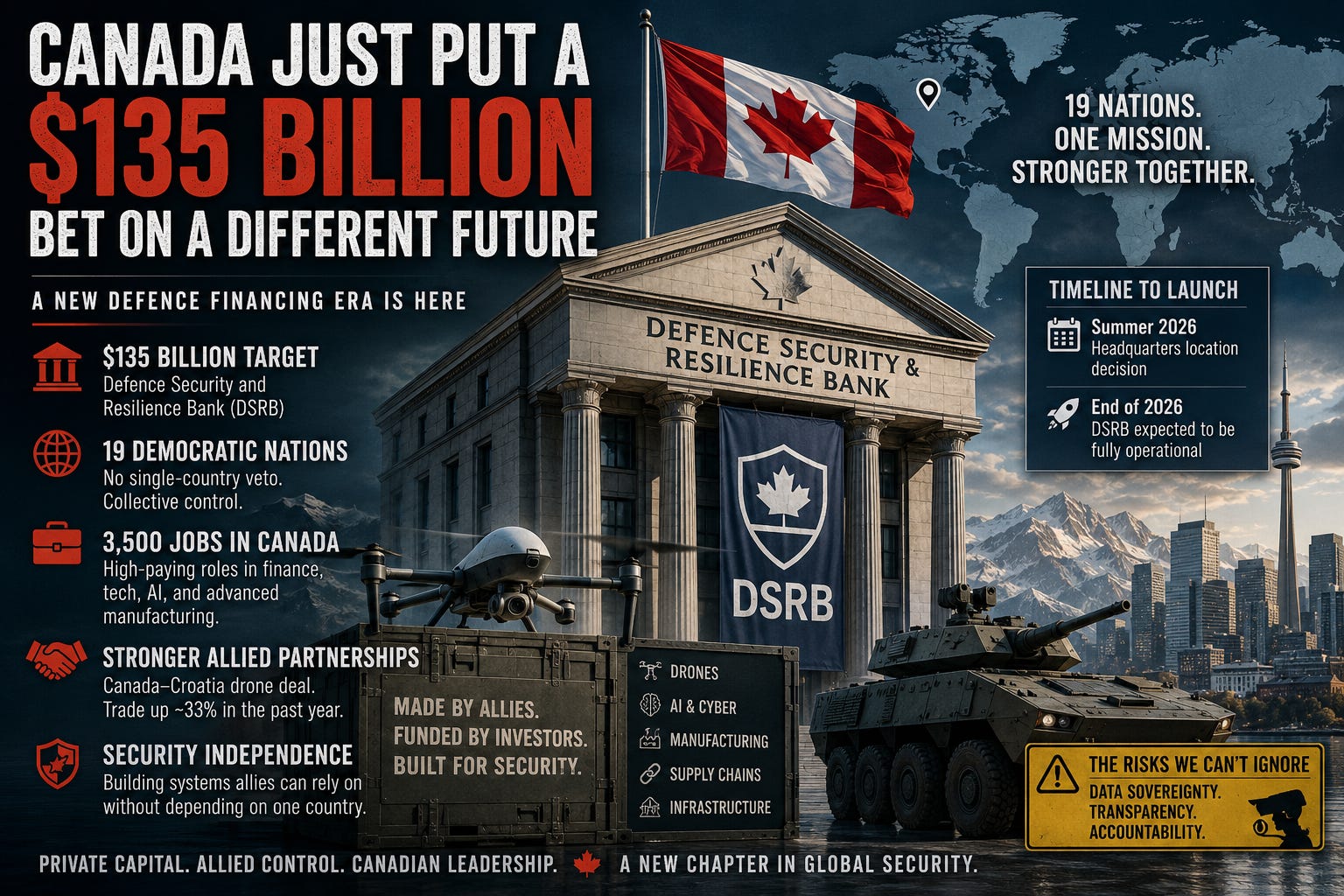
The proposed Defence Security and Resilience Bank (DSRB) aims to mobilize roughly $135 billion in private capital for defence-related projects.
That’s not pocket change.
That’s enough money to influence entire industries.
More importantly, it’s a signal that allied countries are preparing for a future where they don’t want critical defence decisions dependent on the politics of any single nation.
Including the United States.
Why This Matters
The old model relied heavily on governments paying the bills.
The new model relies increasingly on private capital.
For years, many major financial institutions backed away from defence investments because of ESG policies and investor pressure.
Weapons manufacturing became politically uncomfortable territory for banks and investment funds.
That created a problem.
Governments wanted more production.
Manufacturers needed financing.
Banks wanted distance.
The DSRB appears designed to bridge that gap.
Instead of relying entirely on taxpayers, the bank would attract private investment and channel it toward defence infrastructure, manufacturing, technology, cybersecurity, drones, logistics, and supply chains.
In plain English…
The money pipeline is being rebuilt.
Why Canada?
This is where things get interesting.
Canada isn’t the biggest military power.
We’re not the largest economy.
But we are increasingly viewed as stable, predictable, and politically reliable.
Those qualities matter.
If the DSRB proceeds as planned, Canada would host the headquarters and become the administrative centre of a financing network involving 19 democratic nations.
That’s influence.
Real influence.
Not the kind measured in tanks or fighter jets.
The kind measured by who controls the flow of capital.
History shows that money often shapes events long before armies do.
A Croatian Visit That Was About More Than Croatia
One clue arrived during Croatian Prime Minister Andrej Plenković’s June visit to Canada.
On the surface, the trip focused on trade, diplomacy, and cooperation.
Underneath, it reflected something bigger.
Canada and Croatia signed agreements involving drone manufacturing partnerships between Canadian and Croatian firms.
Trade between the two countries reportedly increased by roughly one-third over the past year.
Both governments reaffirmed support for Ukraine and broader transatlantic security goals.
Taken individually, none of those developments change the world.
Taken together, they point toward a growing pattern:
Allies are building deeper defence relationships with each other instead of waiting for direction from Washington.
The Bigger Shift Nobody Is Talking About
The real story isn’t the bank.
The real story is what the bank represents.
For decades, the Western security model concentrated enormous influence in one country.
Now we’re seeing the emergence of distributed systems.
More countries.
More financing sources.
More shared decision-making.
Less dependence on a single political leader or election cycle.
Supporters argue this makes allied security more resilient.
Critics argue it creates new layers of multinational bureaucracy and accountability concerns.
Both arguments have merit.
But regardless of which side you prefer, the trend is becoming harder to ignore.
Countries are building backup systems.
And nations only build backups when they’re worried about the primary system.
The Questions That Still Need Answers
Not everything about this plan is sunshine and maple syrup.
The proposal raises legitimate concerns.
One involves data sovereignty.
Some observers have questioned potential reliance on companies such as Palantir Technologies for underlying data infrastructure.
That matters.
Weapons can be manufactured domestically.
Data control is harder to reclaim once it’s outsourced.
If future defence networks rely heavily on foreign technology platforms, questions about privacy, surveillance, and sovereignty won’t disappear.
They’ll get louder.
Another concern is transparency.
When governments spend money, voters can at least attempt to follow the trail.
When private capital becomes the engine behind military expansion, public oversight becomes more complicated.
That’s a conversation Canadians should have now, not later.
What This Means for Canada
If the project succeeds, Canada gains far more than jobs.
The projected 3,500 high-paying positions are significant.
The bigger prize is strategic relevance.
For decades Canada has often been treated as a middle power.
This initiative could give Canada influence far beyond its population size.
Not because we’re becoming a military giant.
Because we’re becoming a place where allies coordinate capital, technology, manufacturing, and security planning.
That’s a different kind of power.
And in the 21st century, it may prove just as important.
The Recap…
A proposed $135 billion Defence Security and Resilience Bank could make Canada the financial hub of a new allied defence network.
Nineteen countries are backing the concept.
Private capital is replacing traditional funding models.
And beneath all the headlines, allies appear to be building systems that don’t rely quite so heavily on a single nation calling the shots.
The world is changing faster than most people realize.
The Gut-Punch…
The biggest story isn’t that Canada may host a defence bank.
It’s that our allies are spending billions creating alternatives.
Nobody spends that kind of money because they’re confident the old system will always be there.
They spend it because they’re preparing for the possibility that it won’t.
Source credit:
Research compiled from diplomatic briefings, public reporting on Canada-Croatia defence cooperation, and discussions surrounding the proposed Defence Security and Resilience Bank (DSRB).
🔎 The GeezerWise Standard
This space is built on disciplined thinking.
Facts over spin.
Verification before amplification.
Good-faith discussion over tribal noise.
I use AI tools to help shape my spoken drafts into clear writing.
The judgment, conclusions, and final message are mine.
If you’re new here, this explains how I decide what’s worth sharing:
How I Decide What’s Worth Sharing → [link]
💌 Subscribe at GeezerWise.com to receive future letters:
www.geezerwise.com/subscribe
— Fred Ferguson
GeezerWise
#CanadaStrong
Goodness no, not Palantir!!! We don't want it anywhere near this! I want to see us get rid of the contracts with them that we already have!
While Canada makes deals America makes Algae.