

There’s a difference between noise and strategy.
One is loud, emotional, and designed for headlines.
The other is quiet, methodical, and designed to survive the next decade.
Right now, Canada is doing the second one.
Prime Minister Mark Carney is heading on a nine-day Indo-Pacific tour from February 26 to March 7, with stops in India, Australia, and Japan.
On the surface, it looks like standard diplomatic travel.
It isn’t.
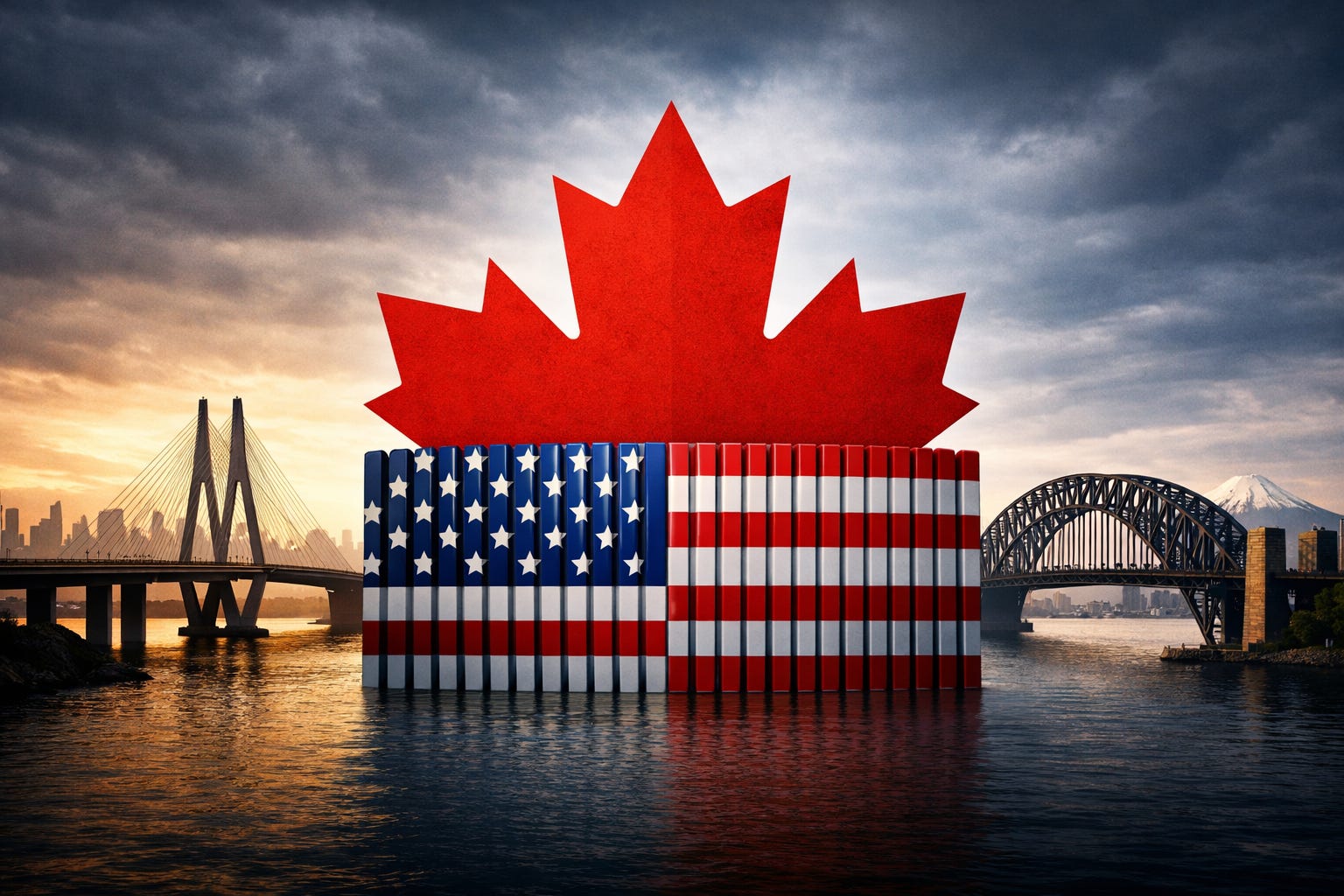
This trip is about reducing Canada’s economic dependence on the United States… before Washington decides to weaponize it again.
And history says that risk is real.
Canada has already dealt with tariffs on steel, aluminum, and softwood lumber, along with constant trade threats and political pressure from the U.S. administration.
Europe has faced similar volatility. Even long-standing allies are learning the same lesson…
Over-reliance on one partner is a strategic vulnerability.
So Canada is building options.
India… Scale and Market Access
The first stop is India… meetings in Mumbai and New Delhi with Prime Minister Narendra Modi.
The goal is to restart and expand negotiations toward a Comprehensive Economic Partnership Agreement.
If completed, bilateral trade could reach roughly $50 billion by the end of the decade.
For Canada, India offers something the U.S. cannot… a massive, fast-growing market that isn’t tied to American political cycles. Discussions include energy, uranium, artificial intelligence, and defense technology.
In plain terms… diversification with scale.
Australia… Resources, Security, Investment
Next is Australia, where Carney will meet Prime Minister Anthony Albanese and address both houses of Parliament… something no Canadian leader has done in two decades.
Australia is a global leader in critical minerals like lithium, nickel, and rare earth elements… the raw materials behind batteries, clean energy systems, and modern defense technology.
Talks include maritime security, aerospace cooperation, and defense innovation.
There’s also a financial angle… attracting Australian investment into Canadian resource and infrastructure projects to strengthen domestic capacity.
Japan… Manufacturing and Supply Chains
The final stop is Tokyo for meetings with Japan’s leadership.
Japan brings advanced manufacturing, clean energy technology, and supply-chain expertise. It also provides geopolitical weight… a stable democratic partner committed to rules-based trade.
For Canada, the focus is securing mineral supply chains and industrial cooperation that do not rely on U.S. routing.
The Bigger Play… A Trade Bridge Across Continents
Here’s where the strategy gets interesting.
Canada is one of the few countries connected to both major trade systems…
The Comprehensive and Progressive Agreement for Trans-Pacific Partnership (CPTPP)
The Canada-EU Comprehensive Economic and Trade Agreement (CETA)
That positioning creates an opportunity no other country fully has.
If Canada aligns supply-chain rules between Asia-Pacific partners and Europe, components could move across nearly 40 countries with reduced tariffs… even when assembled in Canada.
That means goods could flow between Asia and Europe without depending on U.S. supply chains.
It’s not just trade policy.
It’s geopolitical insurance.
Carney has already laid groundwork through meetings with European and Indo-Pacific leaders at international forums like the World Economic Forum, working toward a coalition of mid-sized economies focused on predictable, rules-based trade.
If successful, this network could represent roughly 1.5 billion people.
That’s not a backup plan.
That’s a power shift.
Why This Matters Now
The United States is increasingly using trade as leverage… demanding priority access for American industries while criticizing similar policies from others.
Canada doesn’t need permission to protect its economy.
This Indo-Pacific strategy supports…
Clean energy development
Critical minerals production
Defense manufacturing
Artificial intelligence collaboration
Supply-chain resilience
It also helps Canada pursue its goal of doubling non-U.S. exports by 2030.
Most importantly, it creates options if future U.S. trade negotiations become unstable or adversarial.
The Real Story
The loud story is tariffs.
The quiet story is alignment.
Canada is positioning itself inside a network of reliable partners so that if one relationship weakens, the system still holds.
That’s how smaller countries survive next to giants.
Not by fighting them.
By building alternatives.
The real question isn’t whether this strategy is bold.
It’s whether Canada should have started sooner.
The Recap…
Canada isn’t waiting for Washington anymore.
While the U.S. argues about tariffs, Ottawa is building trade links across Asia and Europe that could reshape our economic future.
Quiet strategy. Big consequences.
This one matters more than people realize.
The Gut Punch…
“Economic independence doesn’t start with confrontation. It starts with options.”
Source Credit:
Source inspiration: international trade reporting and Indo-Pacific diplomacy coverage.
🔎 The GeezerWise Standard
This space is built on disciplined thinking.
Facts over spin.
Verification before amplification.
Good-faith discussion over tribal noise.
I use AI tools to help shape my spoken drafts into clear writing.
The judgment, conclusions, and final message are mine.
If you’re new here, this explains how I decide what’s worth sharing:
How I Decide What’s Worth Sharing → [link]
💌 Subscribe at GeezerWise.com to receive future letters:
www.geezerwise.com/subscribe
— Fred Ferguson
GeezerWise
#CanadaStrong
Well done Canada ,a true politician 👏🇬🇧
Well written and concise piece once again Fred. I agree with you when you say that Canada should have started earlier.
When Trump was elected in 2016 he did finally sign the CUSMA agreement, but even then he had to change the name as if that made a big difference from NAFTA.
If both the government and the opposition had been looking and paying attention to what he was saying, and what he was doing, we should've known that this was a possibility.
I realize that no one in government can be a fortuneteller. With Trump, it wouldn't matter because he's so irrational. You'd have to be as psychotic and narcissistic as what he is to try to even figure it out. He thinks tariffs help and tariffs punish the countries when in fact, tariffs punish his own people .
But dumb is as dumb does!
You know I have some concerns about going to India as there has been interference from them in our election and there may be proof of interference from China previously so we have to be very cautious. However, Carney is a very intelligent and cautious man or he would not have run both the bank of Canada and the bank of England as excellently as he did.
I know that the conservatives are saying well he hasn't kept his election promise of making an agreement and a deal with the states. Have they been watching what rump has been doing to everyone to every country around the world? Except of course to Russia. He put tariffs on an island where only penguins lived. That's how idiotic this is.
The gang down south or should I say rump and his gang decided they could make Canada weak financially and then they could take us over. When Canadians, not just the government, but the people fought back by not taking vacations or cancelling trips for any reason. Canadians started selling their homes that they've had for years down in the US then Canadians stopped buying US products at the grocery store. This is not just a government Thing going on.
What Prime Minister Carney and the trade delegation is doing is for all of Canada for every Canadian to protect us from the bully to the south.